7.3 Simplify Complex Rational Expressions

📘Intermediate Algebra Unit 7 Review
7.3 Simplify Complex Rational Expressions
📘 Intermediate Algebra
Simplifying Complex Rational Expressions
A complex rational expression is a fraction where the numerator, denominator, or both contain fractions themselves. Think of it as a "fraction of fractions." Simplifying these expressions means rewriting them as a single, clean fraction. There are two main methods to do this: rewriting as a division problem and using the LCD method.
What Makes a Rational Expression "Complex"
A rational expression is a fraction where the numerator and denominator are polynomials. A complex rational expression takes this a step further: it has rational expressions nested inside its numerator, denominator, or both.
Here's what one looks like:
The goal is always the same: reduce this to a single fraction in simplified form.
Method 1: Rewriting as a Division Problem
This method treats the main fraction bar as a division sign. You're converting the complex fraction into a division problem, then using the "multiply by the reciprocal" rule you already know.
Steps:
-
Rewrite the complex fraction as a division problem. The numerator of the big fraction gets divided by the denominator:
-
Multiply by the reciprocal of the divisor (flip the second fraction and multiply):
-
Factor the numerator and denominator completely. In this case, nothing factors further.
-
Cancel any common factors between numerators and denominators. Here, there are none to cancel.
-
Multiply across to get your simplified result:
A more interesting example where cancellation actually happens:
Factor as :
Cancel the terms:

Method 2: Using the LCD
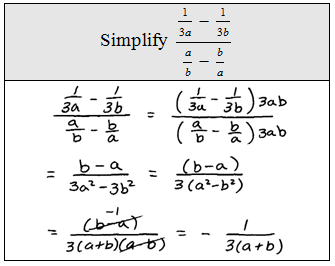
This method works by multiplying the entire numerator and entire denominator of the complex fraction by the LCD of all the smaller fractions inside it. This clears out all the inner fractions at once.
Steps:
-
Identify every denominator inside the complex fraction (both in the top and bottom parts).
-
Find the LCD of all those denominators. Factor each one completely, then take the product of all unique factors at their highest power.
-
Multiply both the numerator and denominator of the complex fraction by that LCD. This is valid because you're multiplying by .
-
Distribute and simplify. The inner fractions should all clear out, leaving you with polynomials.
-
Factor the resulting numerator and denominator, then cancel any common factors.
Example:
The denominators inside are and , so the LCD is .
Multiply the numerator and denominator by :
- Numerator:
- Denominator:
Simplify the numerator:
Final result:
When to Use Which Method
- Division method works best when the complex fraction is one fraction over another fraction (no addition or subtraction inside). It's especially clean when things factor and cancel nicely.
- LCD method works best when the numerator or denominator of the complex fraction involves sums or differences of rational expressions. It handles multiple terms with different denominators more smoothly.
- For straightforward cases like , either method works equally well. Use whichever feels more natural to you.
The more problems you work through, the faster you'll recognize which method will be cleaner for a given expression. When in doubt, the LCD method is the safer general-purpose choice.
See Fiveable more often in Google
Mark Fiveable as a preferred source and Google is more likely to show you our guides in Top Stories, with a "preferred" badge in AI Mode and AI Overviews.