4.6 Solve Systems of Equations Using Determinants

📘Intermediate Algebra Unit 4 Review
4.6 Solve Systems of Equations Using Determinants
📘 Intermediate Algebra
4.1
Solve Systems of Linear Equations with Two Variables
4.2
Solve Applications with Systems of Equations
4.3
Solve Mixture Applications with Systems of Equations
4.4
Solve Systems of Equations with Three Variables
4.5
Solve Systems of Equations Using Matrices
4.6
Solve Systems of Equations Using Determinants
4.7
Graphing Systems of Linear Inequalities
Solving Systems of Equations Using Determinants
Determinants give you a formula-based way to solve systems of linear equations without graphing or substitution. The technique, called Cramer's Rule, uses ratios of determinants to find each variable directly. This section covers how to calculate determinants for 2×2 and 3×3 matrices, how to apply Cramer's Rule, and how to interpret what the determinant tells you about a system's solutions.
Calculation of Matrix Determinants
A determinant is a single number calculated from a square matrix. You'll need to know how to compute determinants for both 2×2 and 3×3 matrices.
2×2 Determinant:
Multiply the top-left and bottom-right entries, then subtract the product of the top-right and bottom-left entries. Think of it as "main diagonal minus off diagonal."
For example, given :
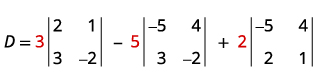
3×3 Determinant:
This is called expansion along the first row (also known as cofactor expansion). Here's how it works step by step:
- Take each element in the first row (, , ) one at a time.
- For each element, cross out its row and column. The remaining 2×2 matrix is called its minor.
- Calculate the determinant of that 2×2 minor.
- Multiply the element by its minor's determinant, applying alternating signs: , , .
- Add the three results together.
The alternating sign pattern comes from the cofactor formula , where and are the row and column of the element. For the first row, this gives .
Application of Cramer's Rule
Cramer's Rule states that for a system of equations with unknowns, each variable can be found using:
where is the determinant of the coefficient matrix and is the determinant of the matrix formed by replacing the -th column with the constants from the right-hand side.
Steps to solve a 2×2 system using Cramer's Rule:
Consider the system:
- Write the system in standard form (variables on the left, constants on the right).
- Form the coefficient matrix using only the coefficients of and :
- Calculate . If , stop here (Cramer's Rule doesn't apply; see the interpretation section below).
- Form by replacing the -column (first column) with the constants:
- Form by replacing the -column (second column) with the constants:
- Calculate the solutions:
Worked example: Solve and .
The solution is . You can verify by plugging back in: ✓ and ✓.
The same process extends to 3×3 systems with three variables (). You'd compute four determinants: , , , and , each time replacing the appropriate column with the constants.
Interpretation of Determinant Values
The value of (the coefficient matrix determinant) tells you what kind of solution the system has:
- If : The system has exactly one unique solution. Cramer's Rule gives you that solution directly.
- If and all are also zero: The system has infinitely many solutions. The equations describe the same line (2×2) or overlapping planes (3×3), so they're dependent.
- If but at least one of is non-zero: The system has no solution. The equations are inconsistent (think parallel lines that never intersect).
The key takeaway: always check first. If it's zero, you can't use Cramer's Rule to find a single answer, but the zero itself is useful information about the system.
Real-World Determinant Problem Solving
Word problems follow the same process, with an extra setup step at the beginning:
- Identify the unknowns and assign variables (e.g., = price of item A, = price of item B).
- Translate the given relationships into equations in standard form.
- Apply Cramer's Rule to solve the system.
- Interpret your answer in context. Check that the values make sense (prices should be positive, quantities should be whole numbers if counting items, etc.).
For example, if 2 shirts and 3 hats cost $52, and 4 shirts and 1 hat cost $68, you'd set up and , then solve using determinants.
Alternative Methods for Solving Systems
Cramer's Rule isn't the only determinant-related method. Two common alternatives:
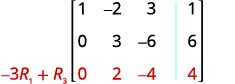
- Gaussian elimination transforms the augmented matrix into row echelon form through systematic row operations. It's often more efficient for larger systems (4+ variables).
- Inverse matrix method solves by computing , where is the inverse of the coefficient matrix. This only works when exists, which happens exactly when .
For the 2×2 and 3×3 systems you'll see in this course, Cramer's Rule is a reliable and direct approach. The alternatives become more practical as systems grow larger.
See Fiveable more often in Google
Mark Fiveable as a preferred source and Google is more likely to show you our guides in Top Stories, with a "preferred" badge in AI Mode and AI Overviews.