2.7 Solve Absolute Value Inequalities

📘Intermediate Algebra Unit 2 Review
2.7 Solve Absolute Value Inequalities
📘 Intermediate Algebra
Solving Absolute Value Inequalities
Absolute value inequalities let you describe a range of values that fall within (or outside) a certain distance from a point. They show up constantly in real-world contexts like manufacturing tolerances, error margins, and geographic ranges. This section builds on what you already know about solving absolute value equations and extends it to inequalities.
Solving Absolute Value Equations and Inequalities
Equations with absolute value
Before tackling inequalities, make sure you're solid on absolute value equations. The core idea: absolute value measures distance from zero, and distance is always non-negative.
To solve an absolute value equation:
- Use inverse operations (addition, subtraction, multiplication, division) to isolate the absolute value expression on one side.
- Check what the absolute value equals:
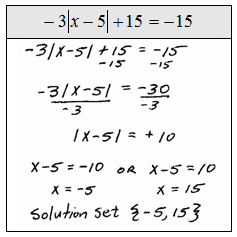
- If the equation is where , there are two solutions: or . For example, gives or .
- If the equation is where , there is no solution. Absolute value can never produce a negative number, so has no real solution.
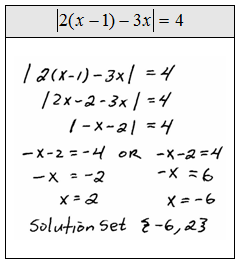
For more complex expressions like , you'd set up two equations after isolating the absolute value: and , then solve each one separately.
Inequalities: absolute value less than
The "less than" case captures values between two endpoints. Think of it as: "the distance from zero is small enough to stay inside a range."
For where , rewrite it as a compound inequality joined by "and":
which you can write compactly as .
Example: Solve .
- Rewrite as .
- The solution is every value strictly between and .
- On a number line, use open circles at and (since those endpoints are not included), and shade the region between them.
This works the same way for . If the inequality is , the solution is , and you'd use closed circles on the number line instead.
For expressions inside the absolute value, apply the same logic. To solve :
- Write the compound inequality:
- Subtract 1 from all three parts:
- Divide all three parts by 2:
Inequalities: absolute value greater than
The "greater than" case captures values outside a range. Think of it as: "the distance from zero is too large to stay inside the range."
For where , rewrite it as two separate inequalities joined by "or":
Example: Solve .
- Rewrite as or .
- The solution is every value less than or greater than .
- On a number line, use open circles at and , and shade the two outer regions (arrows pointing left from and right from ).
The key difference from the "less than" case: the solution set here is two separate regions, not one connected interval. That's why you use "or" instead of "and."
Quick memory trick: Less thAND, greatOR. Absolute value less than → "and" (compound inequality). Absolute value greater than → "or" (two separate inequalities).
Real-world applications of absolute value
- Distance: Absolute value represents distance between two points on a number line, regardless of direction. If a town is at mile marker 50 and a gas station is 15 miles away, the gas station could be at mile marker 35 () or 65 (). As an equation: .
- Tolerance: In manufacturing, absolute value expresses the maximum allowed deviation from a target. If a machine part must be 10 cm long with a tolerance of 0.5 cm, the acceptable range is , written as .
- Range: Absolute value can define all values within a certain distance of a central point. If a store targets customers within 5 miles, that's , where is the distance from the store.
Set Theory and Inequality Properties
When solving absolute value inequalities, you rely on standard inequality properties:
- Addition/subtraction property: Adding or subtracting the same value on both sides preserves the direction of the inequality.
- Multiplication/division property: Multiplying or dividing both sides by a positive number preserves the inequality direction. Multiplying or dividing by a negative number reverses the inequality sign. This is the one students most often forget, so watch for it whenever you divide by a negative coefficient.
Solution sets can be described using interval notation or set-builder notation. For example, the solution to can be written as the interval , and the solution to can be written as .
See Fiveable more often in Google
Mark Fiveable as a preferred source and Google is more likely to show you our guides in Top Stories, with a "preferred" badge in AI Mode and AI Overviews.