3.3 Find the Equation of a Line

📘Intermediate Algebra Unit 3 Review
3.3 Find the Equation of a Line
📘 Intermediate Algebra
Linear equations describe how two variables relate to each other, and writing the equation of a line is one of the most fundamental skills in algebra. This section covers how to find a line's equation when you're given different starting information: a slope and y-intercept, a slope and a point, two points, or a relationship to another line (parallel or perpendicular).
Equations of Lines
Line equation from slope and y-intercept
This is the most straightforward case. If you already know the slope and y-intercept, you just plug them into slope-intercept form:
- is the slope, which tells you the steepness and direction of the line. A slope of means the line rises 2 units for every 1 unit it moves to the right.
- is the y-intercept, the y-coordinate where the line crosses the y-axis. If , the line passes through the point .
To write the equation, substitute your values for and directly.
Example: Given slope and y-intercept :
That's it. No simplifying needed.
Line equation from slope and a point
When you know the slope and one point on the line (but not the y-intercept), use point-slope form:
Here's the process:
- Identify the slope and the point .
- Substitute those values into point-slope form.
- Distribute the slope on the right side.
- Solve for to convert to slope-intercept form.
Example: Given slope and point :
- Start with point-slope form:
- Distribute:
- Add 5 to both sides:
The final equation is , where and .
Line equation from two points
If you're given two points but no slope, you need to calculate the slope first, then use point-slope form.
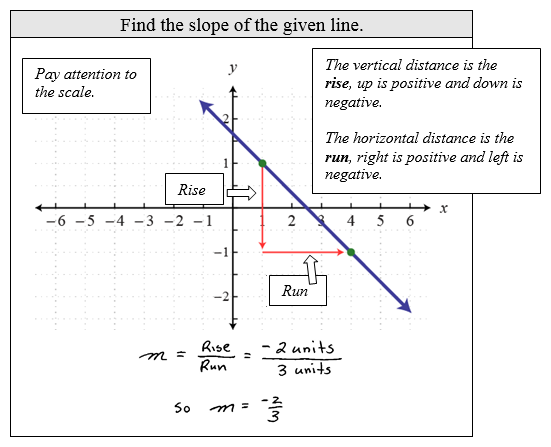
- Find the slope using the slope formula:
- Pick either point (both will give the same final equation).
- Plug the slope and your chosen point into point-slope form.
- Simplify to slope-intercept form.
Example: Given points and :
- Calculate slope:
- Use point :
- Distribute:
- Add 2 to both sides:
The equation is , with slope and y-intercept (the line passes through the origin).
A common mistake here is subtracting the coordinates in the wrong order. Make sure you're consistent: if you start with , you must start with in the denominator too.
Equation of a parallel line
Two lines are parallel if and only if they have the same slope (but different y-intercepts). So to find a line parallel to a given line through a specific point:
- Identify the slope of the given line.
- Use that same slope with the new point in point-slope form.
- Simplify to slope-intercept form.
Example: Find the line parallel to that passes through .
- The given line has slope . The parallel line also has slope .
- Point-slope form:
- Distribute:
- Add 6:
Notice both lines have slope 2, but different y-intercepts (3 vs. 4), confirming they're parallel.

Equation of a perpendicular line
Two lines are perpendicular if their slopes are negative reciprocals of each other. That means you flip the fraction and change the sign. If one slope is , the perpendicular slope is:
Here are some quick examples of negative reciprocals:
- Slope of → perpendicular slope of
- Slope of → perpendicular slope of
- Slope of → perpendicular slope of
To find the equation:
- Find the slope of the given line.
- Take the negative reciprocal to get the perpendicular slope.
- Use the perpendicular slope and the given point in point-slope form.
- Simplify.
Example: Find the line perpendicular to that passes through .
- The given slope is , so the perpendicular slope is .
- Point-slope form:
- Distribute:
- Add 1 (which is ) to both sides:
Watch the fractions carefully in that last step. Adding is where many students make arithmetic errors.
Additional Concepts
- The x-intercept is the point where a line crosses the x-axis. You can find it by setting and solving for . For example, in , setting gives , so the x-intercept is .
- If a line's equation is not already in slope-intercept form, you may need to rearrange it before identifying the slope. For instance, if you're told a line has equation , solve for first: . Now you can see the slope is .
- Linear equations model many real-world relationships, such as cost vs. quantity, distance vs. time, or temperature conversions. The slope represents the rate of change, and the y-intercept represents the starting value.
See Fiveable more often in Google
Mark Fiveable as a preferred source and Google is more likely to show you our guides in Top Stories, with a "preferred" badge in AI Mode and AI Overviews.