6.5 Polynomial Equations

📘Intermediate Algebra Unit 6 Review
6.5 Polynomial Equations
Polynomial Equations
Polynomial equations ask you to find the values of a variable that make the equation true. The core strategy is always the same: get one side equal to zero, factor the polynomial, then use the Zero Product Property to find solutions. This section covers that process for quadratic and higher-degree polynomials, plus how to apply it to word problems.
Polynomial Equations
Zero Product Property for Polynomials
The Zero Product Property states that if the product of two or more factors equals zero, then at least one of those factors must be zero. This is the foundation for solving polynomial equations by factoring.
To use it, follow these steps:
- Rearrange the equation so one side equals zero.
- Factor the polynomial completely.
- Set each factor equal to zero.
- Solve each resulting equation to find the solutions (also called roots).
Example: Solve
Since the product equals zero, either or . Solving each gives or .
A common mistake is trying to apply this property when the product doesn't equal zero. If you have , you cannot just set each factor equal to 10. You'd need to expand, move everything to one side, and factor again.

Factoring Quadratic Equations
Quadratic equations are degree-2 polynomials in the form , where . Your goal is to rewrite the left side as a product of two binomials, then apply the Zero Product Property.
Factoring methods to know:
- Greatest common factor (GCF): Always check for a GCF first. For , factor out to get .
- Factoring by grouping: Useful when . Split the middle term into two terms whose coefficients multiply to , then group and factor.
- Difference of squares: . For example, .
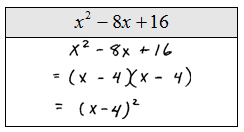
- Perfect square trinomials:
- Trial and error: Test factor pairs of and until you find the combination that produces the correct middle term .
After factoring, set each factor equal to zero and solve the resulting linear equations.
Example: Solve
You need two numbers that multiply to and add to . Those are and .
So or .
Factoring Techniques for Higher-Degree Polynomials
Higher-degree polynomials (degree 3 or above) follow the same overall strategy, but they often require more steps to factor completely.
-
Factor out the GCF. For , pull out first to get . Then factor the quadratic.
-
Look for special patterns:
- Sum of cubes:
- Difference of cubes: A helpful mnemonic: the binomial factor uses the same sign as the original expression, and the trinomial factor's middle term uses the opposite sign.
Example: Factor
Recognize this as . Apply the difference of cubes formula:
-
Factor by grouping for four-term polynomials. Group terms in pairs, factor each pair, then factor out the common binomial.
-
Use synthetic division if you already know (or can guess) one root. The Rational Root Theorem can help you identify candidates to test.
-
Apply the Zero Product Property to all factors and solve each equation.
Real-World Applications of Polynomial Equations
Word problems involving polynomials follow a consistent process:
- Define the variable. Assign a symbol (usually or ) to the unknown quantity.
- Write the equation. Translate the problem's relationships into a polynomial equation.
- Solve by factoring. Get one side equal to zero, factor, and apply the Zero Product Property.
- Check your answer against the context. Not every algebraic solution makes sense in the real world.
Example: A rectangular field's length is 5 meters more than twice its width. The area is 135 square meters. Find the dimensions.
- Let = the width in meters.
- Length = .
- Area equation:
Expand and rearrange:
Factor: , so or .
Since width must be positive, meters. The length is meters.
Always check: ... that's not 135. Let's re-factor. You need two numbers that multiply to and add to . Those are and :
So or . Width must be positive, so meters and length = meters. Check: .
The factoring actually gives : find numbers multiplying to that add to , which are and ... Let's just solve it cleanly. Using the quadratic formula or careful factoring: . Factors of that add to : and . So:
So or . Width must be positive, so meters. Length = meters. Check: .
Hmm. Let's just verify: . That's not 135 either. The correct factoring: we need factors of summing to . Try and : . Try ... these must be integers for grouping. Actually and : sum = . Try : sum . None give , so this quadratic doesn't factor neatly over integers.
This tells you something useful: not every word problem produces "nice" factors. In practice, you'd use the quadratic formula here. The original problem setup was designed to factor cleanly, so always double-check your equation setup.
The takeaway for word problems: verify your answer by plugging it back into the original problem statement, not just the equation.
Key Vocabulary
- Polynomial: An expression with variables and coefficients using only addition, subtraction, multiplication, and non-negative integer exponents (e.g., ).
- Degree: The highest power of the variable. For , the degree is 3.
- Roots (solutions): The values of the variable that make the equation equal zero.
- Rational Root Theorem: If a polynomial with integer coefficients has a rational root , then divides the constant term and divides the leading coefficient. This gives you a list of candidates to test.
See Fiveable more often in Google
Mark Fiveable as a preferred source and Google is more likely to show you our guides in Top Stories, with a "preferred" badge in AI Mode and AI Overviews.