5.3 The Emergence of Us: The Archaic Homo

🗿Intro to Anthropology Unit 5 Review
5.3 The Emergence of Us: The Archaic Homo
🗿 Intro to Anthropology
Archaic Homo Species
Archaic Homo species bridge the gap between earlier members of our genus and anatomically modern humans. Groups like Homo heidelbergensis, Neanderthals, and Denisovans developed larger brains, robust bodies, and increasingly sophisticated tools as they spread across Europe and Asia. Understanding these species helps clarify how environmental pressures, cultural innovation, and interspecies contact shaped the path to modern humanity.

Top images from around the web for Key features of archaic Homo
Homo heidelbergensis endocast - Smithsonian Museum of Natu… | Flickr View original
Is this image relevant?
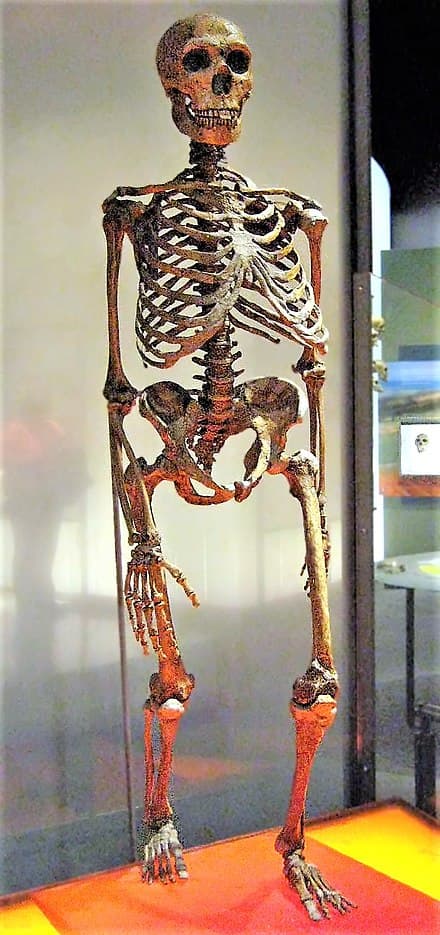
Neanderthal anatomy - Wikipedia View original
Is this image relevant?
Homo heidelbergensis - Wikipedia View original
Is this image relevant?
Homo heidelbergensis endocast - Smithsonian Museum of Natu… | Flickr View original
Is this image relevant?
Neanderthal anatomy - Wikipedia View original
Is this image relevant?
Key Features of Archaic Homo
Homo heidelbergensis (600,000–200,000 years ago)
H. heidelbergensis is often considered a common ancestor of both Neanderthals and modern humans. Key traits include:
- Brain size of roughly 1,100–1,400 cc, significantly larger than earlier Homo species, supporting more complex thinking and planning
- Thick skull bones with a slightly protruding face, which provided attachment points for powerful chewing muscles
- A robust postcranial skeleton (the bones below the skull) built for strength, enabling them to hunt large game and endure physically demanding environments
Homo neanderthalensis (400,000–40,000 years ago)
Neanderthals are our closest extinct relatives, and their anatomy reflects deep adaptation to cold European and Western Asian environments:
- Brain size of 1,200–1,900 cc, overlapping with and sometimes exceeding the modern human range. This doesn't necessarily mean identical cognition, but it does point to significant cognitive capability.
- Prominent brow ridges and a projecting midface suited to cold climates and a diet heavy in tough, fibrous foods
- A shorter, stockier body compared to modern humans, which conserved heat by reducing the surface-area-to-volume ratio. This pattern follows Bergmann's rule, which states that bodies tend to be more compact in colder climates.
- Several unique features: a large nasal cavity that warmed and humidified cold, dry air; a receding chin; and an occipital bun, a bony protrusion at the back of the skull
Denisovans (300,000–50,000 years ago)
Denisovans are the most mysterious of the archaic humans because so little fossil material exists. Most of what we know comes from genetic data extracted from bone fragments and teeth found in Denisova Cave in Siberia.
- They shared some traits with Neanderthals, including a robust build and large brain, which makes sense given their close evolutionary relationship (the two groups diverged from a common ancestor)
- Their dental morphology is distinctive: large molars with complex cusps and roots, suggesting adaptation to a varied diet
- Despite the limited fossils, DNA evidence shows Denisovans interbred with both Neanderthals and modern humans, leaving genetic traces in some present-day populations, especially in Melanesia and Southeast Asia
Environmental Influences on Archaic Homo Evolution
Adaptation to colder climates
Neanderthals evolved during glacial periods in Europe and developed a suite of cold-weather adaptations. Their robust build and shorter limbs minimized heat loss, following both Bergmann's rule (larger body mass in cold climates) and Allen's rule (shorter extremities in cold climates). Their larger nasal cavity served a practical respiratory function, warming and humidifying frigid air before it reached the lungs.
Dietary adaptations
Archaic Homo species relied heavily on high-protein animal resources. Neanderthals hunted large game like mammoths and woolly rhinoceros. This meat-rich diet was critical because larger brains are metabolically expensive, requiring more energy and essential fatty acids than a plant-heavy diet alone could easily provide.
Technological advancements
Tool technology took a major leap forward with archaic Homo:
- The Levallois technique (appearing around 300,000–200,000 years ago) involved carefully preparing a stone core so that a flake of a predetermined shape could be struck off. This produced more standardized, efficient tools than earlier methods.
- Mousterian tools, closely associated with Neanderthals, included scrapers, points, and flakes used for hunting and processing animal resources.
- Hafting, the practice of attaching stone tools to wooden handles, increased leverage and force, making hunting and butchering more effective.
_at_G%25C3%25B6teborgs_Naturhistoriska_Museum_8733.jpg.)
Key Evolutionary Trends in Archaic Homo
These species continued three major trends that define the Homo lineage:
- Bipedalism: Already well-established, but continued refinement of upright walking improved locomotion efficiency and kept the hands free for tool use
- Tool use: Increasingly sophisticated stone tools and composite tools (like hafted spears) reflect growing cognitive and cultural complexity
- Encephalization: A gradual increase in brain size relative to body size, associated with enhanced problem-solving, social behavior, and communication
Neanderthal Extinction
Neanderthals disappeared from the fossil record around 40,000 years ago, right around the time modern humans were expanding into Europe. No single cause explains their extinction. Instead, most paleoanthropologists point to a combination of overlapping pressures.

Theories of Neanderthal Extinction
Competition with modern humans
When modern humans arrived in Europe and Western Asia, they overlapped with Neanderthals in both habitat and resource use. Modern humans may have held advantages in technology (more diverse and specialized toolkits) and social organization (larger social networks and potentially more complex language). Over thousands of years, this competitive pressure could have gradually displaced Neanderthal populations through competitive exclusion, where one species outcompetes another for the same ecological niche.
Climate change and environmental stress
Neanderthals were well-adapted to cold, glacial environments. Ironically, warming trends may have worked against them. During the Late Pleistocene, rapid climate fluctuations shifted the distribution of open grasslands and forests that Neanderthals depended on. These changes fragmented their habitat and disrupted the availability of prey species, putting additional strain on already small populations.
Interbreeding and assimilation
Genetic studies show that people of non-African descent carry roughly 1–4% Neanderthal DNA, clear evidence that the two groups interbred. Rather than a sharp extinction event, some researchers argue that Neanderthals were gradually absorbed into the expanding modern human gene pool. With their already small population sizes and limited genetic diversity, even modest rates of interbreeding could have diluted the Neanderthal lineage over generations.
Combination of factors
The most widely accepted view is that competition, climate change, and interbreeding acted together. No single factor was necessarily fatal on its own, but the cumulative stress from all three pushed Neanderthal populations into a slow decline, ending with their disappearance around 40,000 years ago.
Understanding Human Origins
The study of archaic Homo connects to several broader concepts in how we reconstruct our evolutionary past:
- Paleoanthropology is the scientific study of human evolution through fossil and archaeological evidence. It combines anatomy, genetics, geology, and archaeology to piece together the story of our lineage.
- The Out of Africa hypothesis proposes that anatomically modern humans originated in Africa and then migrated outward, replacing or interbreeding with other hominin species they encountered. The Neanderthal DNA in non-African populations is one of the strongest pieces of evidence for the "interbreeding" part of this model.
- Genetic admixture refers to the introduction of genetic material from one population into another through interbreeding. The presence of Neanderthal and Denisovan DNA in living humans is a direct example, and it continues to influence traits like immune function and altitude adaptation today.
See Fiveable more often in Google
Mark Fiveable as a preferred source and Google is more likely to show you our guides in Top Stories, with a "preferred" badge in AI Mode and AI Overviews.