16.3 Tipping points and abrupt changes in Earth systems

🌈Earth Systems Science Unit 16 Review
16.3 Tipping points and abrupt changes in Earth systems
🌈 Earth Systems Science
Tipping Points and Thresholds
Defining Tipping Points and Thresholds
A tipping point is a critical threshold where a small additional change pushes a system into a large, abrupt, and often irreversible shift in state or function. Think of it like slowly tilting a glass of water: for a while nothing spills, but past a certain angle the water rushes out all at once. That sudden shift is the tipping point.
A threshold is the specific level (of temperature, concentration, pressure, etc.) at which that dramatic change kicks in. The two terms are closely related, but "threshold" emphasizes the measurable value, while "tipping point" emphasizes the behavioral shift that follows.
These concepts matter because Earth's climate, ice sheets, ocean currents, and ecosystems are all complex systems. They don't always respond gradually to gradual forcing. Crossing a tipping point can lock a system into a completely new regime with consequences that play out over decades to millennia.
Identifying Critical Transitions
Critical transitions happen when a system approaches and then crosses a tipping point, fundamentally changing its behavior or structure. Scientists look for early warning signals that a system is nearing a threshold:
- Increased variability in system measurements (e.g., wider temperature swings)
- Slower recovery from perturbations, meaning the system takes longer to bounce back after a disturbance
- Critical slowing down, where the system's internal dynamics become sluggish as it loses resilience
A key example is the Greenland ice sheet. As global temperatures rise, the ice sheet's surface drops to lower, warmer altitudes, which accelerates melting in a positive feedback loop. If warming pushes the ice sheet past its tipping point, it could undergo irreversible collapse over centuries, contributing up to ~7 meters of sea-level rise.
Abrupt Changes and Regime Shifts
Understanding Abrupt Changes
Abrupt changes are rapid, nonlinear responses to external forcing or internal dynamics. Unlike gradual trends, these shifts happen fast relative to the timescale of the forcing that caused them. They occur when a system crosses a tipping point and snaps into a new state.
These changes can severely disrupt environments, ecosystems, and human societies because they outpace the ability to adapt.
A major concern is the potential weakening or collapse of the Atlantic Meridional Overturning Circulation (AMOC), the large-scale ocean current system that carries warm water northward in the Atlantic. Freshwater input from melting ice sheets could slow or shut down the AMOC, causing abrupt cooling of 5–10°C in parts of Europe and disrupting rainfall patterns across the tropics and beyond.

Regime Shifts and Hysteresis
A regime shift is a large, persistent change in a system's structure and function, typically triggered by crossing a tipping point. Once a system enters a new regime, it tends to stay there because new feedbacks stabilize the altered state.
Hysteresis is the reason regime shifts are so hard to undo. It means the path back to the original state is different from the path that led away from it. Simply reversing the conditions that caused the shift often isn't enough to restore the system.
Example: Desertification in the Sahel region of Africa. Overgrazing combined with drought can push grasslands past a tipping point into a desert state. Vegetation loss reduces moisture recycling and increases surface reflectivity (albedo), which suppresses rainfall further. Even if grazing pressure drops and regional rainfall recovers somewhat, the land may remain desert because the soil, vegetation, and local climate feedbacks have locked in the new regime. That gap between "what it took to break it" and "what it would take to fix it" is hysteresis.
Consequences of Tipping Points
Irreversibility and Long-term Impacts
Many tipping-point-driven changes are effectively irreversible on human timescales. Even if the drivers that caused the change are removed, the system cannot return to its original state within centuries or longer.
- Collapse of the West Antarctic Ice Sheet, once triggered, would continue for centuries regardless of subsequent emissions reductions.
- Species extinctions from habitat loss or climate change are permanent. Once a species is gone, that loss cascades through food webs and ecosystem services.
Irreversibility is what makes tipping points so consequential. Gradual changes can sometimes be reversed with gradual effort, but crossing a tipping point closes that door.
Cascading Effects and Systemic Risks
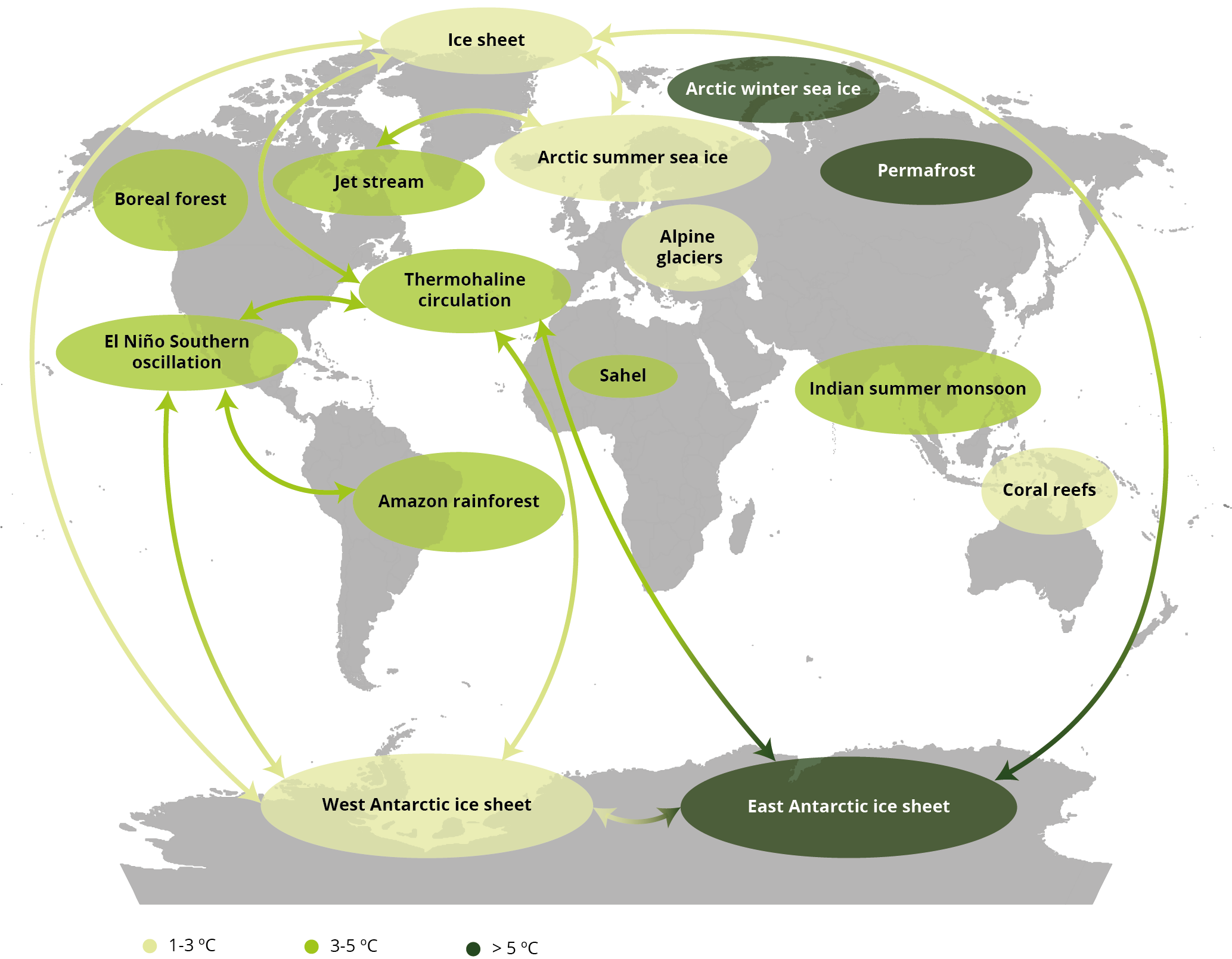
Because Earth's systems are deeply interconnected, a tipping point in one system can trigger cascading effects that propagate through others. This creates systemic risks that are difficult to predict and even harder to manage.
Consider the loss of Arctic sea ice as a cascading trigger:
- Reduced ice cover exposes dark ocean water, which absorbs more solar radiation (the ice-albedo feedback), amplifying regional warming.
- Warmer Arctic temperatures destabilize permafrost, releasing stored methane and carbon dioxide, which accelerates global warming.
- The reduced temperature difference between the Arctic and mid-latitudes weakens the jet stream, altering weather patterns across the Northern Hemisphere.
- Disrupted habitats affect Arctic species (polar bears, seals, ice-dependent algae), with ripple effects through marine food webs and fisheries.
- Coastal communities face compounding threats from sea-level rise, storm surge, and loss of sea-ice protection along shorelines.
Each of these effects can reinforce the others, creating feedback loops that amplify the original change. This is why Earth scientists emphasize that tipping points are not isolated events but potential dominoes in a connected system.
See Fiveable more often in Google
Mark Fiveable as a preferred source and Google is more likely to show you our guides in Top Stories, with a "preferred" badge in AI Mode and AI Overviews.