7.1 Selecting Appropriate Instructional Strategies

📅Curriculum Development Unit 7 Review
7.1 Selecting Appropriate Instructional Strategies
📅 Curriculum Development
Factors in Selecting Instructional Strategies
Choosing the right instructional strategy isn't random. It depends on a set of interconnected factors that shape how you plan and deliver a lesson. Getting these factors right means your teaching approach actually fits what students need to learn and how they learn best.
Learning Objectives
Your objectives determine everything else. They fall into three domains:
- Cognitive domain covers thinking skills: knowledge acquisition, comprehension, application, analysis, synthesis, and evaluation
- Affective domain addresses the development of attitudes, values, and emotional responses
- Psychomotor domain involves physical skills, coordination, and performance
A lesson aimed at having students recall key terms requires a very different strategy than one asking them to design an original solution. The domain and level of your objective should drive your strategy choice.
Learner Characteristics
Who your students are matters just as much as what you're teaching:
- Prior knowledge and experiences shape what students can build on
- Learning preferences (visual, auditory, kinesthetic) affect how students best take in information
- Developmental stage (cognitive, social, emotional) determines what's appropriate and realistic
- Motivation and engagement levels influence how much structure or autonomy students need
Content Complexity and Structure
The nature of the content itself guides your approach:
- Simple, concrete concepts can often be taught through direct methods
- Abstract or complex ideas may need multiple representations, scaffolding, or hands-on exploration
- Content that follows a strict sequence (like math procedures) calls for different pacing than content that can be explored in any order (like historical themes)
Available Resources
Practical constraints shape what's possible:
- Time: How many class periods do you have? Inquiry-based projects take longer than a lecture.
- Materials and technology: Access to textbooks, software, devices, or lab equipment
- Physical space: Classroom size and layout affect whether group work, stations, or demonstrations are feasible

Instructional Setting
The context of delivery matters too. Consider whether instruction is for individuals, small groups, or the whole class. Delivery mode also plays a role: face-to-face, online (synchronous or asynchronous), and blended environments each have different strengths and limitations that affect which strategies work well.
Instructional Approaches and Strategies
Teacher-Centered vs. Student-Centered Approaches
These two broad categories sit on a spectrum. Most effective teaching blends elements of both, depending on the situation.
Teacher-centered approaches focus on content delivery and teacher control. The teacher is the primary source of information.
- Lectures: Presentations and explanations delivered to the whole class
- Demonstrations: The teacher models a process or shows examples
- Guided practice: Structured exercises and drills where students practice with teacher support
Student-centered approaches shift the focus to student engagement, collaboration, and active construction of knowledge.
- Inquiry-based learning: Students investigate questions or problems. This includes problem-based learning, project-based learning, and case studies.
- Cooperative learning: Students work together in structured ways. Methods include jigsaw (each student becomes an expert on one piece), think-pair-share (individual thinking, then partner discussion, then class sharing), and reciprocal teaching.
- Discovery learning: Students explore and experiment to arrive at understanding on their own, with the teacher acting as a facilitator.
Effectiveness of Each Strategy
No single strategy is universally best. Each has trade-offs:
| Strategy | Strengths | Limitations |
|---|---|---|
| Direct instruction | Efficient for teaching foundational knowledge and skills; clear and structured | Can limit higher-order thinking; may reduce student engagement over time |
| Inquiry-based learning | Promotes critical thinking, problem-solving, and self-directed learning | Requires careful scaffolding; students may struggle without adequate support |
| Cooperative learning | Builds social skills, communication, and teamwork | Group dynamics can be uneven; individual accountability is harder to ensure |
| Discovery learning | Fosters curiosity, exploration, and creativity | Time-consuming; less efficient for objectives that require specific factual knowledge |
The key takeaway: match the strategy to what you're trying to accomplish, not to personal preference.
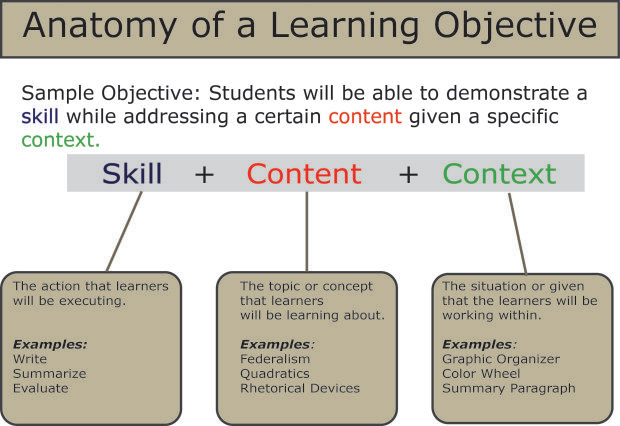
Aligning Instructional Strategies with Objectives
Alignment is the thread that ties objectives, instruction, and assessment together. When these three elements are coherent, instruction becomes purposeful rather than scattered.
Backward Design
Backward design, developed by Wiggins and McTighe, is a planning framework that starts with the end in mind:
- Identify desired results — What should students know or be able to do? (learning objectives)
- Determine acceptable evidence — How will you know they've learned it? (assessments)
- Plan learning experiences and instruction — What activities and strategies will get students there? (instructional strategies)
This reverses the common tendency to plan activities first and figure out assessment later. By starting with objectives, you ensure every activity serves a clear purpose.
Aligning with Bloom's Taxonomy
Bloom's Taxonomy provides a useful framework for matching cognitive demand to strategy:
- Lower-order thinking (remember, understand, apply) aligns well with direct instruction, guided practice, and demonstrations
- Higher-order thinking (analyze, evaluate, create) calls for inquiry-based learning, problem-solving tasks, and case studies
If your objective asks students to evaluate competing arguments, a straight lecture won't get them there. You'll need activities that require students to actually practice evaluating.
Assessment Alignment
Your assessments should match both your objectives and your instructional strategies:
- Formative assessments (checks for understanding, quizzes, class discussions) happen during instruction. They give you real-time data to adjust your approach and provide feedback.
- Summative assessments (projects, presentations, exams) happen after instruction. They evaluate whether students have mastered the learning objectives.
Continuous Evaluation and Refinement
Selecting a strategy isn't a one-time decision. Effective teachers treat it as an ongoing cycle:
- Collect data on student learning and engagement
- Reflect on whether the chosen strategies are working
- Adapt and modify strategies based on what the data and student feedback reveal
This reflective practice is what separates a lesson plan that looks good on paper from one that actually produces learning.
See Fiveable more often in Google
Mark Fiveable as a preferred source and Google is more likely to show you our guides in Top Stories, with a "preferred" badge in AI Mode and AI Overviews.