11.3 Supporting Teachers in Curriculum Implementation

📅Curriculum Development Unit 11 Review
11.3 Supporting Teachers in Curriculum Implementation
📅 Curriculum Development
Professional Development and Coaching for Curriculum Implementation
Even a well-designed curriculum falls flat without strong teacher support during rollout. Professional development, coaching, and feedback systems give teachers the practical tools they need to translate curriculum documents into effective classroom instruction. This section covers the main PD models, how to structure coaching plans, and how to monitor implementation so the curriculum keeps improving over time.
Models for Curriculum Training
Different professional development models serve different purposes. Most districts use a combination rather than relying on just one.
Workshop Model
Workshops are intensive, focused sessions on specific curriculum topics like differentiation strategies or new assessment formats. They're typically short-term (one to two days) and led by facilitators who use hands-on activities and group discussions. Workshops work well for introducing new content or tools, but they're limited on their own because teachers don't get sustained follow-up.
Professional Learning Communities (PLCs)
PLCs are collaborative groups of teachers who meet regularly to work on curriculum implementation together. The emphasis is on collective inquiry: teachers examine student data, share what's working, troubleshoot problems, and refine their practice as a group. Because PLCs are job-embedded and ongoing, they tend to produce deeper, more lasting changes than one-off workshops.
Blended Learning
This model combines face-to-face sessions with online learning, giving teachers flexibility to learn at their own pace and on their own schedule. It's especially useful when teachers need to explore curriculum resources independently or when scheduling in-person time is difficult. The trade-off is that it requires more self-direction from participants.
Mentoring and Coaching
Coaching pairs a teacher with an experienced educator for one-on-one support. Unlike workshops, coaching is personalized: the coach observes lessons, provides targeted feedback, and helps the teacher set individual growth goals. This model is particularly effective for newer teachers or anyone struggling with a specific aspect of implementation because the support is tailored to that person's actual classroom practice.

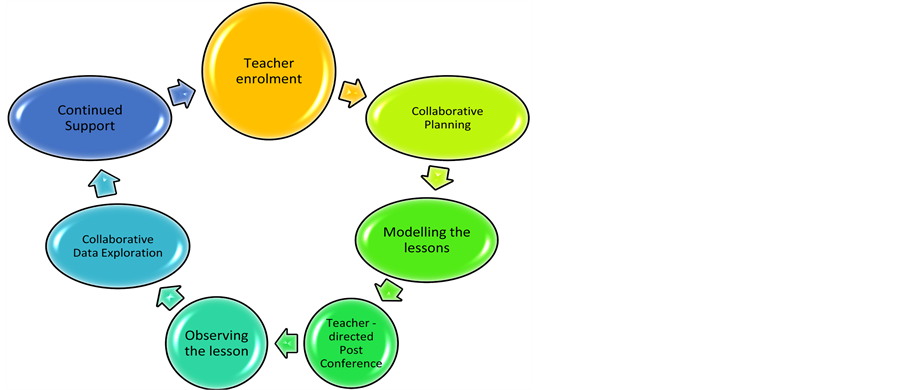
Coaching Plans for Implementation
A coaching plan gives structure to the support process. Without one, coaching tends to become informal and inconsistent. Here's how to build an effective plan:
-
Identify teacher needs and goals. Start with a needs assessment to pinpoint where each teacher needs support with the curriculum. Then collaborate with the teacher to set specific, measurable goals that align with curriculum expectations. For example, a goal might be "Integrate at least two formative assessment checkpoints into each unit by the end of the quarter."
-
Establish a coaching schedule. Plan regular check-ins and classroom observations so progress is tracked consistently. Build in dedicated time for feedback conversations and reflective dialogue after each observation.
-
Provide resources and support materials. Share exemplar lesson plans, model assessments, and curated instructional strategies that show what effective implementation looks like in practice. These concrete examples are often more helpful than abstract advice.
-
Facilitate peer collaboration. Encourage teachers to share both successes and struggles with one another. When teachers problem-solve together, they build a culture of continuous improvement that outlasts any individual coaching relationship.
Monitoring and Continuous Improvement
Monitoring isn't about evaluating teachers; it's about understanding how the curriculum is actually playing out in classrooms so you can make it better. Strong monitoring combines direct observation with teacher voice and student data.
Tools for Monitoring and Feedback
- Observation protocols use checklists or rubrics aligned with key curriculum expectations. Observers focus on specific instructional practices and student engagement rather than trying to evaluate everything at once.
- Lesson plan reviews check whether plans align with curriculum standards and objectives. Reviewers provide feedback on instructional strategies and assessment methods, catching misalignment before it reaches the classroom.
- Student work samples offer direct evidence of how students are performing on curriculum-aligned tasks. Analyzing these samples helps identify where reteaching is needed or where students are ready for enrichment.
- Teacher self-reflection asks teachers to assess their own implementation using a structured protocol. This builds ownership over the process and encourages a growth-oriented stance toward feedback.
Teacher Input for Improvement
Teacher feedback is what closes the loop between curriculum design and classroom reality. Without it, curriculum leaders are guessing about what's working.
- Surveys and questionnaires gather broad feedback on perceived strengths and weaknesses of the curriculum. They can also assess teacher confidence levels and flag professional development needs across a school or district.
- Focus groups and interviews go deeper than surveys. They give teachers space to describe implementation challenges in detail, surface issues that survey questions might miss, and suggest specific curriculum revisions.
- Classroom observations (when aggregated across multiple classrooms) reveal common implementation patterns. If several teachers are struggling with the same unit or strategy, that's a signal the curriculum or the PD needs adjustment, not just individual teachers.
- Student performance data ties everything back to outcomes. Analyzing assessment results across classrooms shows whether the curriculum is producing the intended learning. Where results fall short, the data points toward targeted refinements in both the curriculum and teacher support.
See Fiveable more often in Google
Mark Fiveable as a preferred source and Google is more likely to show you our guides in Top Stories, with a "preferred" badge in AI Mode and AI Overviews.