1.10 Dynamics and Articulation

🎶AP Music Theory Unit 1 Review
1.10 Dynamics and Articulation
🎶 AP Music Theory
TLDR
Dynamics tell you how loud or soft to play, and articulation tells you how each note starts, ends, and connects to the next. In AP Music Theory, you need to recognize these expressive markings both in a score and in performed music, and apply the simple ones when you sight-sing.
Why This Matters for the AP Music Theory Exam
Dynamics and articulation are the expressive layer on top of pitch and rhythm. On the exam, you may need to identify dynamic levels, dynamic changes, and articulation markings in notated music and in music you hear, which shows up in the multiple-choice section. These markings also appear in sight-singing, where you read a melody at sight and apply what the score tells you.
Keep in mind that sight-singing melodies on the exam stay simple. They use a loud dynamic like forte, a moderate tempo like moderato, and articulation limited to standard phrase slurs. The point is to keep your voice clear so you can focus on getting pitch and rhythm right, not to perform fancy crescendos or ritardandos.
Key Takeaways
- Dynamics are relative loudness markings using Italian abbreviations: pp, p, mp, mf, f, ff (softest to loudest).
- Dynamic changes show up as hairpins (crescendo
<and decrescendo>), Italian words (crescendo, decrescendo, subito), or abbreviations; sf or sfz marks a sudden dynamic accent. - Terraced dynamics mean a sudden jump from loud to soft or soft to loud, with no gradual change in between.
- Articulation describes how a note attacks, releases, and connects: staccato dots, tenuto/legato lines, slurs, and marcato accents are the main symbols.
- A tremolo is the rapid, continuous repetition of a single pitch.
- When you sight-sing, apply every marked dynamic, articulation, and tempo, and hold a steady tempo unless the score says otherwise.
Dynamics

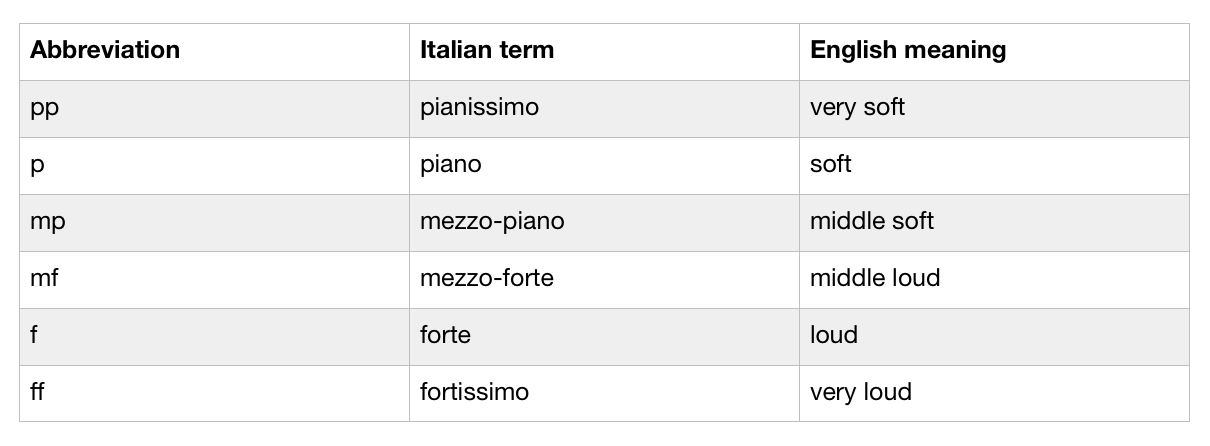
Dynamic markings show how loud or soft the music should be played. They use Italian terms and abbreviations. From softest to loudest:
| Abbreviation | Italian Term | Meaning |
|---|---|---|
| pp | pianissimo | very soft |
| p | piano | soft |
| mp | mezzo piano | medium soft |
| mf | mezzo forte | medium loud |
| f | forte | loud |
| ff | fortissimo | very loud |
Dynamics are relative, not exact volume levels. A forte in one piece or one section might be much louder or softer than a forte somewhere else. Different composers and styles also treat these markings differently, so context matters when you decide how loud to play.
Showing dynamic changes
Changes in dynamics can be shown several ways:
- Hairpins: the
<symbol is a crescendo, which means get louder over the marked space. The>symbol is a decrescendo, which means get softer. A decrescendo is sometimes called a diminuendo and abbreviated "dim." - Words and abbreviations: crescendo and decrescendo can be written out or abbreviated (cresc., decresc.).
- Subito: this means suddenly. You might see the word "subito," or you might just see the dynamic jump from forte to piano with no gradual change. That sudden shift is subito (subito piano for suddenly soft, subito forte for suddenly loud).
Dynamic accents
A dynamic accent gives a momentary boost of volume to a specific note or notes. The marking sf or sfz stands for sforzando, a sudden strong accent. When you see it, play that note with extra force and emphasis compared to the notes around it.
Terraced dynamics
Terraced dynamics mean a loud passage is immediately followed by a soft one, or a soft passage is immediately followed by a loud one. The contrast is sudden, like stepping from one level to another rather than sliding between them.
You may sometimes see extreme markings like fff or pppp in real music. These just keep pushing the relative scale further toward very loud or very soft.
Articulation

Articulation describes how a sound starts (its attack), how it ends, and how detached or connected adjacent notes are. The same idea is sometimes called the attack. Here are the common markings:
- Staccato: a dot above or below the note. The notes are separated, with a clear gap of silence between them. This does not always mean extremely short notes, but it does mean detached.
- Tenuto: a straight line above or below the note. Hold the note for its full duration, often with a slight emphasis.
- Legato: shown with a slur (a curved line). Play or sing the notes smoothly and connected. On a wind instrument you do not re-tongue under the slur; on strings you keep one bow direction; on piano or harp you keep the line connected.
- Marcato: a strong, emphasized, detached sound. It is often shown with a small triangular accent above or below the note. Accents (which look like little sideways hairpins above a note) also call for emphasis.
Slurs vs phrase markings vs ties
A long curved line over a section can mean different things, so read context carefully:
- A legato slur connects notes that should be played smoothly together.
- A phrase marking looks like a big slur but tells you a section is one musical idea, not that every note is physically connected. If staccato dots appear inside the curved line, or the big curves repeat at regular intervals across the piece, you are probably looking at phrasing, not legato. You will work more with phrasing in later units.
- A tie connects two or more of the same pitch and tells you to hold that note across the connection. If the line joins identical notes, it is a tie, not a slur.
Tremolo

A tremolo is the rapid, continuous repetition of a single pitch. It is often notated with slashes or wavy lines on or near the note. Tremolo is related to articulation because it shapes how the sound is produced and sustained.
How to Use This on the AP Music Theory Exam
MCQ
Expect to identify dynamics, dynamic changes, and articulation in both notated music and music you hear. Practice matching the symbol to the term: hairpin to crescendo or decrescendo, dot to staccato, line to tenuto, curved line to slur or legato, triangle to marcato, sf/sfz to sforzando. When listening, focus on relative changes (getting louder or softer, sudden vs gradual) rather than guessing an exact volume.
Common Trap
- Treating a phrase marking as if it means every note is legato. Check for staccato dots inside the curve and for big curves that repeat at regular spots.
- Confusing a slur with a tie. If the curve connects the same pitch, it is a tie (hold the note); if it connects different pitches, it is a slur.
- Reading dynamics as fixed volumes. Forte means relatively loud for that piece, not one set decibel level.
Sight-Singing
When you sight-sing, apply every marked dynamic, articulation, and tempo in the score, not just pitch and rhythm. Keep a steady tempo from start to finish and do not change speed unless the notation tells you to. Sing with continuity, avoiding hesitations and restarts so the metric flow stays intact.
The good news: exam sight-singing melodies keep the expressive markings simple, usually a loud dynamic like forte, a moderate tempo like moderato, and articulation limited to standard phrase slurs. That lets you put most of your focus on accurate pitch and rhythm.
Common Misconceptions
- Misconception: Staccato always means very short.Actually: Staccato means detached with a gap of silence, not necessarily the shortest possible note. The gap is the key feature.
- Misconception: Dynamics are exact volumes.Actually: They are relative. The same marking can sound different across pieces, composers, and sections.
- Misconception: Every curved line is a slur.Actually: Curved lines can be legato slurs, phrase markings, or ties, depending on context and whether they connect the same or different pitches.
- Misconception: Subito needs the word written out.Actually: A sudden jump between dynamic levels with no hairpin is already subito, even if the word is not printed.
- Misconception: You should add expression to make sight-singing impressive.Actually: On the exam, only perform the markings that are actually written, and hold a steady tempo unless a change is notated.
Related AP Music Theory Guides
Practice Questions for 1.10
1 of 10
A score shows a curved line connecting a C4 quarter note to a D4 quarter note. The performer sings the C4 and holds it for two beats, omitting the D4. Which statement describes the discrepancy?
A.
Treated a slur as a legato instruction, singing only the first pitch
B.
Treated a slur as a tie, omitting the second pitch
C.
Treated a slur as indicating a single note value, combining both pitches into one
D.
Treated a slur as a phrase marking, sustaining through both pitches
Vocabulary
The following words are mentioned explicitly in the AP® course framework for this topic.Term | Definition |
|---|---|
accent | A marking that indicates a note should be played with emphasis or stress. |
articulation | An aspect of performance that describes the way a sound starts (its attack) and ends and how detached or connected adjacent pitches are. |
attack | The way a sound begins or starts in performance. |
crescendo | A gradual increase in volume indicated by Italian words or graphic symbols. |
decrescendo | A gradual decrease in volume indicated by Italian words or graphic symbols. |
dynamic accent | A momentary increase of volume applied to a specific note or notes, indicated by sf or sfz. |
dynamics | Musical markings that describe in relative terms how loud or soft music is. |
forte | A dynamic marking abbreviated as f that indicates loud volume. |
fortissimo | A dynamic marking abbreviated as ff that indicates very loud volume. |
legato | An articulation indicated by a line that indicates notes should be played in a smooth, connected manner. |
marcato | An articulation marked with an accent that indicates notes should be played with emphasis and separation. |
metric framework | The underlying pattern of beats and measures that organize the rhythm and structure of a musical composition. |
mezzo forte | A dynamic marking abbreviated as mf that indicates moderately loud volume. |
mezzo piano | A dynamic marking abbreviated as mp that indicates moderately soft volume. |
phrase slurs | Curved lines in musical notation that indicate notes should be performed smoothly and connected within a musical phrase. |
pianissimo | A dynamic marking abbreviated as pp that indicates very soft volume. |
piano | A dynamic marking abbreviated as p that indicates soft volume. |
sforzando | A dynamic accent indicated by the abbreviations sf or sfz that creates a sudden emphasis on a note. |
sight-sing | To perform a notated melody at first sight without prior rehearsal or familiarity, reading and singing the music as it is presented. |
slur | A curved line in musical notation that indicates notes should be played smoothly and connected together. |
staccato | An articulation marking indicated by a dot that indicates notes should be played in a detached manner. |
steady tempo | Maintaining a consistent speed throughout a musical performance without acceleration or deceleration. |
subito | An Italian term indicating a sudden change in dynamics. |
tempo | The speed at which music is performed, indicated by markings such as moderato or allegro. |
tenuto | An articulation indicated by a line that indicates notes should be held for their full value in a connected manner. |
terraced dynamics | The sudden contrast between loud and soft passages of music, rather than gradual changes in volume. |
tremolo | The rapid and continuous repetition of a single pitch. |
Frequently Asked Questions
What are dynamics in music?
Dynamics are relative loudness markings that tell performers how soft or loud to play, such as pp, p, mp, mf, f, and ff.
What does mezzo forte mean?
Mezzo forte, abbreviated mf, means medium loud. It sits between mezzo piano and forte on the basic dynamic scale.
What does sfz mean in music?
Sfz stands for sforzando, a sudden strong accent that gives one note or moment extra dynamic emphasis.
What are hairpins in music notation?
Hairpins show gradual dynamic changes. An opening hairpin means crescendo, and a closing hairpin means decrescendo or diminuendo.
What is articulation in music?
Articulation describes how notes start, end, and connect, including markings such as staccato, tenuto, slurs, marcato accents, and phrase markings.
How are dynamics and articulation tested on AP Music Theory?
You may identify them in performed or notated music, and in sight-singing you should apply the written dynamics, articulation, and tempo markings.
See Fiveable more often in Google
Mark Fiveable as a preferred source and Google is more likely to show you our guides in Top Stories, with a "preferred" badge in AI Mode and AI Overviews.