6.3 Entropy generation and irreversibility

🥵Thermodynamics Unit 6 Review
6.3 Entropy generation and irreversibility
🥵 Thermodynamics
Entropy Generation and Irreversibility
Entropy generation quantifies how much irreversibility occurs during a thermodynamic process. Every real process generates some entropy, and that generated entropy directly translates into lost potential to do useful work. This section covers how to calculate entropy generation, what causes it, and how it connects to lost work and system efficiency.
Entropy Generation and the Second Law
Entropy generation () is the entropy produced within a system boundary due to irreversibilities. It captures the "cost" of real-world imperfections like friction, heat transfer across temperature differences, mixing, and chemical reactions.
The second law of thermodynamics constrains entropy generation to be non-negative:
- for a reversible process (an idealization; no real process achieves this exactly)
- for an irreversible process (every real process)
- is impossible; any calculation that yields a negative value signals an error
The magnitude of tells you how far a process is from the reversible ideal. A larger value means more irreversibility and more wasted potential.
Calculation of Entropy Generation
The general entropy balance for a system accounts for entropy transfer (via heat), entropy storage (change within the system), and entropy generation:
where:
- is the rate of entropy generation
- is the rate of entropy change within the system
- is the heat transfer rate at boundary location (positive into the system)
- is the absolute temperature of the boundary where crosses
For a closed system undergoing a finite process, integrate over time:
Here is the entropy change of the system, and each term accounts for entropy transferred in or out with heat at boundary temperature .
Steps to calculate for a closed system:
- Define the system boundary clearly.
- Calculate using property tables, ideal gas relations, or equations.
- Identify every heat interaction and the boundary temperature at which each occurs.
- Compute .
- Check your answer: if , something is wrong.
Special case: adiabatic process ( at every boundary):
This is a useful shortcut. For an adiabatic process, any increase in system entropy is entirely due to internal irreversibilities.

Factors That Generate Entropy
Four common sources of irreversibility show up repeatedly in thermodynamic systems:
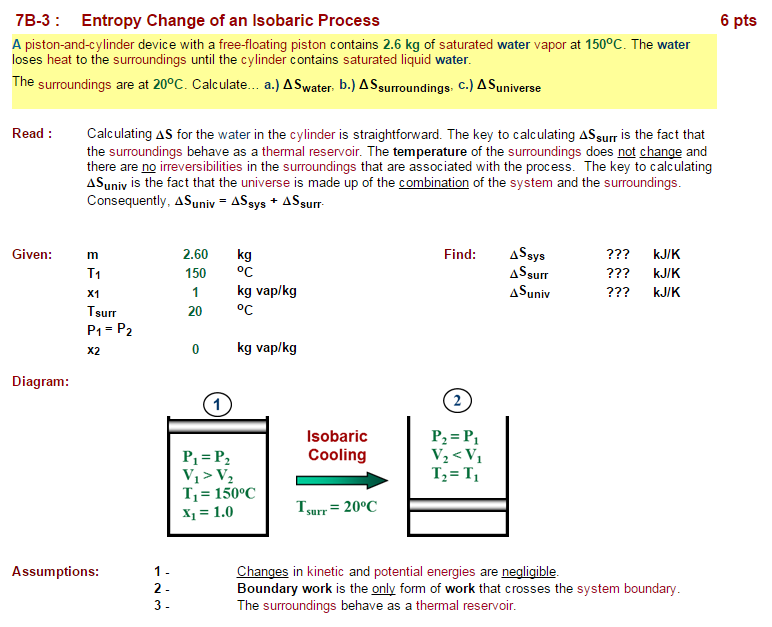
Heat transfer across a finite temperature difference. When heat flows from a hot reservoir at to a cold reservoir at , the entropy generated is:
The larger the temperature gap, the more entropy is generated. If , the transfer would be reversible (but infinitely slow).
Friction. Friction converts ordered mechanical energy into disordered thermal energy (heat). The work lost to friction, , dissipates into the surroundings at temperature , generating entropy on the order of . You can never recover that ordered energy without generating even more entropy elsewhere.
Mixing of different substances. When two fluids at different temperatures, pressures, or compositions come into contact and mix, entropy increases. Think of hot and cold water streams merging in a pipe. The mixed state is more disordered, and you can't spontaneously un-mix them.
Chemical reactions. Reactions like combustion are highly irreversible. The entropy generated depends on the reaction's extent and the temperature at which it occurs. Combustion at very high temperatures, for example, generates less entropy per unit of heat released than combustion at lower temperatures.
Lost Work and Its Connection to Entropy Generation
Lost work () is the gap between the maximum useful work a reversible process could deliver and the actual work the real process delivers. The Gouy-Stodola theorem gives the direct link:
where is the absolute temperature of the surroundings (the "dead state" temperature, often around 298 K).
This equation is powerful because it converts an abstract entropy quantity into a concrete energy penalty measured in joules or kilowatts.
- Every bit of entropy you generate destroys worth of work potential.
- For a heat engine, more means lower thermal efficiency.
- For a refrigerator or heat pump, more means a higher required work input.
Practical takeaway: In engineering design (power plants, turbines, heat exchangers, refrigeration cycles), you improve performance by identifying where entropy generation is largest and targeting those components. For instance, replacing a throttling valve with a turbine in a refrigeration cycle recovers some of the work that throttling would have destroyed.
See Fiveable more often in Google
Mark Fiveable as a preferred source and Google is more likely to show you our guides in Top Stories, with a "preferred" badge in AI Mode and AI Overviews.