17.2 Fermi-Dirac distribution and applications

🥵Thermodynamics Unit 17 Review
17.2 Fermi-Dirac distribution and applications
🥵 Thermodynamics
Fermi-Dirac Distribution
Fermi-Dirac distribution function
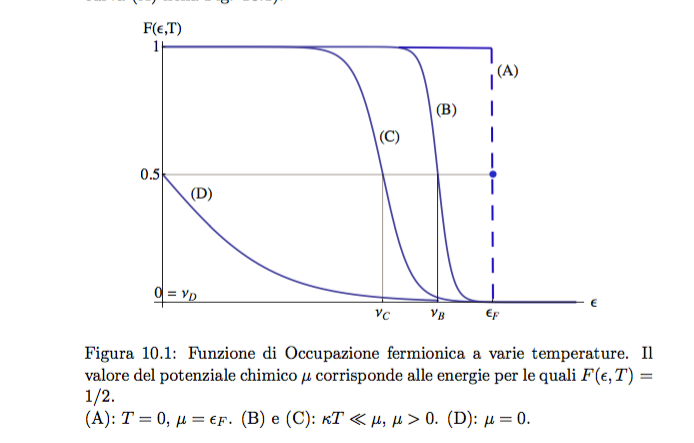
The Fermi-Dirac distribution tells you the probability that a fermion occupies a quantum state at energy for a given temperature . It's built directly on the Pauli exclusion principle: no two identical fermions can share the same quantum state.
The distribution function is:
where is the chemical potential (equal to the Fermi energy at ) and is the Boltzmann constant. This applies to all particles with half-integer spin (electrons, protons, neutrons, quarks), collectively called fermions.
The behavior of this function changes dramatically with temperature:
- At absolute zero (), the distribution becomes a sharp step function. Every state below is fully occupied (), and every state above is completely empty ().
- As temperature increases, the step "smears out" around . Some fermions gain enough thermal energy to jump above the Fermi level, leaving empty states below it. The width of this smeared region is on the order of a few .
- Right at , the occupation probability is always exactly , regardless of temperature.
Compare this to the classical Boltzmann distribution, which has no upper limit on occupation. The "+1" in the Fermi-Dirac denominator is what enforces the exclusion principle and caps at 1.

Fermi energy calculations
The Fermi energy is the energy of the highest occupied state at absolute zero. It sets the energy scale for the entire fermion system.
For a free fermion gas, is calculated from the particle number density :
where is the reduced Planck constant, is the particle mass, and is the spin degeneracy factor ( for electrons, since spin-up and spin-down are both allowed).
A related quantity is the Fermi temperature, . This tells you when quantum statistics actually matter:
- When , the system is deeply degenerate. Most fermions sit well below and only those within ~ of the Fermi surface are thermally active. The Fermi energy stays nearly constant.
- When , thermal energy dominates and the system behaves almost classically. The chemical potential drops below zero and the Fermi-Dirac distribution approaches the Maxwell-Boltzmann distribution.
For conduction electrons in a typical metal, , giving . Room temperature (~300 K) is far below this, which is why metals are strongly degenerate under normal conditions.
increases with particle density: pack more fermions into the same volume and they're forced into higher energy states to avoid violating the exclusion principle.
Applications of Fermi-Dirac distribution
Metals. Conduction electrons in metals like copper and aluminum have high number densities, producing Fermi energies of several eV. Only electrons within roughly of can be thermally excited and participate in conduction. This explains why the electronic heat capacity of metals is much smaller than classical predictions (which assume all electrons contribute). The temperature dependence of resistivity in metals also follows from how the Fermi-Dirac distribution controls which electrons scatter off lattice vibrations.
Semiconductors. In intrinsic semiconductors like silicon and germanium, the Fermi level sits near the middle of the bandgap, between the valence and conduction bands. The Fermi-Dirac distribution determines how many electrons are thermally promoted into the conduction band and how many holes are left in the valence band. Doping shifts the Fermi level: n-type doping pushes it toward the conduction band (more electrons available), while p-type doping pushes it toward the valence band (more holes). The carrier concentrations depend exponentially on the distance between the Fermi level and the band edges.
White dwarf stars. Stellar remnants supported by electron degeneracy pressure are a direct, large-scale consequence of Fermi-Dirac statistics. The relationship between a white dwarf's mass and radius is governed by how densely packed electrons determine the Fermi energy and the resulting pressure.
Degeneracy pressure in stars
Degeneracy pressure is a quantum mechanical effect that arises directly from the Pauli exclusion principle. When matter is compressed to extreme densities, fermions cannot all occupy low-energy states. They're forced into progressively higher energy levels, and this creates a pressure that resists further compression, even at zero temperature.
In white dwarf stars, electron degeneracy pressure balances gravitational collapse. The electrons are packed so tightly that their Fermi energy reaches relativistic scales (~MeV), and the resulting outward pressure stabilizes the star without any need for nuclear fusion.
This balance holds only up to the Chandrasekhar limit ( solar masses):
- Below this mass, electron degeneracy pressure is sufficient to support the star indefinitely. The white dwarf slowly cools over billions of years.
- Above this mass, gravity overwhelms electron degeneracy pressure. The star collapses further, and electrons are captured by protons to form neutrons.
- The result is either a neutron star (supported by neutron degeneracy pressure) or, if the mass is large enough, a black hole.
The Chandrasekhar limit itself can be derived by balancing the gravitational energy of the star against the Fermi energy of a relativistic electron gas, making it a direct quantitative prediction of Fermi-Dirac statistics applied at astrophysical scales.
See Fiveable more often in Google
Mark Fiveable as a preferred source and Google is more likely to show you our guides in Top Stories, with a "preferred" badge in AI Mode and AI Overviews.