13.2 Otto and Diesel cycles

🥵Thermodynamics Unit 13 Review
13.2 Otto and Diesel cycles
🥵 Thermodynamics
Otto and Diesel Cycles
Otto and Diesel cycles are idealized models of the thermodynamic processes inside internal combustion engines. They describe how engines convert chemical energy in fuel into mechanical work through a repeating sequence of compression, combustion, expansion, and exhaust. Understanding these two cycles gives you the foundation for analyzing engine efficiency, comparing engine types, and working through cycle calculations on P-v and T-s diagrams.
The core distinction: the Otto cycle models spark-ignition (gasoline) engines with constant-volume heat addition, while the Diesel cycle models compression-ignition (diesel) engines with constant-pressure heat addition. This single difference in how heat enters the cycle changes the efficiency formulas, compression ratios, and practical applications.

Top images from around the web for Components of Otto cycle
Otto cycle - Wikipedia View original
Is this image relevant?
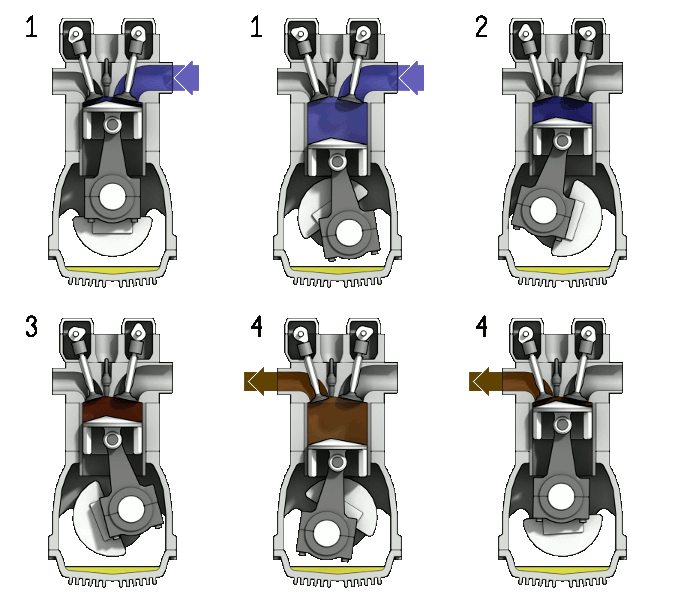
Cylinder (engine) - Wikipedia View original
Is this image relevant?
File:Four stroke engine diagram.jpg - Wikipedia View original
Is this image relevant?
Otto cycle - Wikipedia View original
Is this image relevant?
Cylinder (engine) - Wikipedia View original
Is this image relevant?
Components of the Otto Cycle
The Otto cycle is a four-stroke cycle used in spark-ignition engines. The four strokes are intake, compression, power, and exhaust. Each stroke corresponds to one movement of the piston (up or down), so a full cycle takes two complete crankshaft revolutions.
The key physical components that make this cycle work:
- Piston moves up and down inside the cylinder, compressing the air-fuel mixture and then being driven downward during expansion
- Cylinder encloses the working fluid and serves as the combustion chamber
- Spark plug initiates combustion by producing an electric spark at the top of the compression stroke, igniting the compressed air-fuel mixture all at once
- Intake and exhaust valves control gas flow into and out of the cylinder. The intake valve opens to draw in fresh air-fuel mixture; the exhaust valve opens to expel combustion products
- Connecting rod and crankshaft work together to convert the piston's linear (up-and-down) motion into rotational motion that ultimately drives the wheels or other output
Otto cycle engines power most gasoline vehicles (cars, motorcycles) and smaller engines like lawnmowers, chainsaws, and portable generators.

Processes in the Otto Cycle
The idealized Otto cycle consists of four processes on a P-v diagram:
- Isentropic compression (): The piston moves upward, compressing the air-fuel mixture adiabatically and reversibly. Both pressure and temperature rise significantly. No heat is transferred during this step.
- Constant-volume heat addition (): The spark plug fires. Combustion happens so rapidly that the piston barely moves, so volume stays approximately constant. Pressure and temperature spike as chemical energy is released into the gas.
- Isentropic expansion (): The hot, high-pressure gas pushes the piston downward. This is the power stroke, where the system does work on the piston. The gas expands adiabatically and reversibly.
- Constant-volume heat rejection (): The exhaust valve opens, and pressure drops rapidly at roughly constant volume as heat is rejected to the surroundings. This brings the system back to its initial state.

Processes in the Diesel Cycle
The Diesel cycle also has four processes, but the heat addition step differs:
- Isentropic compression (): Air alone (no fuel yet) is compressed adiabatically and reversibly. Because Diesel engines use much higher compression ratios, the air reaches temperatures high enough to auto-ignite fuel, often exceeding 500°C.
- Constant-pressure heat addition (): Fuel is injected into the hot compressed air. Combustion occurs more gradually as fuel is sprayed in, and the piston begins moving downward during this process, keeping pressure approximately constant while volume increases.
- Isentropic expansion (): The high-pressure, high-temperature gases continue expanding adiabatically, pushing the piston down and doing work.
- Constant-volume heat rejection (): The exhaust valve opens, pressure drops at constant volume, and heat is rejected to the surroundings.
Otto vs. Diesel Cycle Principles
Both cycles share the same basic structure: isentropic compression, heat addition, isentropic expansion, and constant-volume heat rejection. The differences come down to how heat enters the cycle and what that requires mechanically.
| Feature | Otto Cycle | Diesel Cycle |
|---|---|---|
| Ignition method | Spark ignition | Compression ignition (auto-ignition) |
| Heat addition | Constant volume | Constant pressure |
| Compression ratio | Typically 8:1 to 12:1 | Typically 14:1 to 25:1 |
| Fuel type | Gasoline | Diesel fuel |
| Typical applications | Cars, motorcycles, small engines | Trucks, buses, ships, generators |
Why can't Otto engines use compression ratios as high as Diesel engines? If you compress a pre-mixed air-fuel charge too much, it auto-ignites before the spark fires. This is called knock, and it damages the engine. Diesel engines avoid this problem because only air is compressed; fuel is injected after compression is complete.
Diesel engines generally achieve higher thermal efficiency than Otto engines, primarily because of their higher compression ratios. The tradeoff is that Diesel engines tend to be heavier, noisier, and produce higher peak pressures.
Efficiency Calculations for Thermodynamic Cycles
Work and Heat Transfer
Work done by the system during any process can be found from:
A positive value means the gas is expanding and doing work on the piston. A negative value means work is being done on the gas (compression).
Heat transfer depends on the type of process:
- Constant volume (used in Otto heat addition and in heat rejection for both cycles):
- Constant pressure (used in Diesel heat addition):
Since always, more heat is needed to raise the temperature by the same amount at constant pressure than at constant volume. This is because at constant pressure, some energy goes into expansion work.
Thermal Efficiency
The thermal efficiency of any heat engine cycle is:
This tells you what fraction of the heat input gets converted to useful work. The rest is waste heat rejected during process .
Ideal Otto cycle efficiency:
where is the compression ratio (, the ratio of maximum to minimum cylinder volume) and is the specific heat ratio (, typically 1.4 for air).
Notice that efficiency depends only on and . A higher compression ratio always means higher efficiency. For example, with :
- At :
- At :
Ideal Diesel cycle efficiency:
where is the cutoff ratio (), the ratio of the volume at the end of heat addition to the volume at the start of heat addition.
The term in parentheses is always greater than 1 (since ). This means that for the same compression ratio, the Diesel cycle has a lower efficiency than the Otto cycle. However, in practice, Diesel engines operate at much higher compression ratios, which more than compensates, giving them higher real-world efficiency.
As (heat addition over a vanishingly small volume change), the Diesel efficiency formula reduces to the Otto formula. This makes physical sense: constant-pressure heat addition over zero volume change becomes constant-volume heat addition.
See Fiveable more often in Google
Mark Fiveable as a preferred source and Google is more likely to show you our guides in Top Stories, with a "preferred" badge in AI Mode and AI Overviews.