8.6 Speed of light

🎢Principles of Physics II Unit 8 Review
8.6 Speed of light
🎢 Principles of Physics II
Nature of light
Light behaves as both a wave and a particle, a concept called wave-particle duality. This dual nature is central to understanding everything from optics to quantum mechanics.
Wave-particle duality
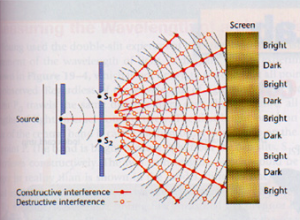
As a wave, light produces interference and diffraction patterns. As a stream of particles (photons), it explains the photoelectric effect and Compton scattering. The famous double-slit experiment shows both behaviors: light creates an interference pattern on a screen (wave behavior), yet arrives in discrete hits (particle behavior).
Einstein's explanation of the photoelectric effect using light quanta earned him the Nobel Prize and helped launch quantum physics.
Electromagnetic spectrum
All electromagnetic waves travel at the same speed in vacuum but differ in frequency and wavelength. The spectrum, from longest to shortest wavelength, runs:
- Radio waves → Microwaves → Infrared → Visible light → Ultraviolet → X-rays → Gamma rays
Visible light occupies a narrow band, roughly 380–700 nm in wavelength. The energy of any electromagnetic wave relates to its frequency through:
where is Planck's constant ( J·s). Higher frequency means higher energy, which is why gamma rays are far more energetic than radio waves.
Speed of light constant
The speed of light in vacuum, , is one of the most important constants in all of physics. Its fixed value connects electromagnetism, relativity, and the structure of spacetime.
Definition of c
The speed of light in vacuum is exactly 299,792,458 meters per second. This isn't just a measured value; it's a defined constant in the SI system (the meter is actually defined in terms of ).
Where does this number come from? Maxwell's equations of electromagnetism predict that electromagnetic waves travel at a speed:
where is the permeability of free space and is the permittivity of free space. This was a stunning result: Maxwell showed that light is an electromagnetic wave, and its speed falls directly out of the theory.
The constant also serves as the bridge between mass and energy in Einstein's equation .
Measurement techniques
Measuring the speed of light has a rich experimental history:
- Galileo's lantern experiment (1638): Two people with lanterns on distant hilltops tried to time light's travel. Light was far too fast for this to work.
- Rømer's astronomical method (1676): Observed that eclipses of Jupiter's moon Io arrived earlier or later depending on Earth's orbital position. First evidence that light has a finite speed.
- Fizeau's cogwheel (1849): Shone light through the gaps of a spinning toothed wheel toward a distant mirror and back. By adjusting the wheel's speed, he could block or pass the returning beam, giving the first accurate terrestrial measurement.
- Foucault's rotating mirror (1862): Improved on Fizeau's method using a rotating mirror instead of a cogwheel, achieving better precision.
- Modern methods: Laser interferometry and cavity resonance experiments measure wavelength and frequency independently, then calculate with extraordinary precision.
Light propagation
How light travels depends entirely on what it's traveling through. This distinction between vacuum and material media is the foundation of optics.
Vacuum vs. medium
In a vacuum, light travels at its maximum speed with nothing to slow it down. In any material medium, light interacts with atoms and molecules, which effectively slows its propagation. The speed in a medium is:
where is the refractive index of the material.
Different wavelengths can travel at slightly different speeds in a medium, a phenomenon called dispersion. This is why a prism splits white light into a rainbow of colors.
Refractive index
The refractive index quantifies how much a medium slows light:
- Vacuum: (by definition)
- Water:
- Glass:
- Diamond:
A higher means light travels more slowly in that material. When light crosses a boundary between two media with different refractive indices, it bends. This is refraction, described by Snell's law. Because varies with wavelength, refraction also produces dispersion, which is how rainbows form.
Special relativity
Einstein's special relativity resolves a deep conflict between Newtonian mechanics and Maxwell's electromagnetism. It reshapes our understanding of space, time, and motion at high speeds.
Einstein's postulates
Special relativity rests on two postulates:
- Principle of relativity: The laws of physics are the same in all inertial (non-accelerating) reference frames.
- Constancy of light speed: The speed of light in vacuum is in every inertial frame, regardless of the motion of the source or observer.
These sound simple, but together they force radical conclusions. Simultaneity becomes relative: two events that happen at the same time in one frame may not be simultaneous in another. These postulates also resolve why Maxwell's equations don't obey Galilean velocity addition the way Newtonian mechanics does.

Time dilation
A clock moving relative to you ticks more slowly than your own clock. The relationship is:
Here, is the proper time (measured by the clock at rest relative to the event), and is the dilated time measured by the moving observer. The factor is called the Lorentz factor.
At everyday speeds, is tiny and , so the effect is negligible. But at speeds approaching , time dilation becomes dramatic. This has been confirmed experimentally with atomic clocks flown on airplanes and is accounted for in GPS satellite timing.
The "twin paradox" is a classic illustration: a twin who travels at relativistic speed and returns will have aged less than the twin who stayed home.
Length contraction
Objects moving relative to you appear shorter along the direction of motion:
where is the proper length (measured at rest) and is the contracted length. Dimensions perpendicular to the motion are unaffected.
Like time dilation, this effect only becomes noticeable at speeds close to . The barn-pole paradox is a well-known thought experiment that uses length contraction to explore how simultaneity and measurement depend on reference frame.
Light speed limit
Nothing with mass can reach or exceed the speed of light. This isn't just a practical limitation; it's built into the structure of spacetime.
Causality principle
If information could travel faster than , you could find reference frames where effects precede their causes. The speed of light limit preserves causality, the requirement that cause always comes before effect.
In spacetime diagrams, an event can only influence other events within its light cone, the region reachable by signals traveling at or below . This ensures a consistent logical ordering of events across all reference frames.
Tachyons vs. tardyons
- Tardyons: Particles with positive mass that always travel slower than . All known matter particles are tardyons. Accelerating a tardyon toward requires ever-increasing energy, approaching infinity at itself.
- Tachyons: Hypothetical particles that would always travel faster than . They would require imaginary mass and could violate causality. No experimental evidence for tachyons has ever been found, and most physicists consider them unphysical.
Experimental evidence
Michelson-Morley experiment
In the late 1800s, physicists believed light traveled through a medium called the luminiferous ether. The Michelson-Morley experiment (1887) set out to detect Earth's motion through this ether.
How it worked:
- A beam of light was split into two perpendicular paths using a half-silvered mirror (beam splitter).
- Each beam traveled to a mirror and reflected back.
- The beams recombined, and any difference in travel time would produce a shift in the interference pattern.
If the ether existed, light traveling parallel to Earth's motion should have a different round-trip time than light traveling perpendicular to it. The result: no detectable difference. The speed of light was the same in both directions.
This null result helped kill the ether theory and strongly supported what would become Einstein's second postulate.
Modern precision measurements
Today, is known with extraordinary precision through several techniques:
- Laser interferometry measures distances and times with extreme accuracy.
- Cavity resonance experiments independently determine frequency and wavelength, then compute .
- Lunar laser ranging bounces laser pulses off reflectors left on the Moon, confirming over large distances.
- Spacecraft tracking verifies light speed constancy across the solar system.
Observations of neutrinos from supernova SN 1987A, which arrived within hours of the light signal after traveling 168,000 light-years, confirmed that even nearly massless particles obey the speed limit.
Consequences in physics
Mass-energy equivalence
Einstein's equation shows that mass and energy are interchangeable. A small amount of mass corresponds to an enormous amount of energy because is such a large number ( m²/s²).
This relationship explains the energy released in nuclear fission and fusion, where a small fraction of the reactants' mass converts to energy. It also predicts the existence of antimatter: when a particle meets its antiparticle, their combined mass converts entirely to energy.
Relativistic momentum
At low speeds, momentum is simply . At relativistic speeds, this formula underestimates the actual momentum. The correct expression is:
As approaches , grows without bound, so momentum increases toward infinity. This is why no amount of force can accelerate a massive particle all the way to . Particle accelerators like the Large Hadron Collider must account for relativistic momentum when steering and accelerating particles near light speed.
Applications
Fiber optic communications
Fiber optic cables transmit data as pulses of light through thin glass or plastic fibers. Light stays inside the fiber through total internal reflection: when light hits the boundary between the fiber core (higher ) and the cladding (lower ) at a shallow enough angle, it reflects completely rather than escaping.
This allows high-bandwidth data transmission over hundreds of kilometers with very low signal loss. Lasers encode information into light pulses, and photodetectors at the receiving end decode them. Undersea fiber optic cables carry the vast majority of international internet traffic.
GPS technology
The Global Positioning System depends on the speed of light in a direct way:
- Each GPS satellite broadcasts a time-stamped signal.
- Your GPS receiver picks up signals from multiple satellites.
- The receiver calculates how long each signal took to arrive, then multiplies by to get the distance to each satellite.
- With distances from at least four satellites, the receiver triangulates your position.
Without relativistic corrections, GPS would accumulate errors of about 10 km per day. Both special relativistic time dilation (satellite clocks tick slightly slower due to orbital speed) and general relativistic effects (satellite clocks tick slightly faster due to weaker gravity) must be corrected for. GPS is one of the most tangible everyday applications of relativity.
Speed of light variations
The speed of light in vacuum is always , but under special conditions, the effective speed of light in a medium can be dramatically altered.
Slow light phenomena
Using techniques like electromagnetically induced transparency (EIT), researchers have slowed the group velocity of light to just a few meters per second in ultracold atomic gases. In 1999, a team at Harvard reduced light's group velocity to about 17 m/s in a sodium Bose-Einstein condensate.
The group velocity describes how fast the envelope of a light pulse moves through the medium. Slowing it down doesn't violate relativity because the speed of individual photons in vacuum remains . Slow light has potential applications in optical memory and quantum information processing.
Superluminal propagation
In some situations, the phase velocity or group velocity of light in a medium can exceed . This has been observed in anomalous dispersion and quantum tunneling experiments.
This does not violate special relativity. The key distinction is between signal velocity (the speed at which actual information travels) and phase/group velocity. No usable information ever travels faster than . The wave peaks might appear to move superluminally, but the leading edge of a signal, which carries new information, always respects the light speed limit.
Cosmological implications
Expanding universe
Light from distant galaxies is redshifted, meaning its wavelength is stretched. This happens because space itself is expanding, stretching the light waves along with it. Hubble's law quantifies this:
where is the recession velocity, is the Hubble constant, and is the distance to the galaxy. Greater distance means greater redshift, which is how we know the universe is expanding.
During cosmic inflation (a brief period just after the Big Bang), space expanded faster than . This doesn't violate relativity because it's space itself expanding, not objects moving through space faster than light. The discovery of accelerating expansion through Type Ia supernovae observations earned the 2011 Nobel Prize in Physics.
Cosmic horizon
Because the universe has a finite age (about 13.8 billion years) and light travels at a finite speed, there's a limit to how far we can see. The observable universe has a radius of about 46 billion light-years. This is larger than 13.8 billion light-years because space has been expanding while the light was traveling toward us.
Anything beyond this cosmic horizon is, in principle, unobservable. We can never receive signals from those regions, and they can never influence us. The horizon problem, which asks why distant regions of the universe look so similar despite apparently never being in contact, is resolved by inflationary theory: these regions were in contact before inflation pushed them apart.
See Fiveable more often in Google
Mark Fiveable as a preferred source and Google is more likely to show you our guides in Top Stories, with a "preferred" badge in AI Mode and AI Overviews.