1.5 Conductors and insulators

🎢Principles of Physics II Unit 1 Review
1.5 Conductors and insulators
🎢 Principles of Physics II
Properties of conductors
Conductors are materials that allow electric charge to flow through them easily. This happens because they contain electrons that aren't locked to individual atoms and can move freely through the material.
Free electrons in conductors
In a conductor, the outermost (valence) electrons are loosely bound to their atoms. These electrons occupy what's called the conduction band, where they're delocalized, meaning they aren't tied to any single atom but instead drift throughout the entire material.
The electron sea model is a useful way to picture this: imagine a lattice of positive metal ions sitting in a "sea" of shared, mobile electrons. The more free electrons per unit volume a material has, the better it conducts. Copper, for example, has roughly free electrons per cubic meter, which is why it's such a good conductor.
Electron mobility
Electron mobility measures how quickly electrons move through a material in response to an electric field. It's defined as drift velocity per unit electric field, with units of .
- Higher mobility means better conductivity
- Lattice structure, temperature, and impurities all affect mobility
- Typical values for most metals range from to
Think of it this way: free electrons are constantly bouncing off atoms in the lattice. Anything that increases those collisions (higher temperature, more impurities) reduces mobility.
Electrical resistivity vs. conductivity
These are two sides of the same coin:
- Resistivity () quantifies how strongly a material opposes current flow, measured in
- Conductivity () quantifies how easily current flows, measured in
They're related by:
For copper: , giving .
Resistivity changes with temperature according to:
where is the temperature coefficient of resistivity. For most metals, is positive, so resistivity increases as the material heats up.
Properties of insulators
Insulators (also called dielectrics) resist the flow of electric current. Their electrons are tightly bound, so charge can't move freely through the material. This makes them essential for electrical safety and energy storage.
Bound electrons in insulators
Unlike conductors, the valence electrons in insulators are locked in place by strong covalent or ionic bonds. There's a large energy gap (called the band gap) between the valence band and the conduction band, typically greater than . Electrons would need to absorb at least that much energy to jump into the conduction band and move freely, which doesn't happen under normal conditions.
Dielectric strength
Dielectric strength is the maximum electric field an insulator can handle before it breaks down and starts conducting. It's measured in or .
- Air:
- Polyethylene:
Breakdown happens when the electric field is strong enough to rip electrons free from their atoms, creating a sudden surge of current. Material purity, temperature, and humidity all influence when this occurs.
Electrical resistance
Insulators have extremely high resistance, often exceeding . They still obey Ohm's law:
The resistance depends on the material's resistivity, its geometry (length and cross-sectional area), and environmental conditions like temperature and moisture.
Conductor vs. insulator comparison
The differences between conductors and insulators come down to what's happening at the atomic level, specifically in their energy band structures.
Energy band structure
- In conductors, the valence and conduction bands overlap, or the conduction band is partially filled. Electrons can move into available energy states with almost no added energy.
- In insulators, a large band gap () separates the valence and conduction bands. Electrons can't easily jump across.
- Semiconductors fall in between, with a smaller band gap () that allows controlled conductivity.
The density of states function describes how many energy states are available at each energy level, which directly affects how many electrons can participate in conduction.
Temperature effects
Temperature affects conductors and insulators in opposite ways:
- Conductors: Resistivity increases with temperature. Higher temperatures cause more lattice vibrations, which scatter electrons and slow them down.
- Insulators: Resistance decreases at higher temperatures. More electrons gain enough thermal energy to jump the band gap.
- Superconductors: Below a critical temperature (), resistance drops to exactly zero.
- Semiconductors can experience thermal runaway, where rising temperature increases current, which generates more heat, which further increases current.
Fermi level differences
The Fermi level is the energy level at which the probability of finding an electron is 50% at a given temperature. At absolute zero, it represents the highest occupied energy state.
- In conductors, the Fermi level sits inside a band of allowed states, so electrons near it can easily move to nearby empty states.
- In insulators, the Fermi level falls within the band gap (closer to the valence band), meaning there are no nearby available states for electrons to move into.
- In semiconductors, the Fermi level can be shifted through doping (adding impurity atoms).
The Fermi-Dirac distribution gives the probability that a state at a given energy is occupied by an electron at a particular temperature.
Common conductor materials
Metals as conductors
Different metals offer different trade-offs between conductivity, cost, weight, and durability:
| Metal | Conductivity () | Notes |
|---|---|---|
| Silver | Highest conductivity of any metal, but expensive | |
| Copper | Most widely used in wiring | |
| Gold | Excellent corrosion resistance; used in high-reliability connectors | |
| Aluminum | Lightweight alternative to copper |
Iron and steel are also used as conductors, particularly in power transmission lines where structural strength matters more than maximum conductivity.

Alloys and composites
Pure metals aren't always the best choice. Alloys combine conductivity with other useful properties:
- Brass (copper-zinc): better mechanical strength than pure copper
- Bronze (copper-tin): corrosion-resistant, good for marine environments
- Nichrome (nickel-chromium): high resistance, used in heating elements
- Carbon fiber composites: conductive but lightweight and strong
- Conductive polymers (e.g., polyaniline): flexible, with tunable conductivity
Superconductors
Superconductors carry current with zero resistance below a critical temperature ().
- Type I superconductors are pure metals with very low values (mercury: )
- Type II superconductors are alloys or compounds with higher values (YBCO: )
The Meissner effect is a defining feature: a superconductor expels all magnetic fields from its interior. Applications include MRI machines, particle accelerators, and experimental power transmission lines.
Common insulator materials
Ceramics and glasses
- Porcelain insulators are standard on high-voltage power lines
- Alumina () provides excellent electrical insulation and heat resistance
- Glass insulates in applications from windows to fiber optics
- Mica has high dielectric strength and heat resistance, useful in electrical components
- Barium titanate ceramics are used in ceramic capacitors for energy storage
Polymers and plastics
- Polyethylene (PE): common wire and cable insulation
- PVC: flexible, durable insulation for electrical cords
- Teflon (PTFE): high-temperature stability, low dielectric loss
- Epoxy resins: encapsulants and insulators in electronic components
- Silicone rubber: flexible insulation with wide temperature tolerance
Semiconductors as insulators
This might seem contradictory, but semiconductors can behave as insulators under certain conditions:
- Intrinsic (undoped) semiconductors like silicon and germanium act as insulators at low temperatures because very few electrons have enough energy to cross the band gap.
- Silicon dioxide () is one of the most important insulators in electronics, forming the gate oxide layer in MOSFET transistors.
- Gallium nitride (GaN) serves as an insulating layer in high-electron-mobility transistors.
- High-purity silicon wafers are used as insulating substrates in integrated circuits.
Electrical behavior
Current flow in conductors
When you apply an electric field across a conductor, free electrons drift in response, creating electric current. The relationship between current density and electron motion is:
where is current density, is the charge carrier density, is the electron charge, and is the drift velocity.
At the circuit level, this is governed by Ohm's law: .
Two additional effects worth knowing:
- Skin effect: At high frequencies, AC current concentrates near the conductor's surface rather than flowing uniformly through the cross-section.
- In superconductors, zero resistance means currents can persist indefinitely without an applied voltage.
Charge distribution on conductors
This is a key concept for electrostatics:
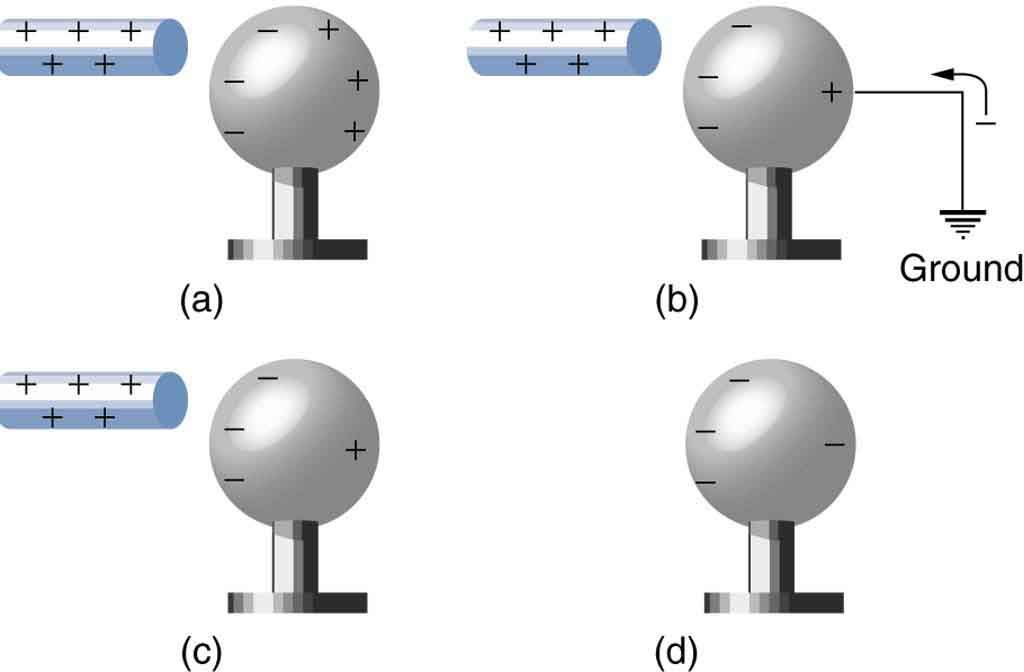
- Excess charge on a conductor always moves to the outer surface.
- The electric field inside a conductor is zero under electrostatic equilibrium.
- Charge density is highest where the surface curves most sharply (smallest radius of curvature). This is why lightning rods work: the sharp tip concentrates charge and creates a strong local field.
- When two conductors are connected, charge flows between them until they reach the same electric potential (electrostatic equilibrium).
A Faraday cup uses these charge distribution principles to detect and measure charged particles.
Polarization in insulators
Even though charges in an insulator can't flow freely, an external electric field still affects them. The field causes a slight displacement of bound charges within molecules, a process called dielectric polarization.
This polarization creates an internal electric field that partially opposes the applied field. There are three main types:
- Electronic polarization: the electron cloud shifts relative to the nucleus
- Ionic polarization: positive and negative ions shift in opposite directions
- Orientational polarization: polar molecules rotate to align with the field
The dielectric constant (relative permittivity, ) quantifies how effectively a material polarizes. Placing a dielectric in a capacitor increases its capacitance by a factor of .
Applications in electronics
Wires and cables
- Copper wires are the standard for power and signal transmission
- Coaxial cables use a central conductor surrounded by insulation and an outer conductive shield to minimize electromagnetic interference
- Fiber optic cables guide light through glass or plastic cores using total internal reflection for high-speed data
- Stranded wires are more flexible than solid wires, better for applications with repeated bending
- Insulation material is chosen based on voltage rating, operating temperature, and environmental exposure
Circuit board materials
- FR-4 (fiberglass-reinforced epoxy) is the most common insulating substrate for printed circuit boards (PCBs)
- Copper foil is etched into conductive traces that connect components
- Solder mask is an insulating layer that prevents accidental short circuits between traces
- Ceramic substrates handle high-frequency and high-temperature applications
- Polyimide films enable flexible PCBs that can bend without breaking
Capacitor dielectrics
The insulating material between a capacitor's plates determines its performance:
- Ceramic capacitors: use materials like barium titanate for high capacitance in small packages
- Electrolytic capacitors: use thin oxide layers as dielectrics for very high capacitance values
- Film capacitors: use polymer dielectrics (polypropylene, polyester) for stability and low losses
- Vacuum capacitors: use empty space as the dielectric for high-power RF applications
The dielectric strength of the insulator sets the maximum voltage the capacitor can handle.
Electromagnetic shielding
Electromagnetic shielding blocks unwanted electric and magnetic fields from reaching sensitive electronics (or prevents signals from leaking out). Conductors and insulators each play a role.
Faraday cages
A Faraday cage is a conductive enclosure that blocks external electric fields. It works because the electric field inside a conductor is zero under electrostatic conditions, and the free charges in the cage rearrange to cancel any external field.
- Effectiveness depends on the conductivity and thickness of the walls
- Any openings or gaps reduce shielding performance (the waveguide effect)
- Real-world examples: microwave ovens, EMI test chambers, and shielded rooms for sensitive equipment
Electromagnetic interference protection
- Conductive coatings on plastic enclosures provide EMI shielding for consumer electronics
- Metallic mesh screens block electromagnetic waves while still allowing airflow
- Ferrite beads and chokes suppress high-frequency noise on cables
- Multilayer shielding combines conductive and absorptive materials for broadband protection
- Conductive gaskets at enclosure seams maintain shielding continuity
Grounding and bonding
- Grounding creates a low-impedance path for fault currents and EMI to dissipate safely
- Bonding connects multiple ground points to equalize potential and reduce ground loops
- Star grounding topology minimizes common impedance coupling between circuits
- Ground planes in PCBs provide low-inductance return paths for high-frequency signals
- Isolated grounds keep sensitive analog circuits separate from noisy digital circuits
Thermal properties
Thermal and electrical conductivity are closely linked. Materials that conduct electricity well tend to conduct heat well too, and for the same reason: free electrons.
Heat conduction in metals
The Wiedemann-Franz law states that the ratio of thermal conductivity to electrical conductivity is proportional to temperature for metals. Free electrons carry both charge and thermal energy, so good electrical conductors are also good thermal conductors.
- Copper's thermal conductivity:
- Heat sinks exploit high thermal conductivity to pull heat away from electronic components
- Thermal interface materials (pastes, pads) improve heat transfer between surfaces
- Some materials like graphite sheets have anisotropic thermal conductivity, conducting heat much better in one direction than another
Thermal insulators
Materials with low thermal conductivity slow heat transfer:
- Fiberglass:
- Aerogels: , thanks to their nanoporous structure
- Foam and air gaps work by trapping pockets of still air
- Reflective materials (aluminized Mylar) reduce radiative heat transfer
- Vacuum insulated panels minimize both conduction and convection
Thermoelectric effects
Three related effects connect temperature differences and electric current:
- Seebeck effect: A temperature difference across a junction of two dissimilar metals generates a voltage. This is how thermocouples work.
- Peltier effect: Running current through a junction of two different conductors causes one side to heat up and the other to cool down. This is the basis for thermoelectric coolers.
- Thomson effect: A single conductor with both current flow and a temperature gradient will absorb or release heat.
Thermoelectric generators use semiconductor materials to convert waste heat directly into electricity, while Peltier devices provide solid-state cooling for electronics.
Optical properties
How materials interact with light depends directly on their electronic structure.
Reflection in metals
Metals are highly reflective because their free electrons can oscillate in response to incoming electromagnetic waves and re-emit the light. Reflectance generally increases with wavelength, approaching nearly 100% in the infrared.
- Skin depth determines how far electromagnetic waves penetrate into the metal (typically just nanometers for visible light)
- Plasmon resonance occurs when the frequency of incident light matches the natural oscillation frequency of the free electron gas
- Metallic mirrors are used in telescopes, lasers, and other precision optical instruments
Transparency in insulators
An insulator is transparent to visible light if its band gap exceeds about , because visible light photons don't carry enough energy to excite electrons across the gap.
- Glass transmits visible light but absorbs ultraviolet and far-infrared
- Single crystals tend to be more transparent than polycrystalline materials because grain boundaries scatter light
- Doping can introduce color centers that absorb specific wavelengths (ruby is doped with chromium)
- Anti-reflective coatings reduce surface reflections to improve light transmission
Optoelectronic applications
- Photodiodes convert light into current using semiconductor junctions
- LEDs produce light through electroluminescence in semiconductor p-n junctions
- Optical fibers guide light via total internal reflection in high-purity glass or plastic
- Photovoltaic cells convert sunlight to electricity using semiconductors
- LCDs control light transmission through electrically manipulated liquid crystals
See Fiveable more often in Google
Mark Fiveable as a preferred source and Google is more likely to show you our guides in Top Stories, with a "preferred" badge in AI Mode and AI Overviews.