5.3 Series circuits

🎢Principles of Physics II Unit 5 Review
5.3 Series circuits
🎢 Principles of Physics II
Fundamentals of Series Circuits
A series circuit connects components end-to-end along a single path, so current flows through each one sequentially without branching. This is the simplest circuit configuration, and understanding how it behaves is the key to analyzing more complex DC circuits later.
Definition of Series Circuits
A series circuit has one defining feature: there's only a single loop for current to travel through. Every component sits along that loop, one after another.
- Current flows through each component sequentially, with no branching points
- The total voltage of the source equals the sum of the voltage drops across all components
- The order of components doesn't matter for calculating total resistance or current
Components in Series
Resistors are the most common series components you'll encounter in this course, but capacitors, inductors, and other elements can also be wired in series. Each component adds to the total opposition the circuit presents to current flow.
Batteries can be connected in series too, with the positive terminal of one connecting to the negative terminal of the next. This increases the total voltage available to the circuit. A flashlight with two 1.5 V batteries in series, for example, supplies 3.0 V.
Current in Series Circuits
Constant Current Principle
This is the single most important fact about series circuits: current is the same everywhere. Every component in the loop carries the same current, because there's nowhere else for charge to go. If 0.5 A flows out of the battery, then 0.5 A flows through every resistor, every wire, and every connection in that circuit.
This follows directly from conservation of charge. Charge can't pile up at any point or disappear, so the flow rate must be constant throughout the single path.
Current Measurement
To measure current, you connect an ammeter in series with the circuit so that all the current passes through it. You can also calculate current using Ohm's Law:
where is the total source voltage and is the total resistance of the circuit.
Voltage in Series Circuits
Voltage Division Rule
While current stays the same everywhere, voltage gets split up among the components. Each component "uses" a fraction of the total voltage proportional to its share of the total resistance. The voltage across any component is:
A component with a larger resistance gets a larger share of the voltage. For example, in a circuit with a 12 V battery and two resistors (, ), the 8 Ω resistor gets twice the voltage drop (8 V) compared to the 4 Ω resistor (4 V).
Voltage Drops Across Components
The sum of all individual voltage drops equals the source voltage. This is a direct consequence of energy conservation: every joule of energy the battery provides must be used up by the components.
If your voltage drops don't add up to the source voltage, something is wrong with your calculation or your circuit.
Resistance in Series Circuits
Total Resistance Calculation
Finding total resistance in a series circuit is straightforward: just add them up.
Every resistor you add increases the total resistance, which in turn decreases the current (for a fixed voltage source). Three resistors of 10 Ω, 20 Ω, and 30 Ω in series give .
Equivalent Resistance
The equivalent resistance is a single resistor value that could replace the entire series combination without changing the circuit's behavior. The current from the source and the total voltage would remain the same. This concept is useful for simplifying circuits before solving them: replace a chain of series resistors with one equivalent value, then apply Ohm's Law.
Power in Series Circuits
Power Distribution Among Components
Total power consumed by the circuit equals the sum of power consumed by each component:
Since current is the same through every component, the component with the highest resistance dissipates the most power. This matters for practical design because higher power dissipation means more heat.
Power Calculation Methods
You have three equivalent formulas for power, and which one you use depends on what quantities you already know:
- From voltage and current:
- From current and resistance:
- From voltage and resistance:
A quick example: if a 20 Ω resistor carries 0.5 A of current, it dissipates .
Analysis of Series Circuits
Kirchhoff's Voltage Law (KVL)
Kirchhoff's Voltage Law states that the sum of all voltages around any closed loop equals zero:
In practice, this means you walk around the loop, adding voltage gains (across sources) and subtracting voltage drops (across resistors). The result must be zero. For a single-loop series circuit with a battery of voltage and two resistors:
This gives you an equation you can solve for the unknown current or component values.
Loop Equations
For circuits with a single loop, KVL gives you one equation, which is usually enough to solve for the unknown. The steps are:
- Choose a direction to trace around the loop (clockwise or counterclockwise).
- Assign a current direction. If you guess wrong, the answer will just come out negative.
- Write voltage gains as positive and voltage drops as negative (or vice versa, as long as you're consistent).
- Set the sum equal to zero and solve.
For multi-loop circuits (covered more in later sections), you'll write one loop equation per loop and solve them simultaneously.
Applications of Series Circuits

Voltage Dividers
A voltage divider is one of the most practical uses of a series circuit. Two resistors in series with a voltage source produce a lower output voltage at the point between them. If you need 3.3 V from a 5 V source, you can choose resistor values whose ratio gives you that fraction.
Voltage dividers show up in sensor circuits (converting resistance changes to voltage signals), power supplies, and signal conditioning for analog-to-digital converters.
String Lights
Traditional holiday string lights are a classic series circuit example. All the bulbs share the same current, so they glow equally. The tradeoff: if one bulb burns out and creates an open circuit, the entire string goes dark because the single current path is broken. Modern LED string lights often incorporate parallel paths to avoid this problem.
Advantages vs. Disadvantages
Benefits of Series Circuits
- Simple to wire and understand
- Current is guaranteed to be equal through all components
- Adding a single switch controls the entire circuit
- Useful for current limiting and voltage division
- Connecting battery cells in series increases total voltage (e.g., stacking 1.5 V cells for higher-voltage applications)
Limitations of Series Circuits
- One failed component (open circuit) shuts down the whole circuit
- Total resistance grows with each added component, reducing current
- Components with different voltage or current requirements are hard to accommodate
- Adding or removing a component changes the voltage and current for every other component in the circuit
Troubleshooting Series Circuits
Common Faults
- Open circuits: A loose connection or burned-out component breaks the single current path, stopping all current flow
- Short circuits: Insulation failure or incorrect wiring bypasses a component, reducing total resistance and potentially causing dangerous overcurrent
- Incorrect component values: A wrong resistor value throws off the voltage division and current for the entire circuit
- Power supply issues: Insufficient voltage or a dying battery can cause all components to underperform
Diagnostic Techniques
- Visual inspection for obvious damage, loose wires, or burnt components.
- Voltage measurements across each component. An open component will have the full source voltage across it; a shorted component will have zero volts.
- Current measurement to check whether current is flowing at all and at the expected value.
- Resistance measurements (with the circuit powered off) to verify individual component values and check for breaks in the path.
Series Circuits in Complex Systems
Combination with Parallel Circuits
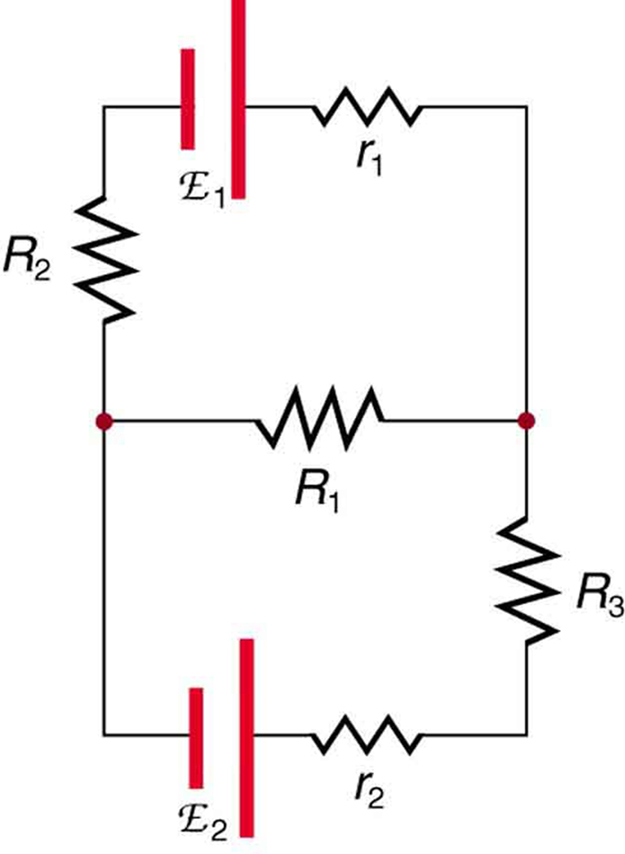
Most real circuits are neither purely series nor purely parallel. Series-parallel circuits combine both configurations to take advantage of each. For example, a voltage divider (series) might feed into a parallel load. Analyzing these circuits requires you to identify which portions are in series and which are in parallel, simplify step by step, and then work backward to find individual voltages and currents.
Multi-Loop Circuit Analysis
When circuits have multiple loops, you apply Kirchhoff's laws systematically. Two common techniques are:
- Mesh analysis: Assign a current variable to each loop and write a KVL equation for each. Solve the resulting system of equations.
- Node voltage analysis: Identify junction points (nodes), assign voltage variables, and use Kirchhoff's current law to write equations at each node.
Both methods reduce a complex circuit to a set of algebraic equations. These techniques build directly on the single-loop series analysis covered in this unit.
See Fiveable more often in Google
Mark Fiveable as a preferred source and Google is more likely to show you our guides in Top Stories, with a "preferred" badge in AI Mode and AI Overviews.