3.7 Improper Integrals

➗Calculus II Unit 3 Review
3.7 Improper Integrals
➗ Calculus II
Improper integrals extend the idea of definite integration to cases where the interval is infinite or the integrand blows up. They show up constantly in later courses (probability, differential equations, physics), so getting comfortable with the limit-based evaluation technique here pays off.
Improper Integrals
There are two reasons an integral becomes "improper":
- Infinite limits of integration: The interval stretches to or (or both), such as .
- Unbounded integrand: The function has a vertical asymptote somewhere in , such as where the integrand blows up at .
The core strategy is the same for both: replace the problematic piece with a variable, evaluate a proper definite integral, then take a limit.
Type 1: Infinite Limits of Integration
For an integral like , you can't plug in directly. Instead, replace the infinite bound with a variable and take a limit.
Definitions:
for any real number (both pieces must converge independently).
Example: Evaluate .
- Replace the upper bound:
- Integrate:
- Evaluate the limit: , so the result is . The integral converges to .
Example: Evaluate .
-
Replace the lower bound:
-
Integrate:
-
Evaluate the limit: as , so the result is . Converges to .
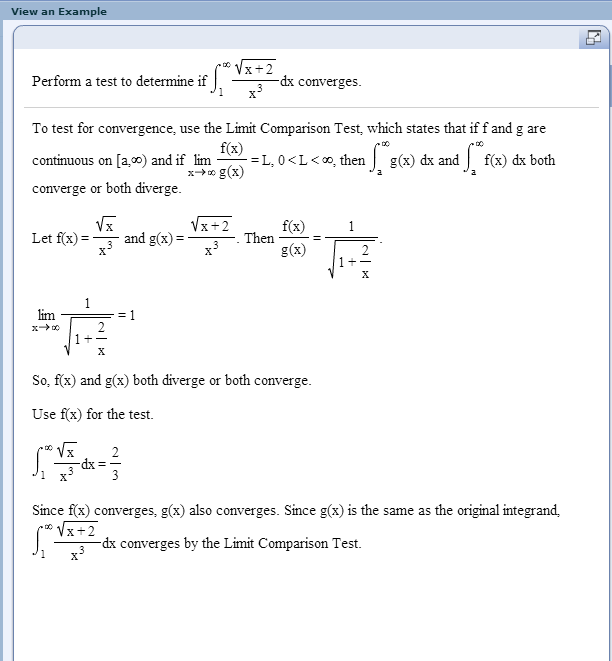
Type 2: Unbounded Integrand (Vertical Asymptote)
If has a vertical asymptote at some point in (or at an endpoint of) the interval, you approach that point with a limit.
- Asymptote at the left endpoint :
- Asymptote at the right endpoint :
- Asymptote at an interior point : Split into two integrals at and evaluate each with its own limit. Both must converge for the whole integral to converge.
Example: Evaluate .
The integrand blows up at (left endpoint).
-
Replace the lower bound:
-
Integrate:
-
Evaluate the limit: , so the result is . Converges to .
Example: Evaluate .
The integrand has a vertical asymptote at , which is inside the interval. You must split here.
- Split:
- Evaluate the first piece:
Since the first piece diverges, the entire integral diverges. You don't even need to check the second piece.
A common mistake: treating as a regular integral and getting a negative answer. Always check for vertical asymptotes inside the interval before integrating.
Convergence and Divergence
- An improper integral converges if the relevant limit(s) exist and are finite.
- It diverges if any required limit fails to exist or is infinite.
- For integrals split into multiple pieces (Type 2 with interior asymptote, or ), every piece must converge independently. If even one diverges, the whole integral diverges.
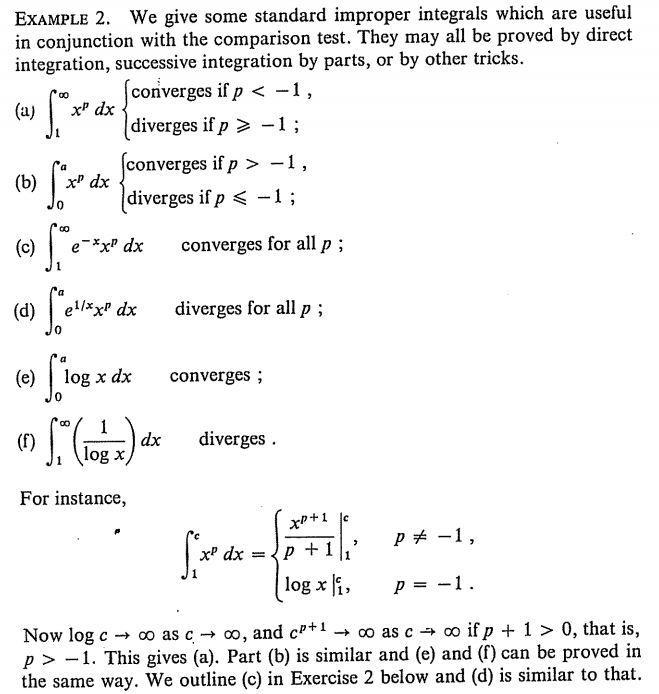
The p-test for : This is a reference result worth memorizing.
- Converges when
- Diverges when
For example, converges (), but diverges (). The p-test is also the go-to comparison function for the Comparison Theorem below.
Comparison Theorem for Convergence
Sometimes you can't find an antiderivative, but you still need to determine whether an integral converges or diverges. The Comparison Theorem lets you do this by comparing to a simpler function.
Comparison Theorem: Suppose for all . Then:
- If converges, then also converges. (Smaller than something finite is finite.)
- If diverges, then also diverges. (Bigger than something infinite is infinite.)
How to apply it:
- Identify a simpler function that bounds from above (to prove convergence) or from below (to prove divergence), and whose integral you already know converges or diverges.
- Verify the inequality (or ) on the interval.
- Evaluate or cite the convergence/divergence of the comparison integral.
- State your conclusion.
Example: Does converge or diverge?
- For : , so . Choose .
- We have for all .
- converges by the p-test ().
- By the Comparison Theorem, converges.
Watch the direction of the inequality. If you want to prove convergence, you need your function to be less than or equal to something that converges. If you want to prove divergence, you need it to be greater than or equal to something that diverges. Comparing in the wrong direction tells you nothing.
See Fiveable more often in Google
Mark Fiveable as a preferred source and Google is more likely to show you our guides in Top Stories, with a "preferred" badge in AI Mode and AI Overviews.