2.3 Volumes of Revolution: Cylindrical Shells

➗Calculus II Unit 2 Review
2.3 Volumes of Revolution: Cylindrical Shells
➗ Calculus II
2.1
Areas between Curves
2.2
Determining Volumes by Slicing
2.3
Volumes of Revolution: Cylindrical Shells
2.4
Arc Length of a Curve and Surface Area
2.5
Physical Applications
2.6
Moments and Centers of Mass
2.7
Integrals, Exponential Functions, and Logarithms
2.8
Exponential Growth and Decay
2.9
Calculus of the Hyperbolic Functions
Volumes of Revolution: Cylindrical Shells
Volumes of revolution let you calculate the volume of 3D solids formed by rotating a 2D region around an axis. The cylindrical shells method is especially useful when the disk/washer approach leads to difficult integrals or when the region doesn't touch the axis of rotation.
This section covers how the shell method works, when to choose it over disks or washers, and how to handle trickier rotations around non-coordinate axes.

Top images from around the web for Application of cylindrical shells method
Volumes of Revolution: Cylindrical Shells · Calculus View original
Is this image relevant?
Volumes of Revolution: Cylindrical Shells · Calculus View original
Is this image relevant?
Volumes of Revolution: Cylindrical Shells · Calculus View original
Is this image relevant?
Volumes of Revolution: Cylindrical Shells · Calculus View original
Is this image relevant?
Volumes of Revolution: Cylindrical Shells · Calculus View original
Is this image relevant?
The Cylindrical Shells Method
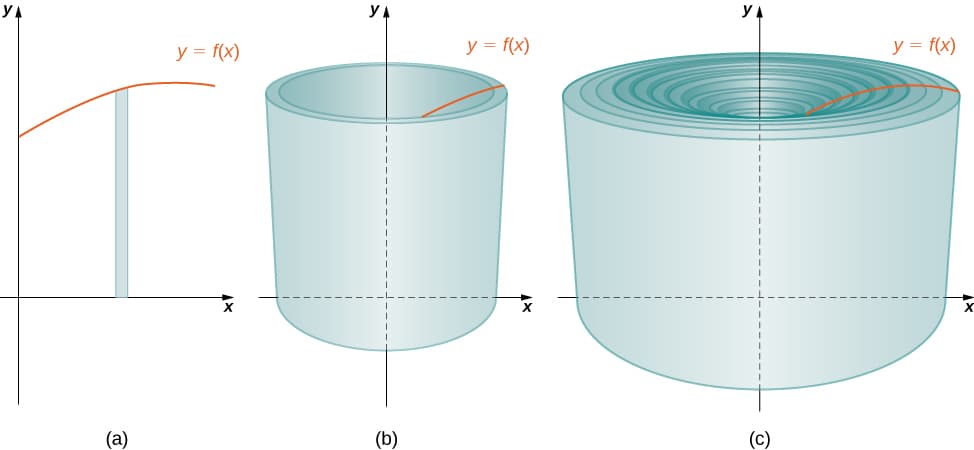
The shell method works by slicing the region into thin vertical (or horizontal) strips. When you rotate one of these strips around the axis, it sweeps out a thin cylindrical shell, like a hollow tube.
The volume of a single shell comes from "unrolling" it into a flat slab:
- Surface area of the shell: , where is the distance from the strip to the axis of rotation and is the height of the strip (determined by the bounding functions)
- Thickness of the shell: or , depending on the variable of integration
You then integrate to sum up all the shells across the region:
- Rotation around the y-axis (vertical axis), integrating with respect to :
Here is the radius (distance from each strip to the y-axis) and is the height.
- Rotation around the x-axis (horizontal axis), integrating with respect to :
Here is the radius and is the width of each horizontal strip.
Setting Up a Shell Integral: Step by Step
- Sketch the region and identify the axis of rotation.
- Draw a representative strip parallel to the axis of rotation. (This is the opposite of disks/washers, where strips are perpendicular.)
- Determine the radius : the distance from the strip to the axis of rotation.
- Determine the height : the length of the strip, found from the bounding function(s). If two functions bound the region, (top minus bottom) or the analogous expression in .
- Write the integral: (or ).
- Identify the limits of integration from where the region starts and ends along your variable.
Comparison of Volume Methods
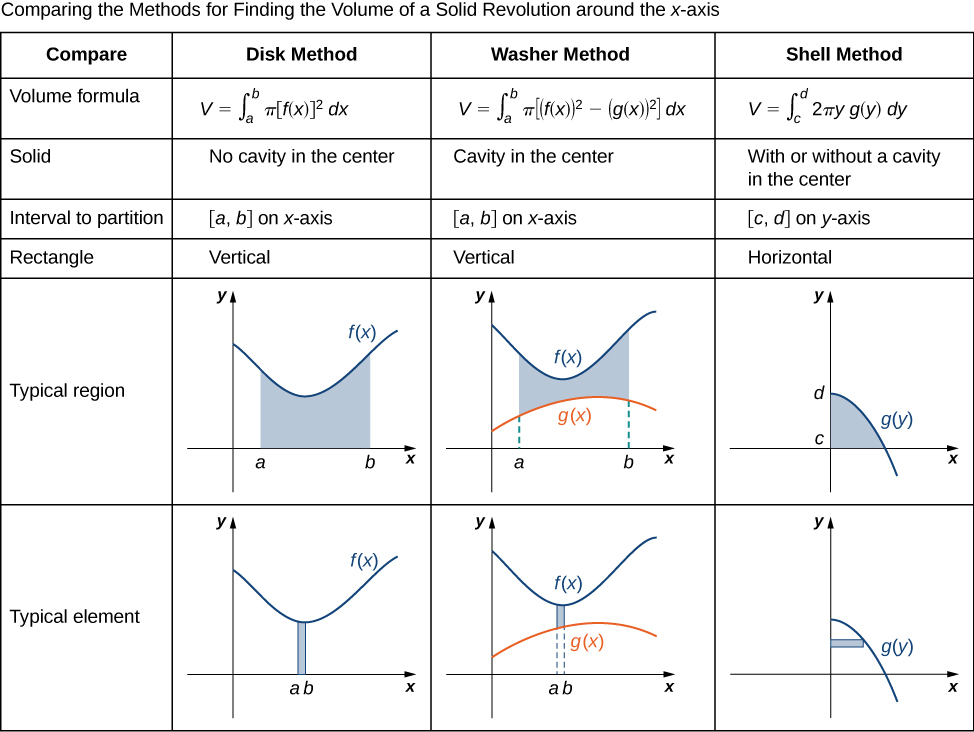
All three methods compute the same volumes, but each has situations where it's the most natural choice.
| Method | Slice orientation | Volume element | Best used when... |
|---|---|---|---|
| Disk | Perpendicular to axis | or | Region is bounded on one side by the axis of rotation |
| Washer | Perpendicular to axis | or | Region is bounded by two functions with a gap between the inner boundary and the axis |
| Shell | Parallel to axis | or | See below |
The shell method tends to be the better choice when:
- The disk/washer setup would force you to solve for in terms of (or vice versa), creating a messier integral.
- The region is bounded by two functions and neither touches the axis of rotation, which would make the washer radii awkward to express.
- The axis of rotation is a line like or rather than a coordinate axis.
A good rule of thumb: if your representative strip is easier to draw parallel to the axis of rotation, shells will likely give you a cleaner integral. If it's easier to draw perpendicular, try disks or washers.
Volumes from Complex Rotations

Regions Bounded by Multiple Functions
When the region is defined by more than one function:
- Find intersection points of the bounding curves. These typically set your limits of integration.
- Check whether one function stays on top across the entire interval. If the "top" and "bottom" functions switch, split the region into subregions at the crossover points.
- Set up a separate integral for each subregion, then add the results for the total volume.
Rotation Around a Non-Coordinate Axis
When the axis of rotation is a line like or instead of the x- or y-axis, the setup is nearly the same. The only change is how you express the radius:
- Rotation around the vertical line : the shell radius becomes
- Rotation around the horizontal line : the shell radius becomes
For example, rotating the region under from to around the line gives:
Notice the radius is because each shell sits to the left of the axis at . Always think about which direction the distance goes and whether you need or to keep the radius positive over your interval.
Key Concepts to Remember
- Integration sums infinitely many thin shells (or disks/washers) to produce an exact volume.
- Revolution means rotating a flat region around an axis to generate a 3D solid. The cross-sections are always circular.
- The differential element ( or ) represents the thickness of each infinitesimally thin shell.
- For shells, you're computing for each element. For disks/washers, you're computing (or ). Both approaches rely on the same underlying idea of summing thin slices.
- The most common mistake is mixing up the strip orientation. Shells use strips parallel to the axis; disks and washers use strips perpendicular to it.
See Fiveable more often in Google
Mark Fiveable as a preferred source and Google is more likely to show you our guides in Top Stories, with a "preferred" badge in AI Mode and AI Overviews.