2.7 Integrals, Exponential Functions, and Logarithms

➗Calculus II Unit 2 Review
2.7 Integrals, Exponential Functions, and Logarithms
➗ Calculus II
2.1
Areas between Curves
2.2
Determining Volumes by Slicing
2.3
Volumes of Revolution: Cylindrical Shells
2.4
Arc Length of a Curve and Surface Area
2.5
Physical Applications
2.6
Moments and Centers of Mass
2.7
Integrals, Exponential Functions, and Logarithms
2.8
Exponential Growth and Decay
2.9
Calculus of the Hyperbolic Functions
Natural Logarithms and Exponential Functions
The natural logarithm and the exponential function form the backbone of most integration techniques you'll encounter in Calculus II. The natural log gives us a way to integrate , and is its own antiderivative. These two facts alone unlock a huge number of problems.

Top images from around the web for Definition of natural logarithm
Logaritmo - Logarithm - qaz.wiki View original
Is this image relevant?
Natural logarithm - Wikipedia View original
Is this image relevant?
Natural logarithm - Wikipedia View original
Is this image relevant?
Logaritmo - Logarithm - qaz.wiki View original
Is this image relevant?
Natural logarithm - Wikipedia View original
Is this image relevant?
Definition of the Natural Logarithm
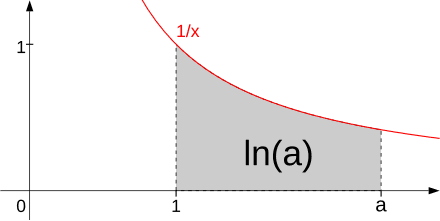
The natural logarithm is defined as an integral:
This means equals the area under the curve from to . That's not just a property; it's the definition you'll use to derive everything else.
The base of the natural logarithm is Euler's number , defined as the unique number satisfying . Equivalently, arises from the limit:
The natural exponential function and natural logarithm are inverse functions, so they undo each other:
- for
- for all
Differentiation and Antidifferentiation Rules
These four results come up constantly:
| Function | Derivative | Antiderivative |
|---|---|---|
| $$\int \frac{1}{x}, dx = \ln |
Notice the absolute value in . That's there because is defined for negative too, but only accepts positive inputs. The absolute value extends the antiderivative to both sides of the domain.
The fact that is its own derivative (and its own antiderivative) is what makes it unique. No other function has this property.
Properties for Simplifying Integrals
Before integrating, you'll often need to rewrite expressions using these properties.
Logarithm properties:
- Product rule:
- Quotient rule:
- Power rule:
Exponential properties:
These aren't just algebra review. You'll actively use the power rule, for instance, to pull exponents out front before integrating, and the product/quotient rules to split complicated logarithmic expressions into simpler pieces.

Converting Between Bases
Most calculus work uses base , so you need to convert other bases before differentiating or integrating.
Change of base formula for logarithms:
Since is just a constant, this turns any base- logarithm into a constant times , which you already know how to handle.
Converting general exponentials:
This works because , so . Once it's in the form , you can integrate using the standard rule .
Integration Techniques and Applications
Integration of Logarithmic and Exponential Expressions
Substitution is your first tool to try. A few common patterns:
- If you see , substitute . The integral becomes .
- If the exponent of is a function of , try substituting equal to that exponent. For example, in , let .
Integration by parts handles products where substitution doesn't simplify things. Here are two essential examples:
Example 1:
- Let and
- Then and
- Apply the formula :
Example 2:
- Let and
- Then and
- Apply the formula:
The trick with is recognizing that you should set . There's no obvious "second function," but integration by parts still works.

Behavior of Logarithmic and Exponential Functions
Understanding the graphs helps you check whether your answers make sense.
- : Domain , range . Increasing for all , but slowly. Vertical asymptote at . Passes through .
- : Domain , range . Always increasing and always positive. Horizontal asymptote at as . Passes through .
Since grows faster than any polynomial and grows slower than any polynomial, limits involving these functions often produce indeterminate forms like or . L'Hôpital's rule resolves these by differentiating the numerator and denominator separately.
Applications of Logarithmic and Exponential Integrals
Exponential growth and decay models take the form , where is the initial quantity and is the growth () or decay () rate. Integrating this function over an interval gives the total accumulated quantity. For example, gives the total output over the first 10 time units.
These integrals appear in population growth, radioactive decay, continuously compounded interest, and Newton's law of cooling.
Fundamental Theorem of Calculus and Types of Integrals
Fundamental Theorem of Calculus
The FTC connects differentiation and integration, and both parts are directly relevant to working with and .
Part 1 (FTC1): If , then . The derivative of a definite integral with respect to its upper limit equals the integrand evaluated at that limit. This is exactly how we know , since is defined as .
Part 2 (FTC2): If is any antiderivative of , then . This is the evaluation theorem you use every time you compute a definite integral.
Types of Integrals
- Indefinite integrals represent the general antiderivative: . The accounts for the family of all antiderivatives.
- Definite integrals compute the signed area between the function and the -axis over . You evaluate them using FTC2: find an antiderivative, then compute .
See Fiveable more often in Google
Mark Fiveable as a preferred source and Google is more likely to show you our guides in Top Stories, with a "preferred" badge in AI Mode and AI Overviews.