8.3 Finite time ruin probabilities and Laplace transforms

📊Actuarial Mathematics Unit 8 Review
8.3 Finite time ruin probabilities and Laplace transforms
📊 Actuarial Mathematics
Definition of finite time ruin probabilities
The finite time ruin probability, denoted , measures the likelihood that an insurer's surplus drops below zero within a specified time horizon , given an initial surplus . This is distinct from the infinite time ruin probability , which considers ruin over an unbounded horizon. Since for all , the infinite time probability serves as a natural upper bound.
Finite time ruin probabilities are harder to compute than their infinite time counterparts, but they're far more practical. Regulators and risk managers care about specific planning horizons (one year, five years), not abstract infinite futures. The trade-off is that the mathematics becomes significantly more involved, which is where Laplace transforms come in.

Top images from around the web for Compound Poisson risk model
Subordinated compound Poisson processes of order k View original
Is this image relevant?
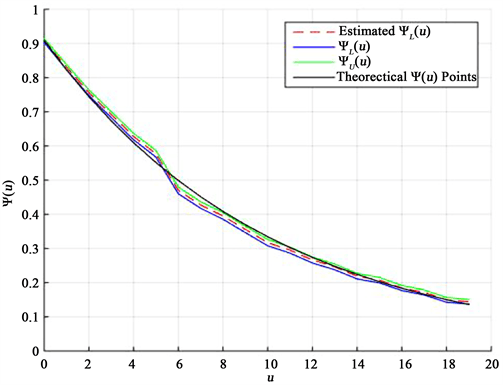
Comparison of Ruin Probabilities in Compound Poisson Risk Model View original
Is this image relevant?
Properties of Poisson processes directed by compound Poisson-Gamma subordinators View original
Is this image relevant?
Subordinated compound Poisson processes of order k View original
Is this image relevant?
Comparison of Ruin Probabilities in Compound Poisson Risk Model View original
Is this image relevant?
Derivation of finite time ruin probabilities
Compound Poisson risk model
The standard framework is the compound Poisson risk model (also called the classical Cramér-Lundberg model). The insurer's surplus at time is:
where:
- is the initial surplus
- is the premium rate (constant, collected continuously)
- is a Poisson process with rate , counting the number of claims up to time
- are i.i.d. claim sizes with distribution function
The surplus starts at , grows linearly from premiums, and drops randomly as claims arrive. Ruin occurs the first time .
For the model to be viable, the net profit condition must hold: . Premiums must exceed expected claims on average, otherwise ruin is certain.
Adjustment coefficient in finite time ruin
The adjustment coefficient (or Lundberg exponent) is the unique positive root of:
This equation balances the moment generating function of claims against the premium inflow. exists and is unique provided the net profit condition holds and the moment generating function exists in a neighborhood of zero.
The adjustment coefficient controls how fast ruin probabilities decay as initial surplus increases. A larger means ruin probabilities decrease more rapidly with surplus, indicating a safer portfolio. While features most directly in infinite time bounds, it also appears in finite time approximations and bounding arguments.
Laplace transforms in ruin theory
Definition and properties of Laplace transforms
The Laplace transform of a function is:
The key properties relevant to ruin theory are:
- Linearity:
- Convolution:
- Differentiation:
The reason Laplace transforms matter here is that finite time ruin probabilities satisfy integro-differential equations that are very difficult to solve directly. The Laplace transform (taken with respect to either or ) converts these into algebraic equations in the transform variable , which are far more tractable.
Bromwich integral for inverse Laplace transforms
Once you have the Laplace transform of the ruin probability, you need to invert it to recover . The formal inversion is given by the Bromwich integral:
The constant must be chosen so that all singularities of lie to the left of the vertical contour . In practice, this integral is rarely computed analytically. Instead, numerical inversion methods approximate it (covered below).
Laplace transform of finite time ruin probabilities

Laplace transform of the Poisson process
For a Poisson process with rate , the Laplace transform of its probability generating structure yields:
This feeds into the transform of the aggregate claims process, since the number of claims follows the Poisson process.
Laplace transform of aggregate claims distribution
The aggregate claims up to time are . For the compound Poisson model, the Laplace transform of (with respect to the claim size variable) is:
This result follows from the compound Poisson structure: conditioning on and using the independence and identical distribution of the . The exponential form makes it much easier to work with than the raw convolution of claim size distributions.
Relationship between Laplace transforms and ruin probabilities
Pollaczek-Khinchine formula for Laplace transforms
The Pollaczek-Khinchine formula connects the Laplace transform of the ruin probability (with respect to initial surplus ) to the claim size distribution. For the compound Poisson model:
This formula arises from representing the maximal aggregate loss as a geometric compound distribution. The ruin probability can be written as the tail of this compound geometric, and taking Laplace transforms produces the algebraic expression above.
Note that this formula applies to the infinite time ruin probability . For finite time probabilities , you typically take a double transform (in both and ) and then perform numerical inversion with respect to .
Laplace transforms vs generating functions
- Laplace transforms are the natural tool for continuous-time risk models (like the compound Poisson model discussed here).
- Generating functions (probability generating functions or moment generating functions) serve an analogous role for discrete-time models.
Both convert convolutions into products and integro-differential equations into algebraic ones. If you encounter a discrete-time surplus model (e.g., claims arriving at fixed intervals), generating functions are the appropriate tool. For continuous-time models, stick with Laplace transforms.
Numerical evaluation of finite time ruin probabilities
Closed-form expressions for exist only in special cases (e.g., exponentially distributed claims). For general claim size distributions, numerical methods are essential.
Inversion of Laplace transforms
The standard approach follows these steps:
- Derive the Laplace transform of with respect to (or a double transform in both variables).
- Evaluate at specific values of determined by the inversion algorithm.
- Approximate the Bromwich integral using a finite weighted sum.
Two widely used algorithms:
- Gaver-Stehfest method: Uses only real-valued evaluations of the transform. Straightforward to implement but can be sensitive to numerical precision.
- Talbot method: Deforms the Bromwich contour into a path that improves convergence. Generally more accurate but requires complex arithmetic.
Both methods avoid direct numerical integration of the oscillatory Bromwich integral, which would be computationally expensive and numerically unstable.

Fast Fourier Transform (FFT) for numerical inversion
The FFT provides an efficient alternative by exploiting the connection between Laplace transforms and Fourier transforms. The approach works as follows:
- Evaluate the Laplace transform along the imaginary axis (i.e., at for a grid of values), which gives a Fourier-type integral.
- Apply the FFT to compute the inverse Fourier transform on a discrete grid.
- Recover from the resulting values.
The FFT reduces computational complexity from to , making it practical to compute ruin probabilities on fine grids of and values simultaneously.
Upper and lower bounds for finite time ruin probabilities
When exact computation is impractical or when you need quick conservative estimates, bounds are valuable.
Lundberg's inequality for upper bounds
Lundberg's inequality states:
where is the adjustment coefficient. Since for any finite , this immediately gives:
This bound is conservative (it ignores the finite time restriction entirely), but it's simple and useful for quick assessments. The bound is tightest when is large relative to the claim arrival rate, since the finite and infinite time probabilities converge as .
De Vylder approximation for lower bounds
The De Vylder approximation replaces the original claim size distribution with an exponential distribution that matches the first three moments. Under this approximation:
where is the adjustment coefficient of the approximating exponential model.
This provides a tractable lower bound. Used together with Lundberg's upper bound, you get a range that brackets the true ruin probability. The De Vylder approximation tends to be quite accurate for moderate values of and , especially when the claim size distribution is not too heavy-tailed.
Applications of finite time ruin probabilities
Solvency capital requirements
Regulatory frameworks like Solvency II (EU) require insurers to hold enough capital so that the probability of ruin over a one-year horizon stays below a specified threshold (typically 0.5%, corresponding to a 99.5% confidence level).
The calculation proceeds as:
- Fix the time horizon (e.g., year) and the target ruin probability (e.g., ).
- Compute as a function of using the methods above.
- Solve for the minimum initial surplus such that .
This determines the Solvency Capital Requirement (SCR). Finite time ruin probabilities provide the mathematical foundation for these regulatory calculations.
Optimal reinsurance strategies
Reinsurance transfers part of the insurer's risk to a reinsurer, reducing the effective claim burden. Common contract types include:
- Proportional reinsurance: The reinsurer pays a fixed fraction of each claim. The insurer's effective claim sizes become .
- Excess-of-loss reinsurance: The reinsurer pays the portion of each claim exceeding a retention level . The insurer's effective claim sizes become .
Each type modifies the claim size distribution, which in turn changes the ruin probability. The optimization problem is to choose the reinsurance parameters ( or ) to minimize subject to the cost of the reinsurance premium. Finite time ruin probability models allow insurers to evaluate these trade-offs quantitatively over realistic planning horizons.
See Fiveable more often in Google
Mark Fiveable as a preferred source and Google is more likely to show you our guides in Top Stories, with a "preferred" badge in AI Mode and AI Overviews.