4.1 Mortality tables and life expectancy

📊Actuarial Mathematics Unit 4 Review
4.1 Mortality tables and life expectancy
📊 Actuarial Mathematics
Mortality tables estimate death and survival probabilities at various ages, forming the backbone of nearly every calculation in life contingencies. Whether you're pricing insurance, valuing pensions, or projecting populations, the work starts here. This section covers how these tables are built, the key functions they contain, and how to use them for life expectancy calculations.
Types of mortality tables
Not all mortality tables are the same. Different tables exist for specific populations, time periods, and insurance products. A table built from general population census data will look quite different from one built using insured lives data, because insured populations tend to be healthier (they passed underwriting).
The choice of table depends on two things: the purpose of your analysis and the characteristics of the group you're studying. Using the wrong table can lead to seriously mispriced products.

Top images from around the web for Data sources for mortality tables
Individual surgeon mortality rates: can outliers be detected? A national utility analysis | BMJ Open View original
Is this image relevant?
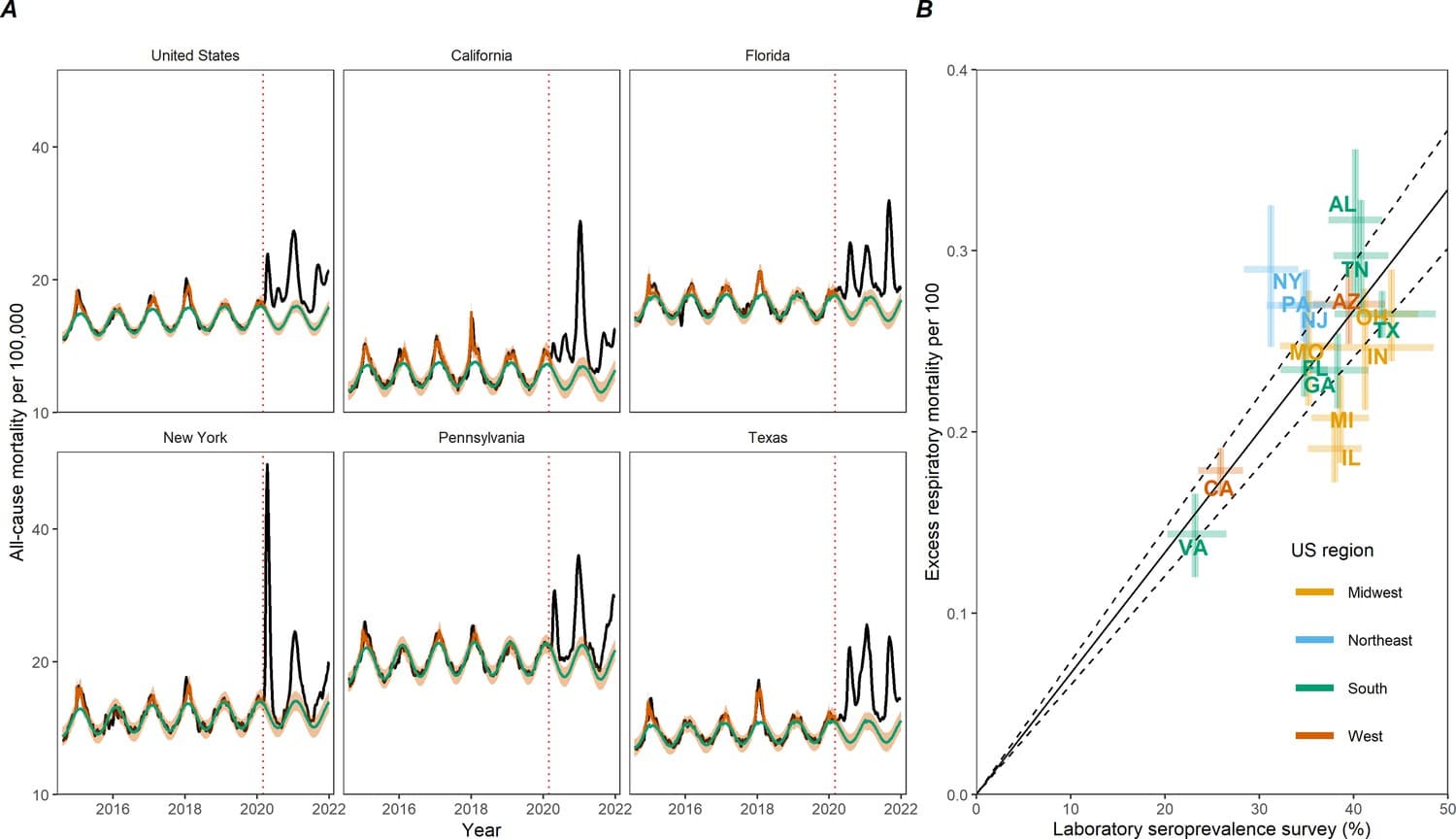
Direct and indirect mortality impacts of the COVID-19 pandemic in the United States, March 1 ... View original
Is this image relevant?
A composite metric for assessing data on mortality and causes of death: the vital statistics ... View original
Is this image relevant?
Individual surgeon mortality rates: can outliers be detected? A national utility analysis | BMJ Open View original
Is this image relevant?
Direct and indirect mortality impacts of the COVID-19 pandemic in the United States, March 1 ... View original
Is this image relevant?
Construction of mortality tables
Data sources for mortality tables
Mortality tables are constructed from data drawn from national vital statistics, insurance company records, and population censuses. At each age, you need two pieces of information: the number of deaths and the exposed-to-risk population (the number of people who could have died during the observation period at that age).
The quality and completeness of this data directly determines how accurate the final table will be. Incomplete death registration or inaccurate population counts will distort the resulting mortality rates.
Assumptions in mortality table construction
Several simplifying assumptions go into building a mortality table:
- Homogeneity: All individuals within the same age group share the same probability of death. In reality, health varies widely within an age group, but this assumption makes the math tractable.
- Constant mortality rates: The rates are assumed to stay fixed over the period the table covers. This is clearly a simplification, since mortality improves over time.
- Stationary population: The exposed-to-risk population has no net migration or shifts in age distribution during the observation period.
These assumptions rarely hold perfectly, which is why actuaries apply judgment and adjustments when using any table in practice.
Graduation techniques for mortality rates
Raw observed mortality rates tend to be jagged, especially at ages where data is sparse. Graduation is the process of smoothing these irregularities to produce a more reliable, consistent set of rates.
Common graduation techniques include:
- Moving average methods: Simple smoothing by averaging rates over neighboring ages
- Parametric models: Fitting a mathematical formula to the data. The Gompertz law () models mortality as exponentially increasing with age. The Makeham law () adds a constant term to capture age-independent causes of death (like accidents).
- Spline interpolation: Fitting piecewise polynomial curves for flexible, localized smoothing
The choice depends on data quality and how smooth you need the final rates to be.
Key functions in mortality tables
Probability of death
The probability of death, , is the likelihood that a person aged dies before reaching age . It's calculated as:
where is the number of deaths at age and is the number alive at age . This is the most fundamental quantity in any mortality table, and every other function builds on it.
Probability of survival
The probability of survival, , is the likelihood that a person aged survives to age . It's simply the complement of :
To find the probability of surviving multiple years, you multiply successive one-year survival probabilities. For example, the probability that a person aged survives to age is:
Force of mortality
The force of mortality, , is the instantaneous rate of mortality at exact age . Think of it as the continuous-time version of . Formally, it's defined as:
The relationship between and the one-year probability of death is:
If the force of mortality is constant over the year (i.e., for ), this simplifies to .
Curtate expectation of life
The curtate expectation of life, , is the expected number of complete (whole) years a person aged will live. It ignores the fractional year in which death occurs.
where is the limiting age of the table. You're summing up the probability of surviving each additional complete year.
Complete expectation of life
The complete expectation of life, , includes fractional years and gives the average total future lifetime for a person aged :
Under the uniform distribution of deaths (UDD) assumption, where deaths are spread evenly within each year of age, there's a convenient approximation:
The half-year addition accounts for the fact that, on average, a person who dies during a year of age dies roughly halfway through it.

Interpretation of mortality tables
Cohort vs period tables
- Cohort (generational) tables follow a specific group of people born in the same year from birth through death. They capture the actual mortality experience of that generation, including all the improvements that occurred over their lifetimes. The downside: you can't complete a cohort table until everyone in the cohort has died.
- Period (current) tables take a snapshot of mortality rates across all ages during a single time period (often a calendar year). They answer: "If today's mortality rates stayed frozen forever, how long would people live?"
Period tables are more practical for short-term pricing and are available immediately. Cohort tables are better for analyzing long-term mortality trends but require projections for anyone still alive.
Select vs ultimate tables
When someone buys life insurance, they go through underwriting (health screening). Right after underwriting, these individuals tend to have lower mortality than the general population because unhealthy applicants were screened out. This is the selection effect, and it wears off over time.
- Select tables capture this lower mortality during the initial years after underwriting. Mortality rates depend on both current age and time since selection: where is the age at selection and is years since.
- Ultimate tables apply after the selection effect has worn off (typically 2-5 years post-underwriting), at which point mortality depends only on current age.
In practice, insurers use select-and-ultimate tables that combine both periods for pricing products like term life insurance.
Life expectancy calculations
Life expectancy at birth
Life expectancy at birth, , is the average number of years a newborn is expected to live given the mortality rates in the table. It's the most widely cited summary statistic from any mortality table and serves as a broad indicator of population health.
Keep in mind that period-based life expectancy at birth doesn't predict how long today's newborns will actually live, because it assumes mortality rates won't change. In reality, mortality tends to improve over time, so actual lifespans usually exceed the period life expectancy.
Life expectancy at specific ages
Life expectancy can be calculated at any age using . For actuarial work, life expectancy at age 65 is particularly important because it drives retirement planning, pension valuations, and annuity pricing.
For example, if a period table shows years, that means a 65-year-old is expected to live an additional 20.1 years on average under current mortality conditions.
Trends in mortality and life expectancy
Historical changes in mortality rates
Mortality rates have declined substantially over the past century due to improvements in healthcare, sanitation, nutrition, and technology. The decline has been most dramatic at younger ages (largely from conquering infectious diseases), which has led to a compression of mortality: deaths increasingly cluster at older ages rather than being spread across the lifespan.
Understanding these historical patterns is critical for projecting future improvements and updating actuarial assumptions.
Factors affecting future mortality improvements
Several factors will shape how mortality continues to evolve:
- Medical advances: New treatments for cardiovascular disease, cancer, and neurodegenerative conditions could extend lifespans further
- Lifestyle changes: Declining smoking rates have already contributed to mortality improvement; rising obesity rates could partially offset future gains
- Socioeconomic conditions: Income inequality and uneven access to healthcare mean that mortality improvements don't affect all subgroups equally
Actuaries building long-term projections need to form a view on these factors, and different assumptions can lead to very different liability estimates for pensions and annuities.
Applications of mortality tables

Life insurance pricing
For life insurance, the key input from the mortality table is , the probability of death. Insurers estimate expected claims using these probabilities, then set premiums to cover expected payouts plus expenses and a profit margin.
Different products and underwriting classes call for different tables. A standard-risk 30-year-old buying term insurance will be priced off a select table, while a substandard-risk applicant might face loaded rates based on adjusted mortality assumptions.
Annuity pricing
Annuity pricing flips the focus from death to survival. Since annuities pay out as long as the annuitant is alive, the insurer needs values to estimate how long payments will continue. Longer expected lifetimes mean higher annuity prices.
Annuity tables typically show lighter mortality (lower death rates) than life insurance tables, because annuity purchasers tend to be healthier than average. Using a life insurance table to price annuities would underestimate liabilities.
Pension plan valuation
Actuaries use mortality tables to estimate how long pension plan members will live and, therefore, how much the plan will need to pay out. The present value of future pension obligations depends heavily on the mortality assumptions chosen.
Even small changes in mortality assumptions can shift pension liabilities by significant amounts. If a plan assumes members will live two years longer on average, the increase in liabilities can be substantial, potentially requiring changes to funding strategies.
Population projections and demographics
Mortality tables combine with fertility and migration data to project future population size and age structure. Governments and planners rely on these projections for healthcare infrastructure, social security funding, and labor market planning.
Comparing mortality tables
Across time periods
Comparing tables from different eras reveals how mortality has improved over time. These comparisons help actuaries quantify the pace of improvement and assess the impact of historical events like pandemics or wars on population mortality. Insurers also use time-period comparisons to decide when their pricing assumptions need updating.
Across populations and regions
Mortality varies significantly across countries and subpopulations. Comparing tables across regions can reveal disparities driven by healthcare access, environmental factors, and socioeconomic conditions. For insurers operating in multiple markets, these comparisons are essential for setting appropriate assumptions and managing risk exposure in each market.
Limitations of mortality tables
Data quality and reliability
The accuracy of any mortality table is only as good as the data behind it. Common data problems include underreporting of deaths, misclassification of cause of death, and errors in population estimates. Graduation techniques help smooth out noise, but they can't fix systematic biases in the underlying data. Actuaries must critically assess data quality before relying on any table.
Applicability to specific individuals
Mortality tables describe average population behavior. Any individual's actual mortality risk depends on personal factors like health status, family history, lifestyle, and genetics, none of which the table captures directly. This is why underwriting exists: it's the process of assessing how an individual deviates from the average and adjusting accordingly.
Impact of socioeconomic factors on mortality
Income, education, and occupation all correlate with mortality. General population tables may mask large differences between socioeconomic subgroups. For example, mortality rates among high-income professionals can be substantially lower than rates among lower-income manual workers of the same age. Actuaries may use specialized tables or apply adjustments to standard tables to account for these differences when the application demands it.
See Fiveable more often in Google
Mark Fiveable as a preferred source and Google is more likely to show you our guides in Top Stories, with a "preferred" badge in AI Mode and AI Overviews.