14.2 Climate Patterns and Environmental Vulnerabilities

🗺️World Geography Unit 14 Review
14.2 Climate Patterns and Environmental Vulnerabilities
🗺️ World Geography
Oceania's Climate Zones
Oceania spans a huge range of climates, from the consistently hot and humid tropics of the Pacific Islands to the subantarctic chill of islands near the Southern Ocean. Understanding these climate zones helps explain why different parts of the region face very different environmental challenges.

Top images from around the web for Tropical and Subtropical Zones
File:Australia-climate-map MJC01.png - Wikimedia Commons View original
Is this image relevant?
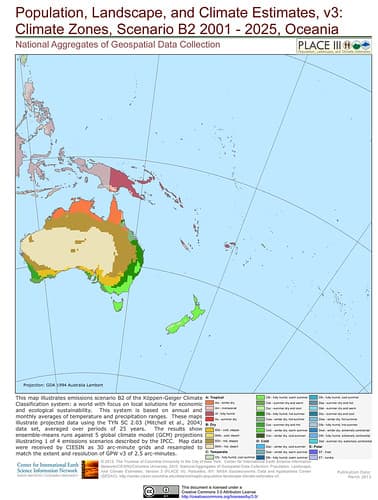
Climate Zones, Scenario B2 2001 - 2025, Oceania | This map i… | Flickr View original
Is this image relevant?
Oceania: Climate Zones | Climate zones were taken from the K… | Flickr View original
Is this image relevant?
File:Australia-climate-map MJC01.png - Wikimedia Commons View original
Is this image relevant?
Climate Zones, Scenario B2 2001 - 2025, Oceania | This map i… | Flickr View original
Is this image relevant?
Tropical and Subtropical Zones
Most of Oceania falls within the tropical and subtropical zones. The tropical zone, covering much of the Pacific Islands, brings high temperatures, heavy rainfall, and persistent humidity year-round. Average temperatures sit between 25°C and 30°C (77°F to 86°F), with little seasonal variation.
The subtropical zone covers parts of Australia and New Zealand. Summers are warm (20°C to 30°C / 68°F to 86°F) and winters are mild (10°C to 20°C / 50°F to 68°F), with moderate rainfall spread across the year.
Temperate and Polar Zones
Southern Australia and much of New Zealand fall within the temperate zone, where seasons are distinct: cool winters (10°C to 20°C / 50°F to 68°F) and warm summers (20°C to 30°C / 68°F to 86°F).
The polar zone is limited to subantarctic islands like the Auckland Islands and Macquarie Island, where temperatures rarely exceed 10°C (50°F) and precipitation stays high year-round.
One more factor worth knowing: the Intertropical Convergence Zone (ITCZ), a belt of low pressure near the equator where trade winds from both hemispheres meet, drives seasonal shifts in rainfall and wind patterns across the tropical Pacific. Its north-south migration throughout the year determines wet and dry seasons for many island nations.
Climate Factors in Oceania

Ocean Currents and Oscillations
Because Oceania is overwhelmingly ocean, currents and atmospheric oscillations have an outsized influence on the region's weather.
- Ocean currents like the South Equatorial Current and the East Australian Current redistribute heat and moisture, shaping temperature and precipitation across thousands of kilometers.
- The Pacific Decadal Oscillation (PDO) is a long-term ocean temperature pattern that shifts between warm and cool phases roughly every 20 to 30 years. It influences how strong and frequent ENSO events are.
- The Madden-Julian Oscillation (MJO) operates on a shorter timescale of 30 to 60 days, affecting rainfall bursts and tropical cyclone activity as it moves eastward across the Pacific.
- The South Pacific Convergence Zone (SPCZ) is a band of cloudiness and rainfall stretching across the southwest Pacific. Its position and strength shift with ENSO events, directly controlling how much rain islands in the region receive.
El Niño-Southern Oscillation (ENSO)
ENSO is the single most important climate driver in the Pacific. It's a periodic fluctuation in sea surface temperatures and air pressure across the equatorial Pacific, swinging between two phases:
- El Niño (warm phase): Sea surface temperatures rise in the central and eastern Pacific. This pulls rainfall eastward, bringing wetter conditions to the central Pacific while causing drought in the western Pacific, including parts of Indonesia and Australia.
- La Niña (cool phase): Sea surface temperatures drop in the central and eastern Pacific. Rainfall shifts back westward, increasing precipitation in the western Pacific while drying out parts of the eastern Pacific and South America.
These cycles don't follow a strict schedule, but El Niño and La Niña events typically recur every 2 to 7 years. Their effects ripple across agriculture, water supply, and cyclone activity throughout Oceania.
Climate Change Impacts on Oceania

Sea Level Rise and Coastal Impacts
Rising sea levels are driven by two main processes: thermal expansion (warmer water takes up more volume) and the melting of land-based ice (glaciers and ice sheets). For low-lying islands and coastal communities, the consequences are direct and severe:
- Erosion and land loss accelerate as higher water levels eat away at shorelines.
- Saltwater intrusion contaminates freshwater lenses and agricultural soil, threatening drinking water and crops.
- Coral bleaching occurs when rising ocean temperatures stress corals, causing them to expel the symbiotic algae they depend on. Bleached reefs lose their ecological function as habitats, their role as natural breakwaters protecting coastlines, and their economic value for fishing and tourism.
- Ocean acidification, caused by the ocean absorbing excess atmospheric , lowers the pH of seawater. This makes it harder for calcifying organisms like corals and shellfish to build their skeletons and shells, weakening reef structures and disrupting marine food webs.
Changes in Weather Patterns and Socioeconomic Impacts
Climate change is also reshaping precipitation and storm patterns across the region:
- Droughts and floods are becoming more intense, reducing freshwater availability and agricultural productivity. For island nations that depend on rain-fed agriculture, this directly threatens food security.
- Tropical cyclones (called typhoons or hurricanes depending on the basin) and heatwaves are projected to grow more intense, damaging infrastructure and endangering human health.
- These impacts fall hardest on communities with the fewest resources to adapt: indigenous populations, women, and people whose livelihoods depend directly on natural resources like fisheries and subsistence farming.
- Cultural heritage sites and traditional practices tied to specific landscapes and ecosystems are also at risk. When coastlines erode or reefs die, communities lose not just economic resources but pieces of their identity.
Environmental Vulnerabilities in Oceania
Low-Lying Islands and Coastal Erosion
Many Pacific island nations sit on atolls, ring-shaped coral formations that barely rise above the ocean surface. Nations like Kiribati, Tuvalu, and the Marshall Islands have average elevations of less than 5 meters (16 feet) above sea level. Even modest sea-level rise puts them at risk of permanent inundation, and some projections suggest parts of these nations could become uninhabitable by the end of the 21st century.
Coastal erosion compounds the problem. Rising seas, stronger storm surges, and shifting wave patterns strip away beaches, damage coastal infrastructure, and destroy protective mangrove forests. When natural barriers like coral reefs and seagrass beds are degraded by pollution, overfishing, or ocean acidification, coastlines lose their first line of defense against waves and flooding.
Extreme Weather Events and Resource Constraints
Tropical cyclones, storm surges, and king tides pose enormous risks to Pacific island nations. The limited land area and low elevation of many islands mean there's simply nowhere to retreat when destructive winds, heavy rainfall, and powerful waves arrive. Damage to housing, roads, water systems, and power infrastructure can set communities back for years.
Beyond storms, saltwater intrusion into groundwater aquifers and farmland from rising seas and overwash events threatens the freshwater and food supplies that island populations depend on daily.
What makes all of this worse is the remoteness and limited resources of many Pacific island nations. Small economies, geographic isolation, and constrained infrastructure make it harder to prepare for, respond to, and recover from environmental disasters. These structural limitations amplify every other vulnerability the region faces.
See Fiveable more often in Google
Mark Fiveable as a preferred source and Google is more likely to show you our guides in Top Stories, with a "preferred" badge in AI Mode and AI Overviews.