13.1 Cultural Diversity and Religious Influences

🗺️World Geography Unit 13 Review
13.1 Cultural Diversity and Religious Influences
🗺️ World Geography
Asia is home to thousands of languages, dozens of major ethnic groups, and nearly every major world religion. Understanding how these cultural forces interact helps explain everything from political borders to daily social life across the continent. This section covers the major religions, regional cultural landscapes, the role of language and ethnicity, and how history and colonialism shaped the diversity you see today.
Religions' Impact on Asian Cultures

Top images from around the web for Major Religions and Their Influence
Religious Demographics | Cultural Anthropology View original
Is this image relevant?
6.3 DIFFUSION OF MAJOR RELIGIONS – Introduction to Human Geography View original
Is this image relevant?
File:World-religions.PNG - Wikimedia Commons View original
Is this image relevant?
Religious Demographics | Cultural Anthropology View original
Is this image relevant?
6.3 DIFFUSION OF MAJOR RELIGIONS – Introduction to Human Geography View original
Is this image relevant?
Major Religions and Their Influence
Asia is the birthplace of most of the world's major religions, and those religions continue to shape laws, social structures, art, and everyday routines across the continent.
- Hinduism is the dominant religion in India (practiced by roughly 80% of the population). It has deeply influenced the caste system, which historically divided society into hierarchical groups based on occupation and birth. Although the caste system was officially abolished by India's constitution in 1950, it still affects social interactions, marriage practices, and economic opportunity in parts of the country.
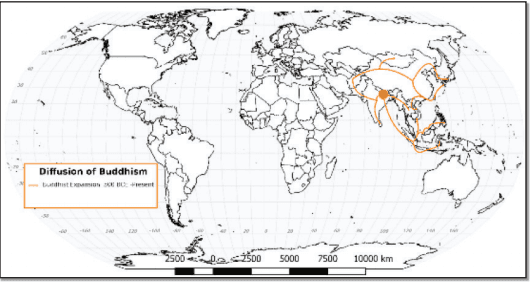
- Buddhism originated in India around the 5th century BCE and spread across East and Southeast Asia. It centers on achieving enlightenment through practices like the Eightfold Path (right speech, right action, right mindfulness, etc.). Buddhist teachings have shaped art, temple architecture, and the widespread practice of meditation in countries like Thailand, Myanmar, Sri Lanka, and Japan.
- Islam is the predominant religion in Indonesia (the world's largest Muslim-majority country by population), Pakistan, and Bangladesh. Daily life for observant Muslims is guided by the Five Pillars of Islam: faith declaration, prayer, charity, fasting during Ramadan, and pilgrimage to Mecca. In many Muslim-majority countries, Sharia (Islamic law) influences legal codes, social norms, and gender roles to varying degrees.
- Christianity, Sikhism, and Shinto also play significant roles in specific regions. The Philippines is predominantly Christian due to Spanish colonization. Sikhism is concentrated in India's Punjab region. Shinto is indigenous to Japan and centers on reverence for nature spirits (kami).
Philosophical and Ethical Systems
Not every major belief system in Asia fits neatly into the category of "religion." Two Chinese philosophical traditions have had enormous cultural influence:
- Confucianism emphasizes social harmony, filial piety (deep respect for parents and elders), and deference to authority. These values have shaped family structures, educational priorities, and political culture across East Asia, particularly in China, South Korea, and Japan. The Confucian emphasis on education, for instance, helps explain the intense focus on academic achievement in these societies.
- Taoism stresses living in harmony with nature and the balance of opposites expressed through yin and yang. Taoist principles have influenced traditional Chinese medicine, martial arts like tai chi, and art forms such as calligraphy and landscape painting.
Cultural Landscapes of Asia
Regional Characteristics and Influences
Each major subregion of Asia has a distinct cultural profile shaped by geography, history, and the interaction of different traditions.
- East Asia (China, Japan, South Korea) shares a foundation of Chinese cultural influence, including the historical use of Chinese characters in writing systems and the prevalence of Confucian values. Yet each country has developed a distinct identity. Japan's culture reflects Shinto and Buddhist traditions alongside rapid modernization. South Korea blends Confucian social norms with a globally influential pop culture industry (K-pop, Korean cinema).
- Southeast Asia (Indonesia, Thailand, Vietnam, Philippines) has an especially diverse cultural landscape. Indigenous traditions mix with Indian and Chinese influences brought by centuries of trade, plus the lasting effects of European colonialism. The region is known for vibrant festivals like Songkran (Thai New Year water festival) and Tet (Vietnamese Lunar New Year), rich culinary traditions, and the coexistence of Islam, Buddhism, and Christianity, sometimes within the same country.
- South Asia (India, Pakistan, Bangladesh, Sri Lanka) is characterized by extraordinary linguistic, ethnic, and religious complexity. Ancient civilizations like the Indus Valley Civilization (c. 3300–1300 BCE) laid early cultural foundations, and British colonialism later reshaped political boundaries and institutions. The region is renowned for colorful festivals like Diwali (festival of lights) and Holi (festival of colors), intricate art forms, and diverse musical traditions ranging from Hindustani classical music to Bollywood film scores.
- Central Asia (Kazakhstan, Uzbekistan, Kyrgyzstan) sits at the crossroads of the ancient Silk Road, and its culture reflects that position. Persian, Turkic, and Russian influences blend with Islamic and nomadic traditions. The region is known for rich textile heritage (especially silk and carpet weaving), intricate Islamic architecture (like the Registan in Samarkand), and a strong cultural emphasis on hospitality.

Globalization and Cultural Change
These regional landscapes are not frozen in time. Globalization, urbanization, and the spread of popular culture are reshaping Asian societies. Traditional practices and values persist, but modern Asian countries constantly navigate the tension between cultural preservation and the pressures of economic development and social change. South Korea's global export of K-pop, for example, coexists with deep-rooted Confucian family expectations.
Language and Ethnicity in Asian Identity
Linguistic Diversity and National Identity
Asia is home to an estimated 2,300 languages spanning major language families like Sino-Tibetan, Indo-European, and Austronesian. Language is central to cultural identity because it carries traditions, literature, and ways of thinking from one generation to the next.
Many Asian countries have adopted a dominant national language to unify diverse populations:
- Mandarin Chinese in China
- Hindi in India (alongside English as a co-official language)
- Indonesian (Bahasa Indonesia) in Indonesia
These national languages serve as unifying forces, but they coexist with numerous regional dialects and minority languages. In China alone, hundreds of distinct dialects and minority languages are spoken alongside Mandarin.
Ethnicity and Cultural Heritage
Ethnicity refers to a group's shared cultural heritage, ancestry, and traditions. Most Asian nations contain multiple ethnic groups, each with distinct customs, beliefs, and ways of life.
Language and ethnicity are often closely linked. A clear example: in the 1950s and 1960s, India redrew its state boundaries along linguistic lines, creating states like Tamil Nadu (Tamil-speaking) and Karnataka (Kannada-speaking). This recognized that language was a core part of regional identity, not just a communication tool.

Challenges and Emerging Identities
Ethnic and linguistic diversity can be a source of cultural richness, but it also creates friction when minority groups face discrimination or political marginalization. Two prominent examples:
- The Rohingya people in Myanmar have faced persecution and mass displacement, largely driven by ethnic and religious tensions.
- In China, minority languages like Tibetan and Uyghur have faced restrictions as the government promotes Mandarin.
Globalization and migration add further complexity. As people move across borders and cultures interact more frequently, hybrid identities emerge that blend elements from multiple traditions. These new forms of expression challenge traditional ideas about cultural authenticity and belonging.
History and Colonialism's Influence on Asian Diversity
Ancient Trade Routes and Cultural Exchange
Asia's cultural diversity didn't develop in isolation. The Silk Road, a network of trade routes connecting East Asia with Central Asia, the Middle East, and Europe, facilitated the exchange of goods, ideas, technologies, and artistic traditions for centuries. Buddhism, for instance, traveled from India to China and beyond largely along these routes.
Empires and Dynasties
Powerful empires left lasting cultural imprints on the regions they controlled:
- The Mauryan Empire (c. 322–185 BCE) in India helped spread Buddhism under Emperor Ashoka.
- The Tang Dynasty (618–907 CE) in China is considered a golden age of Chinese art, poetry, and cosmopolitan culture.
- The Mongol Empire (13th–14th centuries) connected vast stretches of Asia and Europe, facilitating trade and cultural exchange on an unprecedented scale.
These empires typically promoted their own languages, religions, and cultural practices in conquered territories, creating layers of influence that persist today.
European Colonialism
European colonialism (roughly 16th century to mid-20th century) had a profound and lasting impact on Asian cultures. Colonial powers imposed their languages, legal systems, and cultural values, often suppressing indigenous traditions while also creating new hybrid identities.
- British India (1858–1947): The British introduced English as the language of administration and higher education, and it remains widely used in India today. British policies also deepened religious tensions between Hindus and Muslims, contributing to the Partition of India in 1947 and the creation of Pakistan.
- French Indochina (Vietnam, Laos, Cambodia): French colonial rule from the late 19th to mid-20th century left visible cultural traces, including French loanwords in Vietnamese and the fusion of French and local culinary traditions (the bánh mì sandwich is a well-known example).
- Dutch East Indies (Indonesia): Dutch colonization influenced Indonesian legal systems and administration. The Dutch also played a role in the spread of Islam in parts of Indonesia, sometimes encouraging conversion to undermine the authority of existing Hindu and Buddhist kingdoms.
Post-Colonial Cultural Identities
The legacy of colonialism in Asia is complex. Colonial rule often eroded traditional cultures and imposed Western values, but colonial education systems also helped foster nationalist movements that eventually led to independence.
In the post-colonial era, many Asian countries have worked to reassert their cultural identities by reviving indigenous languages, arts, and traditions. Still, the imprint of colonialism remains visible in the continued use of colonial languages (English in India, French in Vietnam), inherited legal systems, and colonial-era architecture found across the continent.
See Fiveable more often in Google
Mark Fiveable as a preferred source and Google is more likely to show you our guides in Top Stories, with a "preferred" badge in AI Mode and AI Overviews.