13.3 Economic Growth and Regional Disparities

🗺️World Geography Unit 13 Review
13.3 Economic Growth and Regional Disparities
🗺️ World Geography
Asia's economic growth has been one of the defining stories of the past several decades. Understanding how different countries achieved growth, why that growth has been uneven, and how globalization and technology shape the region's future is central to grasping modern world geography.
Economic Growth in Asia

Top images from around the web for Factors Contributing to Economic Growth
Economic Growth - Our World In Data View original
Is this image relevant?
Reading: Components of Economic Growth | Macroeconomics View original
Is this image relevant?
Economic Growth – Introduction to Macroeconomics View original
Is this image relevant?
Economic Growth - Our World In Data View original
Is this image relevant?
Reading: Components of Economic Growth | Macroeconomics View original
Is this image relevant?
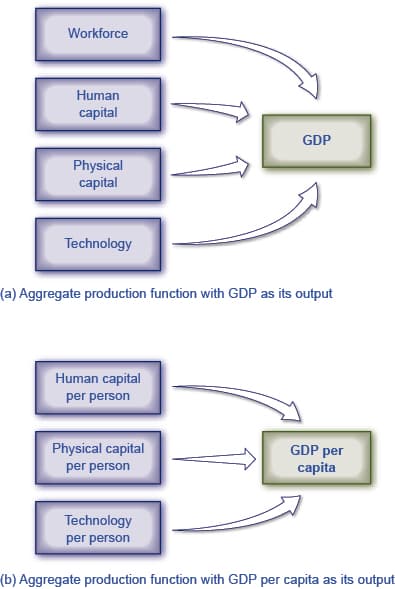
Factors Contributing to Economic Growth
Economic growth is measured by the change in a country's Gross Domestic Product (GDP) over time. GDP represents the total value of goods and services produced within a country. When GDP rises consistently, it signals that an economy is expanding.
Four key factors drive economic growth:
- Physical capital: factories, machinery, roads, ports, and other infrastructure
- Human capital: the education, skills, and health of a workforce
- Natural resources: land, minerals, energy reserves, and other raw materials
- Technological progress: new inventions, better processes, and the adoption of existing technologies
Many Asian countries grew rapidly because they combined several of these factors at once. High savings and investment rates meant more money flowed into building infrastructure and factories. Export-oriented trade policies opened access to global markets. Foreign direct investment brought in outside capital and expertise. And governments actively supported industries they saw as strategic.
Physical capital accumulation has been especially important. China invested heavily in highways, rail networks, and manufacturing zones. Japan and South Korea built world-class industrial capacity in steel, shipbuilding, and electronics over the second half of the 20th century.
Role of Human Capital and Natural Resources
Investments in education and skills training have been just as critical. Singapore and Taiwan deliberately built strong education systems and technical training programs, which allowed them to shift from low-wage manufacturing into higher-value industries like finance and semiconductors.
Natural resource wealth has supported growth in countries like Indonesia (oil, gas, timber) and Malaysia (petroleum, palm oil, tin). But resource wealth can backfire. The "resource curse" describes a pattern where countries rich in natural resources sometimes experience slower overall development because they become overly dependent on resource exports, neglect other industries, or suffer from corruption tied to resource revenues.
Technological progress has been another major factor. Japan pioneered consumer electronics and automotive manufacturing. South Korea built global brands in semiconductors and smartphones. China has rapidly expanded its capabilities in areas like renewable energy and telecommunications.
Finally, institutional factors matter. The quality of governance, strength of rule of law, and ease of doing business all shape whether investment translates into sustained growth or gets lost to corruption and inefficiency.
Asian Economic Systems
Diversity of Economic Models
Asian countries have taken very different paths to economic development. There is no single "Asian model." Instead, you'll find a spectrum from heavy state involvement to highly open market economies.
China operates a socialist market economy. The government maintains control through state-owned enterprises and central planning, but since reforms beginning in 1978, it has increasingly allowed private businesses and market forces to operate. Key policies have included gradual (rather than sudden) economic liberalization, massive infrastructure spending, and aggressive export promotion.
Japan has a developed market economy with a strong private sector. However, the government historically played an active role through industrial policy, guiding investment toward strategic sectors like automobiles and electronics. Japanese firms also developed distinctive practices like lifetime employment and a focus on continuous quality improvement (kaizen).

Export-Oriented Strategies and Mixed Economies
South Korea followed an export-oriented development model. The government channeled resources toward large conglomerates called chaebols (Samsung, Hyundai, LG), using targeted investments, trade promotion, and heavy emphasis on education and technology to build globally competitive industries.
Singapore built one of the world's most open economies. With almost no natural resources and a small population, it focused on attracting foreign investment, developing a highly skilled workforce, and creating a business-friendly environment. It targeted high-value industries like finance, logistics, and biotech.
India has a mixed economy. Until the early 1990s, the government controlled many industries and restricted foreign trade. Reforms since 1991 opened the economy through trade liberalization, deregulation, and increased foreign investment, fueling growth especially in information technology and services.
Many Southeast Asian countries, including Indonesia, Malaysia, and Thailand, pursued export-oriented industrialization with varying mixes of government direction and market openness. Thailand, for example, became a major hub for automobile assembly, while Malaysia developed electronics manufacturing.
Regional Economic Disparities in Asia
Causes of Regional Disparities
Regional economic disparities refer to the uneven distribution of economic activity, income, and development across different areas. These gaps exist both between Asian countries and within individual countries.
Several factors drive these disparities:
- Natural resource distribution: some regions have fertile land, minerals, or energy reserves while others do not
- Historical legacies: colonialism and conflict left lasting imprints on infrastructure and institutions
- Uneven infrastructure: coastal areas with ports often developed faster than landlocked interior regions
- Policy choices: governments sometimes directed investment toward certain regions, leaving others behind
China illustrates this clearly. Coastal provinces like Guangdong and Zhejiang have per capita incomes several times higher than inland provinces like Gansu or Guizhou. Coastal regions benefited from early access to special economic zones, port infrastructure, and proximity to global trade routes.
India shows similar patterns. States like Maharashtra and Karnataka (home to Mumbai and Bangalore) have experienced rapid growth, while states like Bihar and Uttar Pradesh lag behind due to weaker infrastructure, governance challenges, and lower levels of education.
Consequences and Policy Responses
Disparities also exist between urban and rural areas. Cities tend to concentrate economic activity, better-paying jobs, healthcare, and education. Rural areas often depend on agriculture and have fewer services. This urban-rural gap drives large-scale migration toward cities across Asia.
These disparities carry real consequences. They can fuel social tensions and political instability when people in poorer regions feel left behind. They also create economic inefficiencies, since human potential goes underutilized in underdeveloped areas.
Governments have tried various approaches to close these gaps:
- Targeted infrastructure investment in less developed regions (roads, electricity, internet)
- Special economic zones designed to attract business to lagging areas
- Fiscal transfers that redirect tax revenue from wealthier regions to poorer ones
- Education and healthcare spending in underserved areas
Results have been mixed. China's "Go West" campaign brought some development to interior provinces, but coastal regions still dominate economically. India's efforts to improve rural infrastructure have had uneven success depending on state-level governance.

Globalization's Impact on Asian Economies
Benefits of Globalization and Trade
Globalization is the increasing integration of economies worldwide through trade, investment, and technology flows. Many Asian economies have been among its biggest participants and beneficiaries.
Trade has been a primary engine of growth. Countries like China, Japan, South Korea, and several Southeast Asian nations pursued export-oriented strategies, producing goods for global markets. This allowed them to specialize based on comparative advantage, the idea that countries benefit by focusing on what they produce most efficiently relative to others.
Global value chains have been especially important. A single product like a smartphone might involve design in the United States, semiconductor fabrication in Taiwan, assembly in China, and display manufacturing in South Korea. By plugging into these networks, Asian countries gained access to technology, skills, and markets they couldn't have reached alone.
Foreign direct investment (FDI) has also been significant. When multinational companies build factories or offices in Asian countries, they bring capital, technology, and management expertise. This has helped boost productivity and accelerate industrial development across the region.
Challenges and Risks
Globalization brings vulnerabilities too. Economies deeply tied to global trade are exposed to global economic shocks, as many Asian countries experienced during the 1997 Asian Financial Crisis and the 2008 global recession.
Competition from other low-cost producers can undercut domestic industries. And the gains from trade aren't evenly shared. Export-oriented coastal cities may boom while interior agricultural regions see little benefit, which can worsen the regional disparities discussed above.
Trade tensions pose another risk. Tariffs, sanctions, and other protectionist measures can disrupt supply chains that Asian manufacturers depend on. The ongoing trade frictions between the United States and China, for example, have had ripple effects across the region.
Technology and Innovation in Asian Economies
Technological Capabilities and Policies
Technology and innovation drive productivity growth, create new industries, and support long-term development. Several Asian countries have made science and technology central to their economic strategies.
Japan and South Korea are global leaders in technological innovation. Japan's strength in automobiles, robotics, and consumer electronics grew from decades of investment in research and development (R&D), a highly skilled workforce, and close collaboration between government and industry. South Korea followed a similar path, becoming dominant in semiconductors (Samsung), displays, and telecommunications.
China has rapidly expanded its technological capabilities. Government-backed initiatives have poured funding into artificial intelligence, 5G telecommunications, and renewable energy. High-tech zones and innovation clusters in cities like Shenzhen and Beijing serve as hubs for research and startups.
Singapore and Taiwan have carved out specialized niches. Taiwan's semiconductor industry, led by TSMC, produces the majority of the world's most advanced chips. Singapore has built strengths in biotech, fintech, and digital services.
Opportunities and Challenges
The spread of digital technologies and e-commerce has the potential to boost productivity even in less developed regions and traditional sectors like agriculture. Mobile banking, for instance, has expanded financial access in rural areas of India and Southeast Asia.
But technology also creates risks. Technological unemployment occurs when automation displaces workers faster than new jobs are created. Digital divides, gaps in internet access and digital skills, can widen inequality between urban and rural populations and between wealthier and poorer countries.
Policies to address these challenges include:
- Investing in education and workforce retraining
- Funding R&D through grants and tax incentives
- Strengthening intellectual property protections to encourage innovation
- Building innovation ecosystems that connect universities, businesses, and government
See Fiveable more often in Google
Mark Fiveable as a preferred source and Google is more likely to show you our guides in Top Stories, with a "preferred" badge in AI Mode and AI Overviews.