1.3 Geographic Information Systems (GIS) and Remote Sensing

🗺️World Geography Unit 1 Review
1.3 Geographic Information Systems (GIS) and Remote Sensing
🗺️ World Geography
Geographic Information Systems (GIS) and remote sensing are powerful tools for analyzing spatial data. They allow us to capture, store, and visualize geographic information, helping us understand patterns and relationships across the world.
These technologies have changed how we study and interact with our environment. From urban planning to disaster response, GIS and remote sensing provide insights that inform decision-making and shape our understanding of geography.
GIS Components and Functions

Top images from around the web for Key Components of GIS
GIS - EESC 3750 - Geographic Information Systems - Brooklyn College Library LibGuides Home at ... View original
Is this image relevant?
สารสนเทศภูมิศาสตร์ (GIS) View original
Is this image relevant?
Introduction to GIS – EO4GEO View original
Is this image relevant?
GIS - EESC 3750 - Geographic Information Systems - Brooklyn College Library LibGuides Home at ... View original
Is this image relevant?
สารสนเทศภูมิศาสตร์ (GIS) View original
Is this image relevant?
Key Components of GIS
A Geographic Information System (GIS) is a computer-based system for capturing, storing, checking, integrating, manipulating, analyzing, and displaying geospatial data. Think of it as a smart map that can layer different types of information on top of each other and let you ask questions about how they relate.
A GIS has five main components:
- Hardware includes the physical equipment: computers, scanners, printers, GPS units, etc.
- Software provides the functions and tools needed to store, analyze, and display geographic information. This includes a database management system (DBMS), tools for data input and manipulation, and tools for visualization and analysis.
- Data represents real-world objects (roads, land use, elevation, waterways) in digital form. Data can come from digitized maps, aerial photography, satellite imagery, and GPS data collection.
- People are the analysts, technicians, and decision-makers who operate the system and interpret results.
- Methods are the procedures and rules an organization follows for how data is collected, managed, and applied.
GIS integrates spatial data (where things are) with attribute data (what those things are like). Most organizations already use a DBMS to maintain their records, and GIS can work alongside those systems to add a geographic dimension.
Vector and Raster Data Types
GIS stores geographic information in two main data formats:
- Vector data represents discrete features as points, lines, and polygons.
- A point feature (like a city or a well) is represented by a single x,y coordinate.
- A line feature (like a road or river) is represented by an ordered list of connected vertices.
- A polygon feature (like a lake or a county boundary) is represented by vertices that enclose an area.
- Raster data represents the world by dividing it into a grid of square or rectangular cells, where each cell holds a single value and its geographic coordinates. This format works well for continuous data like elevation, temperature, or rainfall.
The real power of GIS is linking geographic information with descriptive information. For example, a road network map (graphical data) can be linked to a database describing each road's speed limit, surface type, and traffic volume. That connection lets you run analyses you couldn't do with either dataset alone.
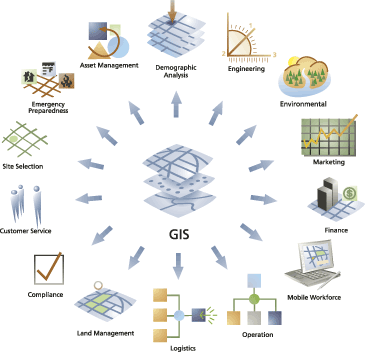
GIS applications span a huge range of fields: scientific research, resource management, urban planning, cartography, criminology, marketing, logistics, archaeology, and environmental impact assessment.
Remote Sensing for Data Collection

Principles of Remote Sensing
Remote sensing is the science of obtaining information about an area, object, or phenomenon by analyzing data acquired from a device that is not in physical contact with the target. A satellite photographing Earth's surface is remote sensing; so is a drone scanning a forest canopy.
Remote sensing technologies rely on the properties of electromagnetic radiation (EMR) to detect and measure characteristics of a target. There are two broad approaches:
- Passive remote sensing detects natural energy (usually sunlight) that is reflected or emitted from the observed scene. A standard satellite camera is a passive sensor.
- Active remote sensing emits its own energy toward a target and then measures the radiation that bounces back. Radar is a common example.
Remote sensing is especially valuable for collecting data on dangerous or inaccessible areas. Applications include monitoring deforestation, tracking sea level rise, mapping coastal and ocean depths, and gathering military intelligence.
Types of Remote Sensing Technologies
Remote sensing technologies fall into three main categories:
- Optical and infrared remote sensing uses visible, near-infrared, and short-wave infrared sensors to form images of Earth's surface by detecting reflected solar radiation. Different materials reflect and absorb light differently at different wavelengths, producing unique spectral reflectance signatures that let analysts distinguish, say, healthy vegetation from bare soil.
- Microwave remote sensing uses microwave radiation to illuminate a target and analyzes the backscattered signal. A major advantage is that microwaves can penetrate clouds and work in darkness, making this technology useful when optical sensors can't get a clear view.
- LIDAR (Light Detection and Ranging) measures distance by firing laser pulses at a target and timing how long the reflected light takes to return. Differences in return times and wavelengths produce highly detailed digital 3-D models, which is why LIDAR is widely used for topographic mapping and flood modeling.
Once collected, remote sensing data goes through digital image processing, which typically involves preprocessing (correcting distortions), enhancement (improving visual clarity), classification (sorting pixels into categories like water, forest, or urban), and modeling (extracting patterns for real-world application).
GIS and Remote Sensing Applications

Urban Planning and Natural Resource Management
GIS and remote sensing apply to a wide range of real-world problems, including urban planning, natural resource management, disaster response, and climate change research.
In urban planning, GIS helps with zoning, land use planning, infrastructure management, and transportation planning. Planners analyze population density, land use patterns (residential vs. commercial), and infrastructure needs (utilities, roads) to make informed decisions about where and how cities should grow.
In natural resource management, GIS and remote sensing monitor resources like forests, wetlands, and wildlife habitats. Satellite imagery can track changes in forest cover over time, making it possible to quantify deforestation rates year by year. GIS can also model wildlife habitat suitability by layering factors such as vegetation type, topography, and proximity to human disturbance.
Disaster Response and Climate Change Research
In disaster response, GIS maps the extent of damage, identifies areas that need assistance, and supports relief planning. After an earthquake or hurricane, satellite imagery and aerial photography can provide rapid damage assessments before ground teams even arrive.
In climate change research, GIS and remote sensing track changes in land cover, sea level, and other environmental indicators over time. Satellite data can monitor shrinking ice sheets in polar regions, expanding desertification, and rising ocean temperatures linked to coral bleaching. GIS then models potential impacts of these changes on human and natural systems, such as coastal flooding risk or projected crop yield losses.
To apply these tools effectively, you need a clear understanding of the problem being addressed, the data and tools available, and the limitations of both. Communicating results clearly to decision-makers and stakeholders is just as important as the analysis itself.
Ethical Considerations for GIS and Remote Sensing
Privacy, Accuracy, and Equity Issues
The use of GIS and remote sensing in decision-making raises several ethical issues worth understanding.
Privacy and confidentiality are a major concern. GIS and remote sensing data can reveal sensitive information about individuals and communities, including their locations, activities (such as illegal logging operations), and behaviors. Data must be collected, stored, and used in ways that protect individual privacy rights.
Data accuracy and reliability also matter. Sensor limitations, data processing methods, and human interpretation can all introduce errors and uncertainties. Decision-makers need to know about these limitations, and analysts should use appropriate methods for validating and verifying data before drawing conclusions.
Equity and fairness are critical too. The benefits and burdens of decisions made using these technologies may not be distributed evenly across communities. For example, a new highway route chosen through GIS analysis might benefit commuters while disproportionately affecting low-income neighborhoods. Transparent, inclusive decision-making processes help ensure that the needs of all affected parties are considered. This connects directly to the concept of environmental justice.
Intellectual Property and Societal Implications
GIS and remote sensing also raise questions about intellectual property rights and data ownership. Much of the data used in these technologies is collected and owned by government agencies, private companies, or research institutions. Clear policies and agreements about data use and sharing are essential. Open data initiatives, where governments make geographic datasets freely available, are one approach to broadening access.
There are broader societal and environmental implications as well. These technologies can significantly influence land use decisions (urban sprawl), resource management (overfishing), and human activities (community displacement). Considering the long-term consequences of decisions made with these tools, and striving for sustainable and equitable outcomes, is part of using them responsibly.
See Fiveable more often in Google
Mark Fiveable as a preferred source and Google is more likely to show you our guides in Top Stories, with a "preferred" badge in AI Mode and AI Overviews.