7.2 Stokes' Theorem

5️⃣Multivariable Calculus Unit 7 Review
7.2 Stokes' Theorem
5️⃣ Multivariable Calculus
Stokes' Theorem connects surface integrals and line integrals, linking the flux of curl through a surface to the circulation of a vector field around that surface's boundary. It generalizes Green's Theorem to three dimensions and shows up constantly in electromagnetic theory and fluid dynamics.
The real payoff: you can convert between surface and line integrals, picking whichever is easier to evaluate. But orientation matters a lot here. Get the surface normal or boundary direction wrong, and your answer picks up a sign error.
Understanding Stokes' Theorem
Interpretation of Stokes' Theorem
Stokes' Theorem says that the total curl flowing through a surface equals the circulation of the vector field around the surface's boundary:
The left side measures how much the curl of passes through the surface . The right side measures how much circulates along the boundary curve . The theorem tells you these two quantities are always equal, as long as the orientation is consistent.
Three ingredients are required:
- An oriented surface (with a chosen normal direction)
- A positively oriented boundary curve (consistent with the surface normal)
- A vector field that is continuously differentiable on and near
Think of it this way: instead of adding up all the tiny local rotations (curl) across an entire surface, you can just measure the net rotation around the edge. Green's Theorem does exactly this in 2D; Stokes' Theorem is the 3D version.
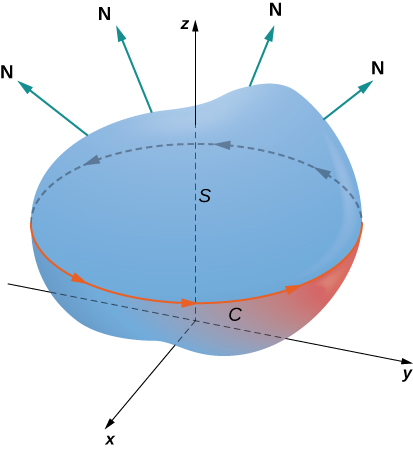
Orientation of Surface Boundaries
Getting orientation right is the single most common source of errors with Stokes' Theorem.
Right-hand rule: Curl the fingers of your right hand in the direction you traverse the boundary curve . Your thumb should point in the direction of the surface normal . If it doesn't, either flip the normal or reverse the direction you travel along .
- When viewed from the side the normal points toward, the boundary curve should run counterclockwise.
- For a closed surface (like a sphere), the convention is that the normal points outward, but note that closed surfaces have no boundary, so Stokes' Theorem applied to a closed surface gives zero.
- If you reverse the orientation of either the surface or the curve (but not both), the integral picks up a minus sign.
Before computing anything, sketch the surface and boundary, mark the normal direction, and confirm the curve's orientation matches via the right-hand rule.

Conversion Between Integral Types
The power of Stokes' Theorem is that you get to choose which side of the equation to evaluate.
Surface integral → Line integral:
- Identify the vector field and the surface .
- Find the boundary curve of the surface.
- Parametrize with positive orientation (consistent with the surface normal).
- Evaluate .
This direction is useful when the surface is complicated but the boundary is a simple curve (e.g., a circle or line segments).
Line integral → Surface integral:
- Identify a surface whose boundary is the given curve . You can pick any such surface; the theorem guarantees the same answer.
- Compute .
- Choose a parametrization for and find .
- Evaluate .
This direction helps when the line integral is messy but you can pick a convenient surface. For instance, if is a circle in 3D, you might choose the flat disk it bounds rather than some curved surface.
Simplification of Surface Integrals
Stokes' Theorem is especially handy when you're given a surface integral of a curl and the surface itself is hard to work with, but its boundary is simple.
Steps to simplify:
- Confirm the integrand has the form for some vector field . If you're given a surface integral of a general vector field , you'd need to find such that , which isn't always straightforward.
- Identify the boundary curve of the surface.
- Parametrize with the correct orientation.
- Evaluate .
A classic example: suppose you need to integrate over the top hemisphere of . The boundary is just the unit circle in the -plane, so you can replace the hemisphere integral with a line integral around that circle.
Before applying the theorem, always verify that is continuously differentiable on the entire surface and that the surface actually has a well-defined boundary. If the surface is closed (no boundary), the integral of any curl over it is zero.
See Fiveable more often in Google
Mark Fiveable as a preferred source and Google is more likely to show you our guides in Top Stories, with a "preferred" badge in AI Mode and AI Overviews.