3.1 Functions of Several Variables

5️⃣Multivariable Calculus Unit 3 Review
3.1 Functions of Several Variables
5️⃣ Multivariable Calculus
Understanding Functions of Several Variables
In single-variable calculus, every function takes one input and gives one output. Functions of several variables generalize this idea: they take multiple inputs and produce a single output. This is the foundation for everything else in multivariable calculus, so getting comfortable with the notation, evaluation, and visualization here will pay off throughout the course.

Top images from around the web for Functions of several variables
Functions of Several Variables · Calculus View original
Is this image relevant?
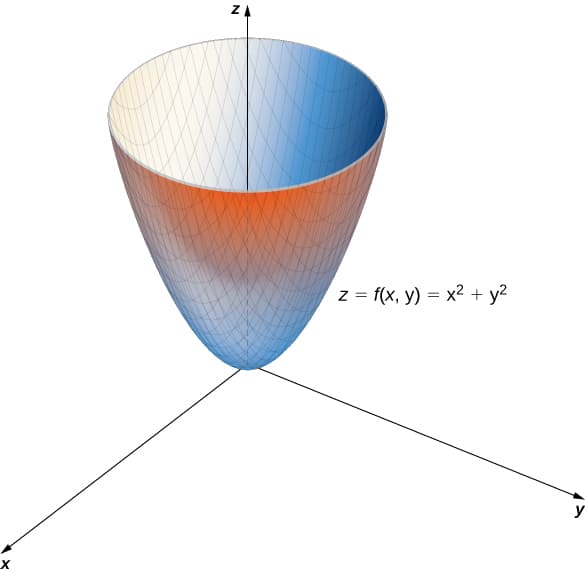
Functions of Several Variables · Calculus View original
Is this image relevant?
Functions of Several Variables · Calculus View original
Is this image relevant?
Functions of Several Variables · Calculus View original
Is this image relevant?
Functions of Several Variables · Calculus View original
Is this image relevant?
What Are Functions of Several Variables?
A function of several variables maps multiple inputs to a single real number. The general notation is:
where is the number of input variables. Most of this course focuses on two or three variables, so you'll typically see or .
The domain is the set of all input points (or ) where the function is defined. The range is the set of all possible output values.
For example, has a domain restricted to (a disk of radius 3), because the expression under the square root can't be negative. Its range is .
These functions show up everywhere:
- Physics: Temperature at a point in a room,
- Economics: A production function like , where is labor and is capital
- Engineering: Stress on a beam as a function of position and load

Evaluating Multivariable Functions
Evaluation works the same way as in single-variable calculus: substitute the given values and simplify.
Steps for evaluation:
- Identify the input values for each variable.
- Substitute them into the expression.
- Simplify using standard order of operations (PEMDAS).
- For composite functions, evaluate the innermost function first.
- Check that the input is actually in the domain (watch for division by zero, square roots of negatives, or logarithms of non-positive numbers).
Example: For , evaluate :
Notice that would be undefined because doesn't exist. Always check domain restrictions before plugging in.

Level Curves and Level Surfaces
Level curves are one of the most useful tools for visualizing a function of two variables. A level curve of is the set of all points where the function equals some constant :
Each value of gives a different curve in the -plane. A collection of level curves for several values of is called a contour map.
Think of a topographic map: each contour line connects points at the same elevation. The function value is the "elevation," and the level curves show you where the elevation is constant.
- Closely spaced level curves mean the function is changing rapidly (steep slope).
- Widely spaced level curves mean the function is changing slowly (gentle slope).
- Closed loops often indicate a local maximum or minimum at the center.
Example: For , the level curves are circles centered at the origin with radius . As increases, the circles get larger, telling you the function increases as you move away from the origin.
For functions of three variables, the analog is a level surface: the set of points where . For instance, the level surfaces of are spheres centered at the origin.
Graphs of Two-Variable Functions
The graph of is a surface in 3D space. Each point on the surface has coordinates , where the height above (or below) the -plane represents the function's value.
Some common surfaces to recognize:
- Planes: Graphs of linear functions like . These are flat, tilted sheets.
- Paraboloids: gives a bowl opening upward. opens downward.
- Saddle surfaces (hyperbolic paraboloids): curves upward in one direction and downward in the other, like a Pringles chip.
- Ellipsoids: Surfaces defined by .
Key features to identify on a graph:
- Maxima and minima: High points and low points on the surface
- Saddle points: Points that are a max in one cross-section but a min in another
- Symmetry: If , the surface is symmetric about the -plane
- Cross-sections: Slicing the surface with a plane (like fixing ) gives you a familiar 2D curve that's often easier to analyze
Connecting level curves to graphs: A contour map is essentially a "top-down view" of the 3D surface. Each level curve at height is what you'd see if you sliced the surface with the horizontal plane and looked straight down. This connection between the 2D contour map and the 3D surface is worth internalizing early, since it comes up repeatedly in optimization and gradient problems later in the course.
See Fiveable more often in Google
Mark Fiveable as a preferred source and Google is more likely to show you our guides in Top Stories, with a "preferred" badge in AI Mode and AI Overviews.