8.2 Applications of the Divergence Theorem

5️⃣Multivariable Calculus Unit 8 Review
8.2 Applications of the Divergence Theorem
5️⃣ Multivariable Calculus
Understanding the Divergence Theorem
The Divergence Theorem connects surface integrals to volume integrals. It says that the total flux of a vector field through a closed surface equals the volume integral of that field's divergence over the region inside. In practice, this means you can replace a difficult surface integral with a (usually easier) volume integral.
This conversion is useful across physics and engineering. Fluid dynamics, electromagnetism, and heat transfer all involve computing flux through surfaces, and the Divergence Theorem often turns those problems from painful to manageable.

Top images from around the web for Applications of Divergence Theorem
The Divergence Theorem · Calculus View original
Is this image relevant?
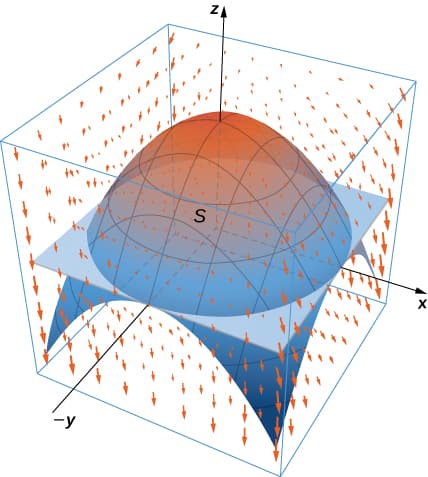
The Divergence Theorem · Calculus View original
Is this image relevant?
The Divergence Theorem · Calculus View original
Is this image relevant?
The Divergence Theorem · Calculus View original
Is this image relevant?
The Divergence Theorem · Calculus View original
Is this image relevant?
The Divergence Theorem Formula
The theorem states:
Here's what each piece means:
- is the vector field describing flow or force
- is the outward unit normal vector to the surface (direction matters)
- is a closed surface bounding a region (no holes or gaps)
- is the volume enclosed by
The left side measures total flux through the surface. The right side sums up all the "sources" and "sinks" inside the volume. The theorem says these two quantities are always equal for smooth, well-behaved fields.
For the theorem to apply, you need two things: the surface must be closed (think spheres, cubes, or cylinders with caps), and the vector field must be continuously differentiable throughout the enclosed volume.
Divergence of Vector Fields
For a vector field , the divergence is:
Divergence is a scalar. It measures how much the field is "spreading out" or "compressing" at each point.
- Positive divergence means the point acts as a source (net outward flow, like a water fountain)
- Negative divergence means the point acts as a sink (net inward flow, like a drain)
- Zero divergence means no net expansion or contraction at that point. This is the hallmark of an incompressible fluid flow, where volume is conserved.
Think of divergence as the rate of change of flux per unit volume. It tells you whether a tiny region is locally expanding or contracting under the field's influence.

Applying the Divergence Theorem
Surface to Volume Integral Conversion
When you spot a flux integral over a closed surface, here's how to apply the theorem:
- Confirm the surface is closed. If it's not (e.g., just the top hemisphere of a sphere), you can't apply the theorem directly. You'd need to add the missing piece to close it, apply the theorem, then subtract.
- Compute the divergence by taking the partial derivatives and summing them.
- Set up the volume integral over the enclosed region.
- Choose coordinates that match the geometry. A sphere calls for spherical coordinates (). A cylinder calls for cylindrical coordinates (). A box stays in Cartesian.
- Evaluate the integral using standard techniques (substitution, iterated integration, etc.).

Flux Calculations: A Worked Strategy
Suppose you need to find the flux of through the unit sphere.
- Identify the setup. The unit sphere is a closed surface, so the Divergence Theorem applies. The enclosed volume is the unit ball.
- Compute divergence. .
- Convert to spherical coordinates. In spherical coordinates, , , , and .
- Evaluate. By symmetry, the integrals of , , and over the full sphere each equal zero (odd functions over symmetric domains). So the total flux is .
This calculation would be significantly harder as a direct surface integral. That's the payoff of the theorem: you trade a vector-valued surface computation for a scalar volume computation.
When to Use the Divergence Theorem
The theorem saves the most work when:
- The divergence simplifies to a constant or simple expression (making the volume integral easy)
- The surface is complicated but encloses a region with nice geometry
- The surface has multiple pieces (e.g., a cylinder with two caps and a lateral surface) that would each require separate parameterizations
If the divergence turns out to be messier than the original surface integral, you might be better off computing the flux directly. Always check the divergence first before committing to either approach.
See Fiveable more often in Google
Mark Fiveable as a preferred source and Google is more likely to show you our guides in Top Stories, with a "preferred" badge in AI Mode and AI Overviews.