3.2 Limits and Continuity

5️⃣Multivariable Calculus Unit 3 Review
3.2 Limits and Continuity
5️⃣ Multivariable Calculus
Understanding Limits and Continuity in Multivariable Calculus
Limits and continuity in multivariable calculus extend the single-variable versions of these ideas to functions with two or more inputs. They're the foundation for partial derivatives and everything that follows in this unit, so getting comfortable with them now pays off quickly.
The core challenge: in single-variable calculus, you could only approach a point from the left or right. With multiple variables, you can approach from infinitely many directions and along curved paths. That changes how you evaluate limits and how you prove they exist (or don't).

Top images from around the web for Concept of multivariable limits
Limits and Continuity · Calculus View original
Is this image relevant?
The Precise Definition of a Limit · Calculus View original
Is this image relevant?
File:Illustration for epsilon-delta definition of continuity 6.svg - Wikimedia Commons View original
Is this image relevant?
Limits and Continuity · Calculus View original
Is this image relevant?
The Precise Definition of a Limit · Calculus View original
Is this image relevant?
Concept of Multivariable Limits
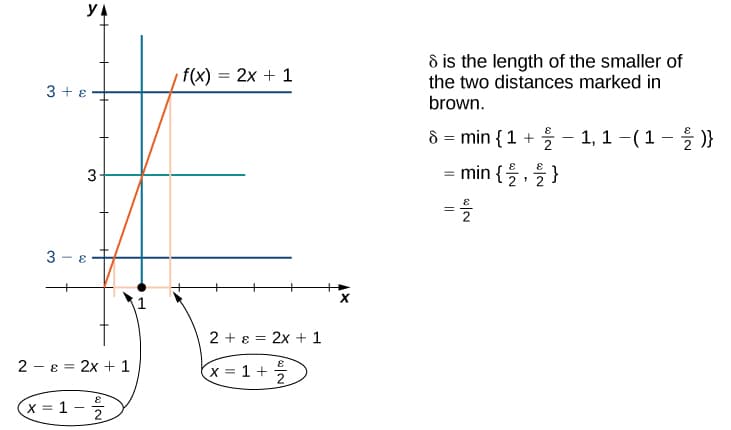
For a function , the limit as describes what value approaches as the input gets arbitrarily close to . The formal definition mirrors the single-variable epsilon-delta version: for every , there exists a such that whenever .
The key difference from single-variable limits is the path dependence issue. In , you can approach a point along straight lines, parabolas, spirals, or any other curve. For the limit to exist, must approach the same value along every possible path.
- If two different paths give different limiting values, the limit does not exist
- A limit can also fail to exist due to oscillation or unbounded behavior near the point
- Showing the limit is the same along a few paths does not prove it exists; you'd need a general argument covering all paths

Evaluation of Multivariable Limits
Several techniques help you evaluate (or disprove) multivariable limits. Which one to reach for depends on the form of the function.
Direct substitution. If the function is continuous at the point, just plug in. For example, . This fails when substitution gives an indeterminate form like .
Factoring and simplification. When you get , try canceling common factors from the numerator and denominator, or rationalizing expressions that contain radicals. This is the same instinct as in single-variable calculus.
Polar coordinate transformation. This is one of the most useful tools for multivariable limits at the origin. Substitute and , then take :
- Rewrite in terms of and
- Simplify the expression, factoring out powers of where possible
- If the result depends only on (not ) and approaches a single value as , that's the limit
- If the result still depends on after simplification, the limit does not exist (different angles give different values)
For example, becomes . As , this goes to regardless of , so the limit is .
Squeeze theorem. Bound the function between two expressions that both converge to the same limit. This works well when you can use inequalities like or to trap the function.
Testing paths to disprove a limit. If you suspect the limit doesn't exist, try approaching along different paths (e.g., , , ). Two paths giving different values is enough to conclude the limit does not exist.
A note on L'Hôpital's rule: it does not directly generalize to multivariable limits the way it works in single-variable calculus. You can sometimes apply it along a specific path (reducing to a single-variable problem), but this only tells you the limit along that one path. Polar coordinates and the squeeze theorem are generally more reliable tools here.

Continuity of Multivariable Functions
A function is continuous at if three conditions hold:
- is defined
- exists
If all three are satisfied at every point in a region, is continuous on that region.
Types of discontinuities:
- Removable: The limit exists but either the function isn't defined there or its value doesn't match the limit. You can "fix" it by redefining at that single point.
- Jump: The function has different limiting values depending on the direction of approach. (In multivariable settings, this often shows up as path-dependent limits.)
- Infinite: The function blows up to near the point.
Common functions and their continuity:
- Polynomials in and are continuous everywhere
- Rational functions (ratios of polynomials) are continuous on their domain, meaning everywhere the denominator is nonzero
- Compositions of continuous functions (like or ) are continuous wherever they're defined
Domains matter. Continuity questions often involve specifying the type of domain:
- Open sets don't include their boundary points (like the interior of a disk)
- Closed sets include all boundary points (like a disk plus its edge)
- Connected sets are "one piece," with no gaps between separate regions
Properties of Continuous Multivariable Functions
Continuous functions combine nicely under standard operations:
- Sums, differences, and products of continuous functions are continuous
- Quotients are continuous wherever the denominator is nonzero
- Compositions are continuous as long as the inner function maps into the domain of the outer function
Two major theorems carry over from single-variable calculus:
Intermediate Value Theorem: If is continuous on a connected domain and takes values and , then takes on every value between and somewhere in that domain. This is useful for proving that equations have solutions.
Extreme Value Theorem: If is continuous on a closed and bounded set, then attains a global maximum and a global minimum on that set. Both conditions (closed and bounded) are required. This theorem is the reason optimization problems on closed regions are guaranteed to have solutions.
Finally, continuity is preserved under coordinate transformations. If is continuous in Cartesian coordinates, it remains continuous when you express it in polar, cylindrical, or spherical coordinates. This gives you the freedom to work in whichever coordinate system makes the problem simplest.
See Fiveable more often in Google
Mark Fiveable as a preferred source and Google is more likely to show you our guides in Top Stories, with a "preferred" badge in AI Mode and AI Overviews.