8.3 Physical Interpretations and Engineering Applications

5️⃣Multivariable Calculus Unit 8 Review
8.3 Physical Interpretations and Engineering Applications
5️⃣ Multivariable Calculus
Vector Field Analysis and Applications
Vector fields let you model fluid flow, electromagnetic fields, and heat transfer mathematically. Divergence, one of the central operations on vector fields, measures how much a field spreads out or compresses at a given point. The Divergence Theorem then bridges local behavior (what's happening at each point inside a volume) to global behavior (the total flux crossing a surface), which makes many real-world calculations far more tractable.

Top images from around the web for Meaning of vector field divergence
Fluid Dynamics – TikZ.net View original
Is this image relevant?
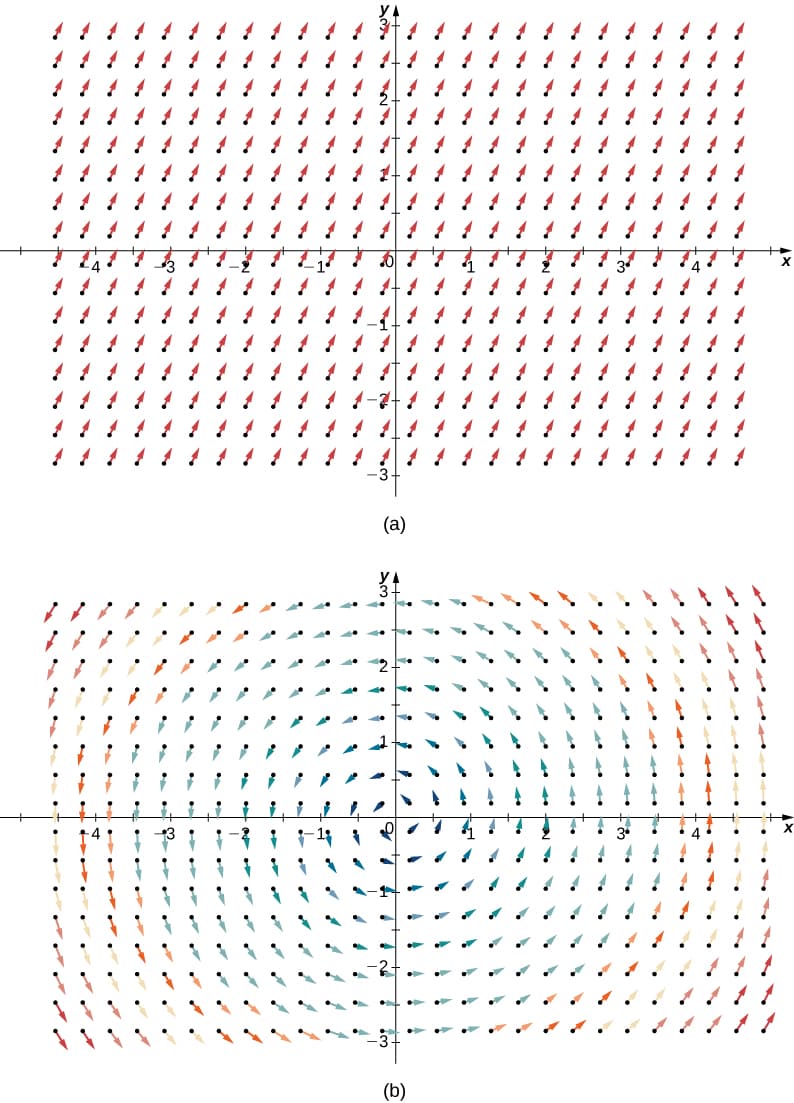
Divergence and Curl · Calculus View original
Is this image relevant?
HartleyMath - Vector Fields View original
Is this image relevant?
Fluid Dynamics – TikZ.net View original
Is this image relevant?
Divergence and Curl · Calculus View original
Is this image relevant?
Meaning of vector field divergence
Divergence quantifies the source or sink strength of a vector field at a point. Think of it as asking: "Is stuff being created, destroyed, or just passing through here?"
- Positive divergence means the field is expanding outward from that point (a source). Fluid is being pumped in, charge is present, or heat is being generated.
- Negative divergence means the field is converging inward (a sink). Fluid is being drained, charge of opposite sign is present, or heat is being absorbed.
- Zero divergence means there's no net creation or destruction at that point. In fluids, this corresponds to incompressible flow, where the density stays constant.
The physical meaning shifts depending on the application:
- Fluid dynamics: Divergence of the velocity field gives the volumetric strain rate, the rate at which a small fluid element expands or contracts per unit volume.
- Electromagnetism: Divergence of the electric field reveals the local charge density (up to a constant). Where , there are charges.
- Heat transfer: Divergence of the heat flux vector tells you the rate of heat generation or absorption per unit volume at that point.

Divergence theorem in fluid dynamics
The Divergence Theorem converts a surface integral (flux through a boundary) into a volume integral (behavior throughout the interior), or vice versa:
In fluid dynamics, is typically the fluid velocity field (or for mass flux). The surface integral on the right gives the total net flux of fluid through the closed surface , while the volume integral on the left sums up all the sources and sinks inside.
Steps to apply the theorem to a fluid flow problem:
- Identify the vector field representing fluid velocity (or mass flux ).
- Define the closed surface bounding the volume you care about.
- Decide which side is easier to compute. Often the volume integral is simpler, especially when has a clean form.
- Compute and set up the volume integral, or parameterize and set up the surface integral.
- Evaluate and interpret: a positive result means net outflow (more fluid leaves than enters), and a negative result means net inflow.
For example, if you need the total volumetric flow rate out of a pipe junction, you can either integrate the velocity over every surface of the junction, or compute the (usually simpler) volume integral of the divergence inside.

Divergence theorem for electromagnetic fields
The electric field is a vector field, and the Divergence Theorem is exactly what connects the differential and integral forms of Gauss's Law.
Differential form (local):
Here is the volume charge density and is the permittivity of free space. This says that wherever there's charge, the electric field has nonzero divergence.
Integral form (global), obtained by integrating both sides over a volume and applying the Divergence Theorem:
The left side is the total electric flux through the closed surface , and is the total charge enclosed. This is enormously useful because you can choose a Gaussian surface that exploits symmetry, making the surface integral easy to evaluate:
- Point charges or spherical distributions: Use a spherical Gaussian surface centered on the charge. By symmetry, is constant over the sphere.
- Line charges (infinite or very long): Use a cylindrical Gaussian surface coaxial with the line. The flux through the curved surface dominates.
- Infinite planar charge distributions: Use a rectangular box (pillbox) straddling the plane. Flux exits through the two flat faces.
- Arbitrary volume charge distributions: The theorem still holds, though you may not get a closed-form answer without additional symmetry.
Heat transfer with divergence theorem
In thermal analysis, the heat flux vector describes how thermal energy flows through a material. Fourier's Law relates it to the temperature gradient:
The negative sign means heat flows from hot to cold. Here is the thermal conductivity (a material property, in ) and is the temperature field.
Applying the Divergence Theorem to the heat flux:
The right side gives the total heat flow rate out of the surface . The left side sums up all internal heat generation or absorption. In steady state with no internal heat generation, energy conservation requires that the net heat flow out of any closed surface is zero, which leads to the steady-state conduction equation:
If is constant, this simplifies to Laplace's equation: .
The Divergence Theorem helps you:
- Calculate total heat flow through a surface without evaluating the surface integral directly (convert to a volume integral of ).
- Determine temperature distributions by solving the conduction equation inside a domain.
- Analyze regions with internal heat sources (like resistive heating in a wire), where .
To solve these problems, you also need boundary conditions on the surface:
- Dirichlet (constant temperature): The temperature is specified at the boundary, e.g., on a heated wall.
- Neumann (constant heat flux): The normal component of is specified, e.g., a perfectly insulated boundary has .
- Robin (convective): A combination of temperature and flux, modeling convective cooling at a surface: , where is the convective heat transfer coefficient and is the ambient temperature.
See Fiveable more often in Google
Mark Fiveable as a preferred source and Google is more likely to show you our guides in Top Stories, with a "preferred" badge in AI Mode and AI Overviews.