7.1 Natural and anthropogenic climate forcings

🌡️Intro to Climate Science Unit 7 Review
7.1 Natural and anthropogenic climate forcings
🌡️ Intro to Climate Science
Natural and Anthropogenic Climate Forcings
Climate forcings are factors that push Earth's energy balance toward warming or cooling. Understanding which forcings matter most, and on what timescales, is central to explaining why the climate is changing now. This section covers natural forcings (solar variability, volcanoes), human-caused forcings (greenhouse gases, aerosols, land use), and the evidence tying recent warming to human activity.

Top images from around the web for Natural vs anthropogenic climate forcings
Modern Climate Change | Sustainability: A Comprehensive Foundation View original
Is this image relevant?
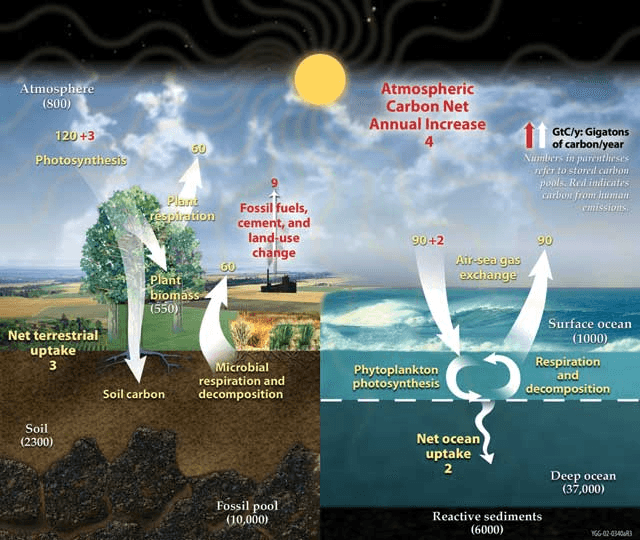
Biogeochemical Cycles and the Flow of Energy in the Earth System | Sustainability: A ... View original
Is this image relevant?
Heat Transfer in the Atmosphere | Physical Geography View original
Is this image relevant?
Modern Climate Change | Sustainability: A Comprehensive Foundation View original
Is this image relevant?
Biogeochemical Cycles and the Flow of Energy in the Earth System | Sustainability: A ... View original
Is this image relevant?
Natural vs. Anthropogenic Climate Forcings
A climate forcing is anything that changes the amount of energy entering or leaving Earth's climate system. These forcings fall into two categories based on their origin.
Natural forcings come from processes that operate without human influence:
- Solar variability: changes in the Sun's energy output over time
- Volcanic eruptions: injection of gases and particles into the atmosphere
- Orbital changes (Milankovitch cycles): slow shifts in Earth's orbit that affect how much sunlight different regions receive over thousands of years
Natural forcings tend to produce short-term or cyclical climate effects. A volcanic eruption might cool the planet for a year or two; sunspot cycles repeat roughly every 11 years.
Anthropogenic forcings result from human activities:
- Burning fossil fuels, which releases greenhouse gases
- Emitting aerosols from industry and agriculture
- Changing land surfaces through deforestation and urbanization
Since the Industrial Revolution (roughly the mid-1700s), anthropogenic forcings have grown steadily and are now the dominant driver of long-term climate change. Unlike most natural forcings, their effects accumulate over decades and centuries.

Radiative Forcing of Climate Factors
Radiative forcing is measured in watts per square meter () and describes how much a given factor shifts Earth's energy balance. A positive value means warming; a negative value means cooling.
Greenhouse Gases (GHGs) absorb and re-emit infrared radiation, trapping heat in the atmosphere. This produces positive radiative forcing (warming). The main anthropogenic GHGs are:
- Carbon dioxide (): the largest single forcing, with about since pre-industrial times. It comes primarily from fossil fuel combustion and deforestation.
- Methane (): a more potent greenhouse gas per molecule than , but present in lower concentrations. Sources include agriculture, landfills, and natural gas leaks.
- Nitrous oxide (): released by agricultural fertilizers and certain industrial processes.
Aerosols are tiny particles or droplets suspended in the atmosphere. Their effects are more complex because different types push in opposite directions:
- Sulfate aerosols (from burning coal and volcanic eruptions) reflect incoming sunlight back to space, producing negative radiative forcing (cooling).
- Black carbon (soot) absorbs sunlight, producing positive radiative forcing (warming).
Aerosols also influence cloud formation, which adds further complexity. Overall, the net aerosol effect is cooling, partially offsetting some greenhouse gas warming.
Land-use changes alter the physical properties of Earth's surface:
- Deforestation removes trees that store carbon, releasing back into the atmosphere. It also changes surface albedo (reflectivity) and reduces evapotranspiration.
- Urbanization replaces natural surfaces with concrete and asphalt, creating urban heat islands where local temperatures rise. Dark rooftops and pavement can lower albedo in some cases, while in others, replacing dark forests with lighter surfaces can increase it.

Solar and Volcanic Climate Influences
Solar variability refers to changes in the Sun's energy output (solar irradiance) over time.
- The 11-year sunspot cycle produces small fluctuations in solar output, on the order of about . This translates to a radiative forcing change of roughly , far too small to explain recent warming.
- Longer-term solar changes, such as the Maunder Minimum (roughly 1645–1715), when sunspot activity was unusually low, may have contributed to cooler conditions during parts of the Little Ice Age. Even these longer shifts are modest compared to the forcing from accumulated greenhouse gases.
Overall, solar variability accounts for only a small fraction of the warming observed since the mid-20th century.
Volcanic eruptions inject sulfur dioxide () high into the stratosphere, where it forms sulfate aerosol layers that reflect sunlight and cool the planet.
- The 1991 eruption of Mount Pinatubo lowered global average temperatures by about for roughly 1–2 years.
- The 1883 eruption of Krakatoa produced similarly dramatic but temporary cooling.
Because volcanic aerosols settle out of the stratosphere within a few years, volcanic forcing is inherently short-lived. It cannot explain a sustained, multi-decade warming trend.
Evidence for Anthropogenic Climate Change
Multiple independent lines of evidence point to human activities as the primary cause of recent warming.
Observed temperature rise: Global average surface temperature has increased by approximately since the late 1800s, with most of that warming occurring since the mid-20th century. This rate of change is unprecedented in the context of at least the past 2,000 years of climate reconstructions.
Attribution studies use climate models to test what happens when different forcings are applied individually or in combination:
- Models driven by only natural forcings (solar + volcanic) cannot reproduce the warming observed since the 1950s.
- Models driven by only anthropogenic forcings (GHGs + aerosols + land use) closely match the observed trend.
- Models that include both natural and anthropogenic forcings provide the best match to observations.
This tells you that natural forcings alone fall far short of explaining what's happened; human-caused forcings are necessary.
Fingerprints of anthropogenic warming are specific patterns that distinguish greenhouse-gas-driven warming from other possible causes:
- Tropospheric warming with stratospheric cooling: More greenhouse gases trap heat in the lower atmosphere (troposphere) while the stratosphere above actually cools because less heat escapes upward. If the Sun were the main cause, both layers would warm.
- Increased downward longwave radiation at Earth's surface, directly measured by ground-based instruments, confirming the enhanced greenhouse effect.
- Rising sea levels from both thermal expansion of warming ocean water and melting of land-based ice sheets and glaciers.
Scientific consensus: Surveys of peer-reviewed climate literature consistently find that 97% or more of actively publishing climate scientists agree that recent climate change is primarily driven by human activities. Major scientific organizations worldwide support this conclusion.
See Fiveable more often in Google
Mark Fiveable as a preferred source and Google is more likely to show you our guides in Top Stories, with a "preferred" badge in AI Mode and AI Overviews.