3.4 Heat transfer mechanisms in the Earth system

🌡️Intro to Climate Science Unit 3 Review
3.4 Heat transfer mechanisms in the Earth system
🌡️ Intro to Climate Science
Heat Transfer Mechanisms in the Earth System
Radiation, conduction, and convection are the three ways energy moves through Earth's climate system. Together, they distribute the Sun's energy from the tropics toward the poles, shaping weather patterns, ocean behavior, and global temperatures. Latent heat transfer adds another layer by moving energy through phase changes of water.

Top images from around the web for Heat transfer mechanisms
Heat Transfer in the Atmosphere | Physical Geography View original
Is this image relevant?
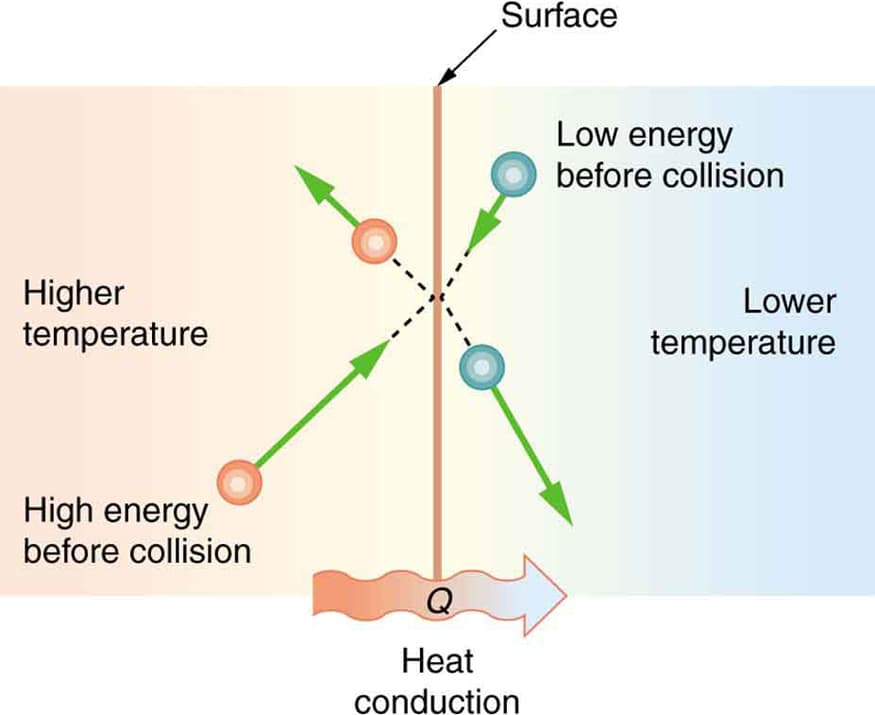
Conduction | Physics View original
Is this image relevant?
Convection · Physics View original
Is this image relevant?
Heat Transfer in the Atmosphere | Physical Geography View original
Is this image relevant?
Conduction | Physics View original
Is this image relevant?
Heat Transfer Mechanisms
Radiation transfers energy through electromagnetic waves and doesn't require a medium. This is how the Sun's energy reaches Earth across the vacuum of space (shortwave radiation) and how Earth emits energy back to space (longwave, or infrared, radiation). Radiation is the only mechanism that moves energy between Earth and space.
Conduction transfers energy through direct molecular contact. When molecules vibrate, they pass kinetic energy to neighboring molecules. This requires a medium (solid, liquid, or gas). You see conduction at work where Earth's hot surface warms the thin layer of air sitting directly on top of it, or in heat moving through rock in Earth's interior. Conduction is relatively slow in fluids, which is why convection tends to dominate in the atmosphere and oceans.
Convection transfers energy through the bulk motion of fluids (liquids or gases). When a fluid is heated, it becomes less dense and rises; cooler, denser fluid sinks to replace it. This creates circulation patterns. Major examples include atmospheric circulation cells (like Hadley cells) and ocean currents (like the Gulf Stream).

Ocean Currents and Heat Redistribution
Ocean currents act as a massive heat transport system, carrying warm water from the tropics toward the poles and cold water back toward the equator.
- Warm currents move heat from low to high latitudes. The Gulf Stream, for instance, carries warm Caribbean water northeastward across the Atlantic, which is a major reason why Western Europe has milder winters than you'd expect for its latitude. The Kuroshio Current does something similar in the Pacific, moving warm water from the tropics toward Japan and the North Pacific.
- Cold currents move cooler water from high to low latitudes. The Antarctic Circumpolar Current circulates cold water around Antarctica, and cold currents along the west coast of South America cool nearby coastal regions.
These currents directly shape regional climates. Coastal areas near warm currents tend to have moderated, milder temperatures, while coasts near cold currents tend to be cooler and drier.

Atmospheric Circulation and Heat Transfer
Earth's atmosphere redistributes heat through a system of large-scale circulation cells organized by latitude:
- Hadley cells (equator to ~30° latitude): Warm air rises at the equator, flows poleward at high altitude, then descends around 30° latitude. These are the strongest cells and move the most heat, driving tropical weather patterns.
- Ferrel cells (~30° to ~60° latitude): These mid-latitude cells circulate between the descending air at 30° and rising air at 60°. They're driven partly by the Hadley and Polar cells on either side.
- Polar cells (~60° to 90° latitude): Cold, dense air sinks at the poles and flows toward 60° latitude, where it meets warmer air and rises. These cells are the weakest of the three.
Jet streams are fast, narrow bands of strong wind in the upper atmosphere, typically found near the boundaries between these cells. They steer weather systems and air masses, influencing how heat and moisture get distributed across mid-latitudes. The polar jet stream, for example, marks the boundary between cold polar air and warmer subtropical air.
Latent Heat in Earth's Energy Budget
Latent heat is the energy absorbed or released when water changes phase (liquid to gas, gas to liquid, etc.) without changing temperature.
- Evaporation absorbs energy from the surface, cooling it. Huge amounts of water evaporate from oceans, lakes, and land surfaces every day, pulling heat away from the surface.
- Condensation releases that stored energy into the atmosphere, warming the surrounding air. This happens when moist air rises, cools, and water vapor condenses into cloud droplets.
This cycle is a major component of Earth's energy budget. Surface energy is essentially "packaged" into water vapor, transported by winds, and then released into the atmosphere wherever condensation occurs. That released energy drives atmospheric circulation and fuels weather systems.
Tropical cyclones are a dramatic example: they draw enormous energy from latent heat released as warm ocean water evaporates and then condenses in towering thunderstorms. Frontal weather systems in the mid-latitudes also intensify when latent heat is released during precipitation. Global precipitation patterns are shaped in large part by where and how this latent heat gets released.
See Fiveable more often in Google
Mark Fiveable as a preferred source and Google is more likely to show you our guides in Top Stories, with a "preferred" badge in AI Mode and AI Overviews.