4.2 Ocean currents and thermohaline circulation

🌡️Intro to Climate Science Unit 4 Review
4.2 Ocean currents and thermohaline circulation
🌡️ Intro to Climate Science
Ocean Currents
Ocean currents are massive flows of water that redistribute heat, salt, and nutrients across the globe. They play a central role in regulating climate and sustaining marine ecosystems. Two main types exist: wind-driven surface currents and density-driven deep currents.

Top images from around the web for Drivers of ocean currents
8.2 Winds and the Coriolis Effect – Introduction to Oceanography View original
Is this image relevant?
8.2 Winds and the Coriolis Effect – Introduction to Oceanography View original
Is this image relevant?
Thermohaline circulation | Earth Science View original
Is this image relevant?
8.2 Winds and the Coriolis Effect – Introduction to Oceanography View original
Is this image relevant?
8.2 Winds and the Coriolis Effect – Introduction to Oceanography View original
Is this image relevant?
Drivers of Ocean Currents
Three forces work together to set ocean water in motion:
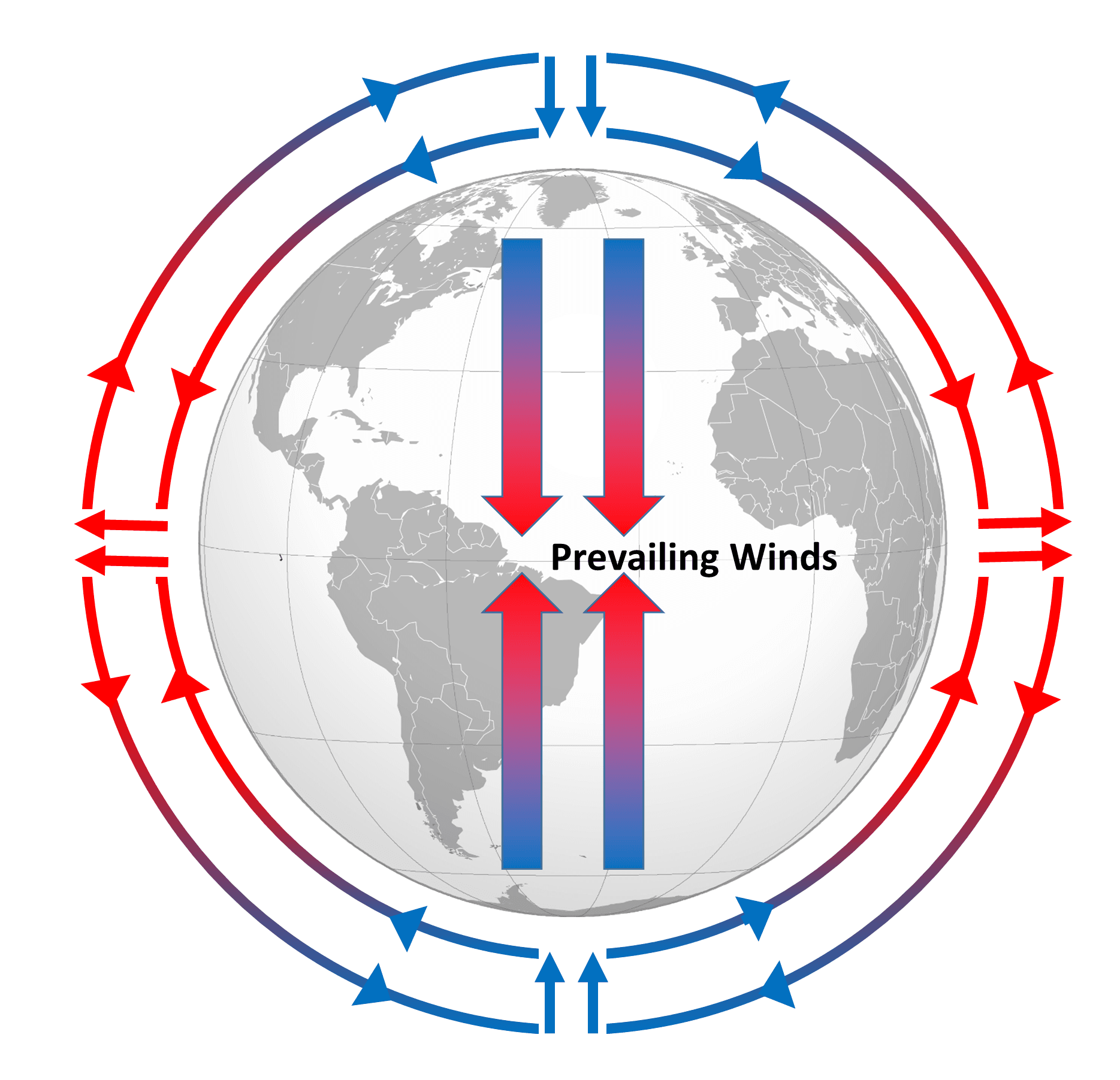
Wind stress creates friction between moving air and the ocean surface, pushing water along. The major global wind belts each drive corresponding currents:
- Trade winds (blowing east to west near the equator) and westerlies (blowing west to east at mid-latitudes) power large surface currents like the Gulf Stream in the Atlantic and the Kuroshio Current in the Pacific.
- Polar easterlies drive currents at high latitudes.
Density differences arise from variations in water temperature and salinity. Cold water is denser than warm water, and saltier water is denser than fresher water. Where these density gradients exist, denser water sinks and less dense water rises, setting up the vertical circulation that drives thermohaline currents.
The Coriolis effect deflects moving water (and anything else in motion) because of Earth's rotation. In the Northern Hemisphere, currents deflect to the right; in the Southern Hemisphere, they deflect to the left. This deflection causes surface currents to curve, forming large circular flow patterns called gyres (e.g., the North Atlantic Gyre, the North Pacific Gyre).

Surface vs. Deep Ocean Currents
- Surface currents occupy roughly the upper 400 meters of the ocean and are primarily wind-driven. They move relatively fast and respond to seasonal wind changes. Major examples include the Gulf Stream, the Kuroshio Current, and the Antarctic Circumpolar Current (the only current that flows completely around the globe).
- Deep ocean currents flow below about 400 meters and are driven by density differences rather than wind. They move much more slowly and are more stable over time. Key examples are North Atlantic Deep Water (NADW) and Antarctic Bottom Water (AABW), both of which play critical roles in thermohaline circulation.

Thermohaline Circulation
What Thermohaline Circulation Is and How It Works
Thermohaline circulation (THC) is the large-scale ocean circulation driven by density differences caused by variations in temperature (thermo) and salinity (haline). Here's how the process unfolds:
- Warm surface water flows from the tropics toward the poles.
- As this water reaches high latitudes, it cools and releases heat to the atmosphere.
- Sea ice formation in polar regions leaves salt behind, increasing the salinity of the surrounding water.
- The combination of cold temperature and high salinity makes this water very dense, so it sinks to the ocean floor.
- This dense deep water then spreads slowly along the ocean bottom toward lower latitudes.
- Eventually, deep water returns to the surface through upwelling, often in regions like the equatorial Pacific, where it brings nutrient-rich water up to support marine life and primary productivity.
The two most important deep water masses formed through this process are:
- North Atlantic Deep Water (NADW), which forms in the Nordic and Labrador Seas of the North Atlantic
- Antarctic Bottom Water (AABW), which forms near Antarctica in the Southern Ocean and is the densest water mass in the global ocean
The Ocean Conveyor Belt and Its Role in Climate
The global ocean conveyor belt (sometimes called the Great Ocean Conveyor) is the interconnected system of surface and deep currents that links all the world's ocean basins. Thermohaline circulation is the engine that keeps it running.
This conveyor belt matters for climate in several ways:
- Heat redistribution: It transports enormous amounts of heat from the equator toward the poles, reducing the temperature difference between tropical and polar regions. Western Europe, for instance, has a notably mild climate for its latitude partly because the conveyor delivers warm water northward across the Atlantic.
- Carbon storage: Cold surface water at high latitudes absorbs atmospheric . When this water sinks, it carries dissolved carbon into the deep ocean, where it can remain stored for centuries. This makes the conveyor belt an important part of the global carbon cycle.
- Nutrient cycling: Upwelling zones where deep water returns to the surface bring nutrients that fuel phytoplankton growth, supporting entire marine food webs.
Climate change and the conveyor belt: Rising global temperatures threaten to disrupt this system. As ice sheets and glaciers melt, they add large volumes of freshwater to the ocean at high latitudes. This freshwater reduces surface salinity, making the water less dense and weakening the sinking that drives the conveyor. A significant slowdown or shutdown of the conveyor belt could alter weather patterns across Europe, shift tropical rainfall belts, and reduce the ocean's ability to absorb . Observations already suggest the Atlantic branch of the conveyor has weakened over recent decades, though the full consequences remain an active area of research.
See Fiveable more often in Google
Mark Fiveable as a preferred source and Google is more likely to show you our guides in Top Stories, with a "preferred" badge in AI Mode and AI Overviews.