1.4 Introduction to climate change and global warming

🌡️Intro to Climate Science Unit 1 Review
1.4 Introduction to climate change and global warming
🌡️ Intro to Climate Science
Climate change refers to long-term shifts in temperature, precipitation, and other climate variables, driven largely by greenhouse gas emissions from human activities. Understanding the science behind these shifts is essential for projecting future conditions and developing effective responses. This guide covers the core definitions, causes, impacts, and reasons why climate science matters.
Understanding Climate Change and Global Warming

Top images from around the web for Definition of climate change
Climate Zones and Biomes | Physical Geography View original
Is this image relevant?
Images - Thumbnails View original
Is this image relevant?
10.4 Climate Change | Environmental Biology View original
Is this image relevant?
Climate Zones and Biomes | Physical Geography View original
Is this image relevant?
Images - Thumbnails View original
Is this image relevant?
Definition of climate change
Climate change describes long-term shifts in global or regional climate patterns, occurring over decades to millennia. These shifts include changes in temperature, precipitation, wind patterns, and other climate variables.
Both natural and human factors can drive climate change. Natural causes include volcanic eruptions (which release particles that temporarily cool the atmosphere) and variations in solar output. Human causes include greenhouse gas emissions and land-use changes like deforestation. Contemporary climate change is overwhelmingly driven by human activities, which is why you'll often see it distinguished from past, naturally driven climate shifts.

Causes of contemporary climate change
Greenhouse gases (GHGs) are at the center of the story. These gases absorb and re-emit infrared radiation, trapping heat in the atmosphere rather than letting it escape to space. The main human-produced GHGs are:
- Carbon dioxide (): Released primarily by burning fossil fuels and deforestation. Atmospheric has risen from pre-industrial levels of roughly 280 ppm to over 420 ppm today.
- Methane (): Released by livestock farming, rice cultivation, landfills, and natural gas extraction. Methane is far more potent than per molecule but stays in the atmosphere for a shorter time.
- Nitrous oxide (): Released by agricultural fertilizers, industrial processes, and combustion of fossil fuels.
The human activities that release these gases include:
- Burning fossil fuels (coal, oil, natural gas) for energy and transportation
- Deforestation and land-use changes, which reduce carbon sinks and release stored carbon
- Agricultural practices, particularly livestock and rice cultivation
- Industrial processes like cement production and chemical manufacturing
Positive feedback loops amplify the initial warming, making the problem worse over time:
- Ice-albedo feedback: As ice and snow melt, Earth's surface becomes darker and absorbs more solar energy instead of reflecting it, which causes further warming and more melting.
- Permafrost thawing: Warming temperatures thaw permafrost in Arctic regions, releasing stored and that had been locked in frozen soil for thousands of years.
- Water vapor feedback: Warmer air holds more water vapor, which is itself a potent greenhouse gas. This creates additional warming on top of the original temperature increase.

Impacts and Importance of Studying Climate Change
Impacts on nature and society
Natural systems are already experiencing significant changes:
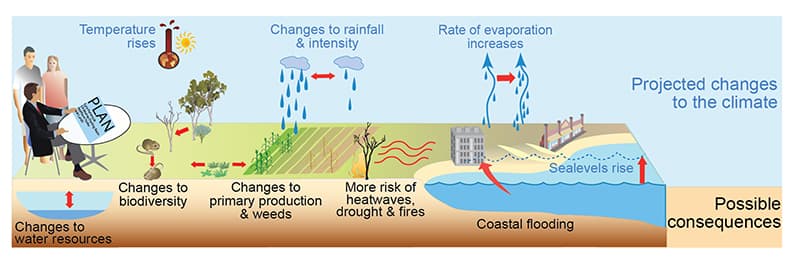
- Rising sea levels result from two processes: thermal expansion (water expands as it warms) and the melting of land-based ice sheets in Greenland and Antarctica. Global sea levels have risen about 20 cm since 1900.
- Shifting precipitation patterns lead to more frequent and severe droughts in some regions and flooding in others.
- Species redistribution: Plants and animals are shifting their ranges toward the poles or to higher elevations as temperatures change, disrupting existing ecosystems.
- Ocean acidification: The ocean absorbs roughly 25% of atmospheric , which lowers the water's pH. This threatens marine organisms that build calcium carbonate shells and skeletons, including coral reefs.
Human societies face interconnected challenges:
- Food security: Changing temperatures and precipitation patterns alter crop yields and growing seasons, with some regions facing sharp declines in agricultural productivity.
- Extreme weather: Heatwaves, hurricanes, and wildfires are becoming more frequent and intense, causing damage to infrastructure and loss of life.
- Disease spread: Warmer conditions expand the geographic range of disease-carrying organisms, increasing the risk of vector-borne diseases like malaria and dengue fever.
- Population displacement: Sea-level rise, coastal erosion, and other climate hazards force communities to relocate, creating climate refugees.
Importance of climate science
Climate science helps us understand what's happening and why:
- It identifies the main drivers of climate change (GHG emissions, land-use changes) and traces their consequences (temperature rise, sea-level rise, ecosystem disruption).
- It develops and refines climate models that project future conditions under different emission scenarios, known as Representative Concentration Pathways (RCPs).
- Through detection and attribution studies, it distinguishes human-caused changes from natural variability, establishing how much of the observed warming is due to human activity.
Climate science also directly informs policy and action:
- It provides the evidence base for mitigation policies like carbon pricing and renewable energy incentives aimed at reducing emissions.
- It guides adaptation measures such as coastal protection infrastructure and improved water resource management to minimize climate risks.
On the international stage, climate science supports cooperation through bodies like the Intergovernmental Panel on Climate Change (IPCC), which synthesizes research findings into comprehensive assessments. These assessments underpin international agreements like the Paris Agreement, which set targets for limiting global temperature rise.
Finally, climate science plays a key role in public communication. Translating research findings into accessible information helps individuals and communities make informed decisions about reducing carbon footprints and building resilience to climate impacts.
See Fiveable more often in Google
Mark Fiveable as a preferred source and Google is more likely to show you our guides in Top Stories, with a "preferred" badge in AI Mode and AI Overviews.