2.1 Layers of the atmosphere and their characteristics

🌡️Intro to Climate Science Unit 2 Review
2.1 Layers of the atmosphere and their characteristics
🌡️ Intro to Climate Science
Earth's atmosphere is organized into distinct layers, each defined by how temperature changes with altitude. Understanding this structure is essential for making sense of weather, ozone chemistry, and how energy moves through the climate system.
Atmospheric Layers and Characteristics

Top images from around the web for Layers of Earth's atmosphere
Layers of the Atmosphere | Physical Geography View original
Is this image relevant?
sciencepage622 - The Five layers Of The Atmosphere-Andy View original
Is this image relevant?
File:Atmospheric Layers.svg - Wikimedia Commons View original
Is this image relevant?
Layers of the Atmosphere | Physical Geography View original
Is this image relevant?
sciencepage622 - The Five layers Of The Atmosphere-Andy View original
Is this image relevant?
Layers of Earth's atmosphere
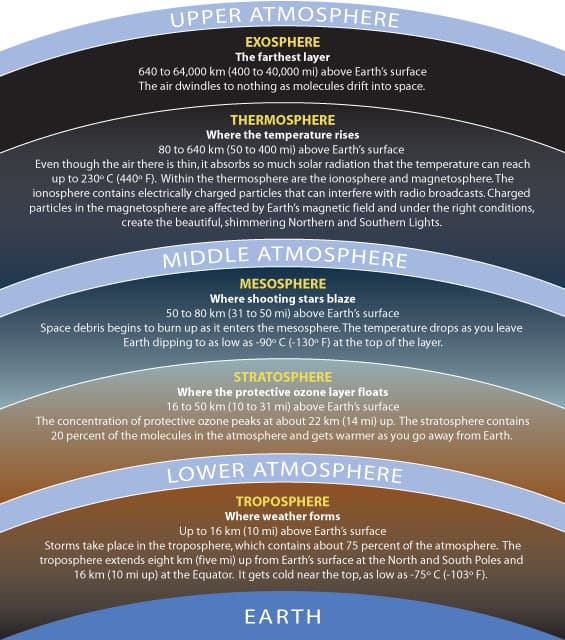
The atmosphere is divided into five main layers, stacked from the surface outward. The boundaries between them are defined by reversals in the temperature trend (whether temperature is increasing or decreasing with altitude).
- Troposphere — The lowest layer, extending from Earth's surface to an average altitude of about 12 km (7.5 miles). It contains 75–80% of the atmosphere's total mass and nearly all of its water vapor and aerosols. This is where we live and where virtually all weather occurs.
- Stratosphere — Extends from the tropopause up to about 50 km (31 miles). This layer contains the ozone layer, which absorbs UV radiation from the sun. That absorption is what makes the stratosphere warm up with altitude rather than cool down.
- Mesosphere — Extends from the stratopause up to about 85 km (53 miles). Temperature drops with altitude again here, reaching as low as () at the mesopause. This is the coldest part of the entire atmosphere.
- Thermosphere — Extends from the mesopause to roughly 500–1,000 km (311–621 miles). Temperatures rise dramatically because gas molecules absorb high-energy solar radiation. Auroras (northern and southern lights) occur here when charged particles from the sun interact with atmospheric gases.
- Exosphere — The outermost layer, stretching from the thermopause out to about 10,000 km (6,200 miles). It's the transitional zone where Earth's atmosphere gradually fades into outer space.

Characteristics of atmospheric layers
Each layer has a distinct temperature profile, and that profile drives the layer's behavior.
- Troposphere
- Temperature decreases with altitude at an average lapse rate of about
- Pressure and density drop rapidly with altitude
- Contains almost all atmospheric water vapor, so clouds, rain, and storms are concentrated here
- Strong vertical mixing makes this layer turbulent and dynamic
- Stratosphere
- Temperature increases with altitude because ozone absorbs UV radiation and releases heat
- Very dry and stable, with little vertical mixing
- Pressure continues to decrease, but more gradually than in the troposphere
- Commercial jets sometimes cruise near the lower stratosphere to avoid weather turbulence
- Mesosphere
- Temperature decreases with altitude again, reaching its minimum at the mesopause
- Pressure drops to roughly 1/1,000th of sea-level pressure at the top
- Meteors burn up in this layer due to friction with gas molecules
- Noctilucent clouds (thin, wispy ice clouds) can form near the mesopause during summer at high latitudes
- Thermosphere
- Temperature can reach up to (), but air density is extremely low, so it wouldn't feel "hot" in the way you'd expect
- Individual gas molecules move at very high speeds, which is what "temperature" measures at this scale
- Temperatures are highly variable depending on solar activity and time of day
- The International Space Station orbits within this layer
- Exosphere
- Atmospheric pressure is essentially negligible
- Dominated by hydrogen and helium, which are light enough to escape Earth's gravity entirely
- Many satellites orbit within this layer

Function of atmospheric boundaries
The boundaries between layers are called "pauses," and each one marks a reversal in the temperature trend.
- Tropopause (~12 km altitude)
- The boundary between the troposphere and stratosphere
- Below it, temperature decreases with altitude; above it, temperature begins increasing
- Acts as a kind of lid on the troposphere, limiting how high convective air currents can rise and effectively capping most weather systems
- Its height varies: taller over the tropics (~16 km) and lower over the poles (~8 km)
- Stratopause (~50 km altitude)
- The boundary between the stratosphere and mesosphere
- Marks where the warming effect of ozone absorption fades and temperature begins decreasing again
- Separates the stable stratosphere from the mesosphere above
- Mesopause (~85 km altitude)
- The boundary between the mesosphere and thermosphere
- The coldest point in the atmosphere, where the temperature trend reverses from decreasing to increasing
Ozone layer in the stratosphere
The ozone layer is a region of naturally elevated ozone () concentration within the stratosphere, located roughly 20–30 km (12–19 miles) above Earth's surface. It plays a critical role in both protecting life and shaping the atmosphere's temperature structure.
- UV protection: Ozone absorbs harmful ultraviolet radiation, particularly UV-B and UV-C wavelengths. Without this shield, Earth's surface would receive far more radiation capable of damaging DNA and increasing rates of skin cancer and cataracts.
- Stratospheric temperature inversion: The energy ozone absorbs from UV radiation is converted to heat, which is why temperature increases with altitude in the stratosphere. This creates a stable layer with very little vertical mixing.
- Anthropogenic ozone depletion: Manufactured chemicals, especially chlorofluorocarbons (CFCs), can break down ozone molecules in the stratosphere. A single chlorine atom released from a CFC can destroy thousands of ozone molecules. This process is most severe over polar regions during late winter and early spring, producing what's known as the "ozone hole." The 1987 Montreal Protocol banned most CFCs, and the ozone layer has been slowly recovering since.
See Fiveable more often in Google
Mark Fiveable as a preferred source and Google is more likely to show you our guides in Top Stories, with a "preferred" badge in AI Mode and AI Overviews.