12.3 Future climate scenarios and their potential impacts

🌡️Intro to Climate Science Unit 12 Review
12.3 Future climate scenarios and their potential impacts
🌡️ Intro to Climate Science
Representative Concentration Pathways and Climate Projections
Climate scientists need a way to model what the future might look like under different levels of greenhouse gas emissions. That's where Representative Concentration Pathways (RCPs) come in. Each RCP describes a plausible trajectory for greenhouse gas concentrations, aerosols, and other climate drivers through the year 2100, and each one is tied to a specific radiative forcing value. Radiative forcing is the difference between the solar energy Earth absorbs and the energy it radiates back to space, measured in . A higher radiative forcing means more energy trapped in the climate system, which means more warming.
These RCPs serve as inputs for climate models, which are mathematical representations of Earth's climate system (like general circulation models and Earth system models). By running different RCPs through these models, scientists can project a range of possible futures.

Top images from around the web for Representative Concentration Pathways scenarios
Increasingly severe consequences of climate change (GMT 9) — European Environment Agency View original
Is this image relevant?
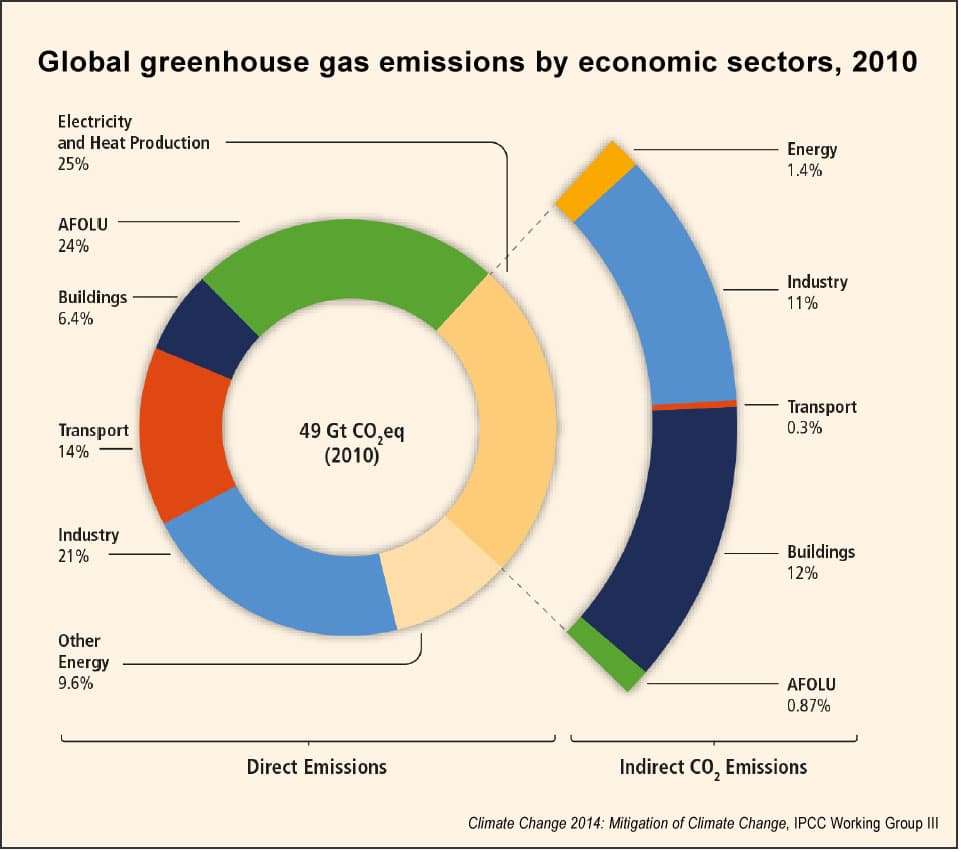
How to mitigate climate change: Key facts from the U.N.'s 2014 report - Journalist's Resource View original
Is this image relevant?
Increasingly severe consequences of climate change (GMT 9) — European Environment Agency View original
Is this image relevant?
Increasingly severe consequences of climate change (GMT 9) — European Environment Agency View original
Is this image relevant?
How to mitigate climate change: Key facts from the U.N.'s 2014 report - Journalist's Resource View original
Is this image relevant?
Representative Concentration Pathway Scenarios
There are four main RCPs, ranging from aggressive emission cuts to unchecked growth:
- RCP2.6 ( by 2100): The most optimistic scenario. Emissions peak around 2020 and then decline sharply. This requires stringent mitigation efforts worldwide.
- RCP4.5 (): An intermediate scenario where emissions peak around 2040 and then gradually decline.
- RCP6.0 (): Another intermediate scenario, but emissions don't peak until around 2080 before declining.
- RCP8.5 (): The high-emission, "business-as-usual" scenario. Emissions continue rising throughout the entire 21st century with no significant mitigation.
The number in each RCP name corresponds to its radiative forcing value by 2100. So RCP8.5 traps far more energy than RCP2.6, producing much more warming.

Projections Under RCP Scenarios
Temperature: All scenarios project warming, but the range is dramatic. Compared to the 1986–2005 baseline:
- Under RCP2.6, global average temperature rises by about 0.3°C to 1.7°C by 2100.
- Under RCP8.5, that jump is 2.6°C to 4.8°C by 2100.
The difference between these two outcomes depends almost entirely on the emission choices made in the coming decades.
Precipitation: The water cycle intensifies as the planet warms. Wet regions are generally projected to get wetter, and dry regions to get drier. Under higher emission scenarios, extreme precipitation events (both floods and droughts) become more frequent and more intense.
Sea Level: Thermal expansion of ocean water and melting ice sheets drive sea level rise under all scenarios:
- RCP2.6: 0.26 to 0.55 m of rise by 2100
- RCP8.5: 0.45 to 0.82 m of rise by 2100
Sea level rise won't be uniform across the globe. Some coastal regions will experience significantly higher increases than others due to ocean currents, land subsidence, and gravitational effects from ice sheet loss. This uneven rise makes coastal flooding and erosion especially dangerous in certain areas.
Impacts and Responses to Future Climate Change
Climate Change Impacts on Systems
Ecosystems face cascading disruptions. As temperatures and precipitation patterns shift, species distributions change and phenology (the timing of seasonal events like migration and flowering) gets thrown off. Coral reefs and polar bears are among the species at highest extinction risk because they can't easily adapt or relocate. Beyond individual species, entire ecosystem functions like carbon storage and water filtration can be altered as productivity and nutrient cycling shift.
Agriculture sees a mixed picture depending on location. In low-latitude regions, higher temperatures and shifting rainfall reduce crop yields and increase the risk of crop failures, threatening food security. In high-latitude regions, longer growing seasons could actually benefit certain crops like wheat and potatoes. But globally, the negative impacts are projected to outweigh the positives, especially under higher emission scenarios where droughts and pest outbreaks become more common.
Human health is affected through several pathways:
- Heat-related illness and death increase, particularly in cities where the urban heat island effect amplifies heat waves.
- Vector-borne diseases like malaria and dengue fever spread into new regions as warmer temperatures expand the range of mosquitoes and other carriers.
- Air quality worsens as higher temperatures increase ground-level ozone and extend pollen seasons, worsening respiratory conditions.
Mitigation and Adaptation Strategies
Addressing climate change requires two complementary approaches. Mitigation focuses on reducing greenhouse gas emissions to limit how much the climate changes. Adaptation focuses on reducing vulnerability to the changes that are already happening or are unavoidable.
Mitigation strategies:
- Transitioning to low-carbon energy sources like solar, wind, and nuclear power
- Improving energy efficiency across buildings, transportation, and industry (better insulation, fuel-efficient vehicles)
- Implementing carbon pricing mechanisms such as carbon taxes or cap-and-trade systems to create economic incentives for reducing emissions
Adaptation strategies:
- Developing drought-resistant crops (like sorghum and millet) and improving water management through techniques like drip irrigation and rainwater harvesting
- Strengthening urban infrastructure with features like sea walls and green roofs to build resilience against extreme weather
- Establishing early warning systems and emergency response plans for climate hazards such as hurricanes and wildfires
These two approaches work together. Effective mitigation reduces the severity of future changes, which means less adaptation is needed. But some impacts, like the sea level rise already locked in from past emissions, are unavoidable regardless of mitigation efforts. That's why adaptation remains necessary even under the most optimistic scenarios.
See Fiveable more often in Google
Mark Fiveable as a preferred source and Google is more likely to show you our guides in Top Stories, with a "preferred" badge in AI Mode and AI Overviews.