3.1 Solar radiation and Earth's energy budget

🌡️Intro to Climate Science Unit 3 Review
3.1 Solar radiation and Earth's energy budget
🌡️ Intro to Climate Science
Solar Radiation

Top images from around the web for Characteristics of solar radiation
Solar maximum - Wikipedia View original
Is this image relevant?
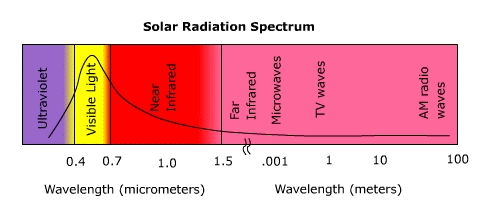
The nature of electromagnetic radiation View original
Is this image relevant?
The Solar Cycle · Astronomy View original
Is this image relevant?
Solar maximum - Wikipedia View original
Is this image relevant?
The nature of electromagnetic radiation View original
Is this image relevant?
Characteristics of solar radiation
The Sun produces energy through nuclear fusion in its core, converting hydrogen into helium. This energy radiates outward as a continuous spectrum of electromagnetic waves spanning three main ranges:
- Ultraviolet (UV): wavelengths shorter than 400 nm
- Visible light: 400–700 nm, where solar intensity peaks
- Infrared (IR): wavelengths longer than 700 nm
The solar constant is the average intensity of solar radiation arriving at the top of Earth's atmosphere: . This value isn't truly constant, though. It fluctuates slightly based on Earth's distance from the Sun (closer at perihelion in January, farther at aphelion in July) and on solar activity cycles like the roughly 11-year sunspot cycle.

Components of Earth's energy budget
Earth's energy budget tracks the balance between energy coming in and energy going out. If these two don't match, the planet warms or cools.
Incoming energy (shortwave radiation):
- The Sun sends shortwave radiation (mostly UV and visible light) toward Earth
- Some of this is reflected back to space by clouds, aerosols (dust, smoke, sulfate particles), and reflective surfaces like ice. The fraction reflected is called albedo.
- The rest is absorbed by the surface and atmosphere
Outgoing energy (longwave radiation):
- Earth's surface and atmosphere emit longwave (infrared) radiation back toward space
- Greenhouse gases like and water vapor absorb some of this outgoing radiation and re-emit it in all directions, warming the lower atmosphere
Energy transfer within the system:
- Latent heat: energy absorbed during evaporation and released during condensation
- Sensible heat: energy transferred by direct contact (conduction) or by moving air and water (convection)
- These processes redistribute heat from the surface into the atmosphere and from the tropics toward the poles

Earth's Energy Balance
Solar vs. terrestrial radiation balance
At equilibrium, the energy Earth absorbs from the Sun equals the energy it radiates back to space. You can express this with a simple equation:
Where:
- = Earth's average albedo, approximately 0.3 (meaning 30% of incoming sunlight is reflected)
- = solar constant,
- The factor of accounts for geometry: sunlight hits a circular cross-section () but spreads over the entire spherical surface ()
- = emissivity, approximately 0.95 for Earth (how efficiently it radiates compared to a perfect blackbody)
- = Stefan-Boltzmann constant,
- = Earth's effective radiating temperature in Kelvin
When you solve this equation without accounting for the greenhouse effect, you get an equilibrium temperature around 255 K (about ). Earth's actual average surface temperature is roughly 288 K (). That 33°C difference is the warming provided by greenhouse gases.
Distribution factors of solar radiation
Not every part of Earth receives the same amount of solar energy. Four main factors control the distribution:
Latitude is the single biggest factor.
- Near the equator, sunlight strikes the surface at a nearly perpendicular angle, concentrating energy over a smaller area.
- Near the poles, sunlight arrives at a shallow angle and spreads over a much larger area, delivering less energy per square meter.
Seasonal variation results from Earth's axial tilt of 23.5°.
- During the June solstice, the Northern Hemisphere tilts toward the Sun and receives more direct radiation (its summer).
- During the December solstice, the Southern Hemisphere gets its turn.
- This tilt also drives the length of daylight hours, which amplifies seasonal differences at high latitudes.
Atmospheric conditions reduce the solar radiation that reaches the surface.
- Clouds reflect a significant portion of incoming sunlight
- Air molecules scatter shorter wavelengths (which is why the sky looks blue)
- Ozone in the stratosphere absorbs most incoming UV radiation
Surface characteristics determine how much of the arriving radiation gets absorbed versus reflected.
- Albedo is the fraction of sunlight a surface reflects:
- Fresh snow and ice: 0.8–0.9 (highly reflective)
- Oceans and forests: 0.06–0.2 (mostly absorbing)
- Elevation matters too. Higher-altitude locations sit above more of the atmosphere, so less radiation is scattered or absorbed before reaching the surface.
See Fiveable more often in Google
Mark Fiveable as a preferred source and Google is more likely to show you our guides in Top Stories, with a "preferred" badge in AI Mode and AI Overviews.