2.1 Relative Motion, Distance, and Displacement

⚾️Honors Physics Unit 2 Review
2.1 Relative Motion, Distance, and Displacement
⚾️ Honors Physics
continue practicing 2.1
Multiple choice
Relative Motion, Distance, and Displacement
Motion is all about perspective. Whether you're watching from the sidelines or riding along, objects can appear to move differently depending on where you observe from. This concept of relative motion, along with the distinction between distance and displacement, forms the foundation for analyzing motion in one dimension.
Motion in Multiple Reference Frames
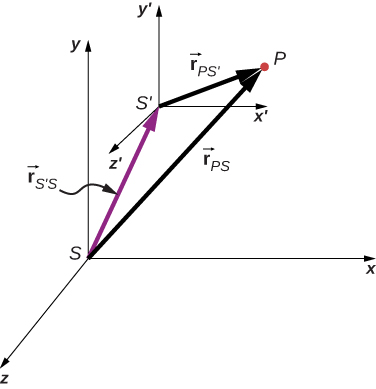
A reference frame is a coordinate system you use to describe the position and motion of objects. Think of it as the "viewpoint" from which you're making measurements.
Relative motion is the motion of an object as observed from a particular reference frame. The same object can look like it's doing completely different things depending on which frame you're observing from:
- A person sitting in a moving train is at rest relative to the train, but moving at 80 km/h relative to someone standing on the platform.
- A ball thrown straight up inside an accelerating elevator follows a simple vertical path from the thrower's perspective, but traces a curved, accelerating path from the ground's perspective.
Both velocity and acceleration can change depending on the reference frame, which is why specifying your frame matters every time you describe motion.
Galilean relativity states that the laws of physics are the same in all inertial frames of reference (frames that aren't accelerating). This principle also helps explain real phenomena like the Coriolis effect, where Earth's rotation creates an apparent deflection of moving objects when viewed from Earth's surface.
Distance vs. Displacement Concepts
These two terms sound interchangeable, but they measure fundamentally different things.
- Distance is the total length of the path traveled. It's a scalar quantity (magnitude only, always positive or zero).
- Displacement is the change in position from start to finish. It's a vector quantity (has both magnitude and direction).
Consider a car that drives 5 km east, then 3 km west:
Distance = 5 km + 3 km = 8 km (every meter driven counts)
Displacement = 5 km east − 3 km west = 2 km east (only the net change in position matters)
A few more examples that make the distinction click:
- Your car's odometer measures distance, not displacement. It never decreases, even when you backtrack.
- A runner who completes one full lap on a circular track covers a nonzero distance but has zero displacement, since they end up right where they started.
One more key term: position is a vector that describes an object's location relative to a chosen origin. Displacement is the change in position.

Calculations of Distance and Displacement
Calculating distance means adding up the magnitudes (absolute values) of every segment of the path:
Calculating displacement means finding the net change in position:
where is the final position and is the initial position.
Worked example: A hiker walks 2 km north, then 1.5 km south, then 3 km north.
- Distance:
- Displacement: Taking north as positive, , so 3.5 km north.
Interpreting your results: Comparing distance to displacement tells you something about the path.
- If distance is much greater than the magnitude of displacement, the object likely backtracked or followed a winding path.
- If distance roughly equals the magnitude of displacement, the object moved in a nearly straight line without reversing direction.
Motion Analysis
Two quantities build directly on position and displacement:
- Velocity is the rate of change of position with respect to time. It's a vector, so it describes both how fast an object moves and in what direction.
- Acceleration is the rate of change of velocity with respect to time. It indicates changes in speed, direction, or both.
An inertial frame is any reference frame in which Newton's laws hold true. In practice, this means the frame itself is not accelerating. A car cruising at constant velocity on a straight highway is (approximately) an inertial frame; a car slamming on its brakes is not.
See Fiveable more often in Google
Mark Fiveable as a preferred source and Google is more likely to show you our guides in Top Stories, with a "preferred" badge in AI Mode and AI Overviews.