1.2 The Scientific Methods

⚾️Honors Physics Unit 1 Review
1.2 The Scientific Methods
⚾️ Honors Physics
continue practicing 1.2
Multiple choice
The Scientific Method and Its Applications in Physics
The scientific method is the foundation of how physics works. It gives you a structured way to move from curiosity about a phenomenon to a reliable, tested explanation. This section covers the steps of that process, the role of models, the differences between hypotheses, theories, and laws, and the types of reasoning physicists use.
Steps of the Scientific Method
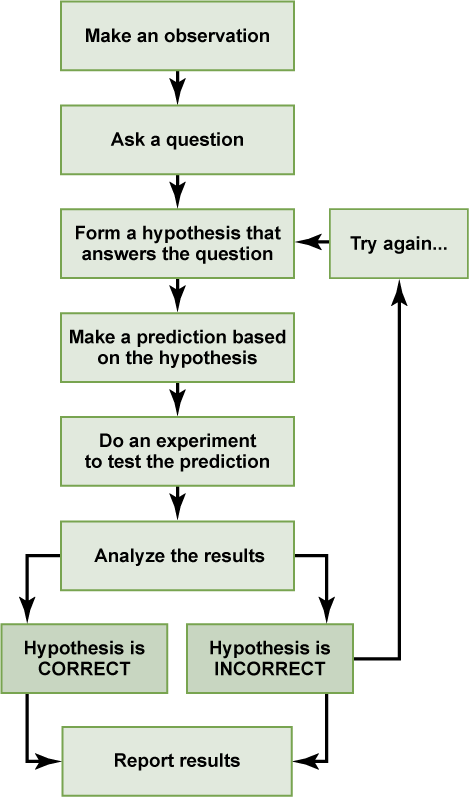
The scientific method isn't always a rigid, linear recipe. Scientists often loop back to earlier steps as new data comes in. But the general flow looks like this:
-
Observation and question — You notice something in the natural world and ask a focused question about it. For example: Why does an apple fall from a tree instead of floating upward?
-
Hypothesis — You propose a tentative, testable explanation based on what you already know. A hypothesis also includes a prediction. Example: Objects fall because a force called gravity pulls them toward Earth. If so, all objects near Earth's surface should accelerate downward at the same rate.
-
Experiment — You design a controlled experiment to test your prediction. This means isolating variables and collecting data with appropriate tools. Example: measuring the acceleration of falling objects of different masses using a motion sensor.
-
Analysis — You examine the data using graphs, calculations, and statistical methods. The goal is to compare your actual results to what your hypothesis predicted.
-
Conclusion — Based on the analysis, you determine whether the evidence supports, refutes, or requires modification of your hypothesis. Example: The data shows all objects accelerate at approximately near Earth's surface, supporting the hypothesis.
-
Communication and replication — You share your findings through publications or presentations so other scientists can replicate the experiment. Peer review ensures the methods and conclusions hold up to scrutiny. Results only become widely accepted once they've been independently verified.
Models in Physics
Models are simplified representations of real systems. They strip away unnecessary complexity so you can focus on the physics that matters most. There are two main types.
Physical models are tangible or visual representations that capture the essential features of a system.
- The Bohr model of the atom depicts electrons orbiting the nucleus in fixed energy shells. It's not a perfect picture of how atoms actually work, but it helps you visualize atomic structure and predict the emission spectra of hydrogen.
- A simple pendulum (a mass on a string) helps you study periodic motion and energy conservation without worrying about air resistance or the mass of the string.
Mathematical models use equations to describe how a system behaves in terms of variables and parameters.
- Newton's second law, , relates force, mass, and acceleration. With this single equation, you can predict the motion of objects under a wide range of conditions.
- The Schrödinger equation, , describes the quantum state of a system and enables predictions about atomic and molecular properties.
Why models matter: They guide experiment design and help you interpret results by providing a framework for what you expect to happen. Without models, you'd just be collecting data with no way to make sense of it.
Limitations: Every model involves approximations. The Bohr model works well for hydrogen but fails for heavier atoms. Newtonian mechanics breaks down at speeds approaching the speed of light (where you need relativity) and at atomic scales (where you need quantum mechanics). Recognizing when a model breaks down is just as important as knowing how to use it.

Hypotheses vs. Theories vs. Laws
These three terms have specific meanings in science that differ from everyday usage. Students often confuse them, so pay close attention to the distinctions.
- Hypothesis — A tentative, testable explanation for an observation, based on limited evidence. It's a starting point, not a final answer. Example: the hypothesis that the universe is expanding was initially based on observations of redshifted light from distant galaxies.
- Theory — A well-substantiated explanation of a natural phenomenon, built from multiple confirmed hypotheses and supported by a large body of evidence. A theory is not just a guess. Example: the theory of general relativity describes gravity as curvature of spacetime and explains everything from falling apples to the orbits of planets and the bending of light near massive objects.
- Law — A concise statement, often mathematical, that describes what happens under certain conditions. Laws don't explain why something happens. Example: Coulomb's law, , describes the force between two charged particles but doesn't explain the underlying mechanism of electromagnetism.
How they relate: Hypotheses are tested through experiments. When many hypotheses are confirmed and woven together into a broad explanation, you get a theory. Laws are often derived from theories as specific, concise descriptions of particular behaviors. A theory doesn't "graduate" into a law; they serve different purposes.
Scientific Reasoning and Methodology
Physicists rely on several core principles and reasoning strategies to build reliable knowledge.
- Empiricism — Scientific knowledge must be grounded in observable evidence and experimentation, not just logical argument or authority. If you can't measure it or observe it, it's not physics yet.
- Falsifiability — A hypothesis must be structured so that it could be proven wrong. If no possible experiment could disprove a claim, that claim isn't scientific. This principle keeps science self-correcting.
- Inductive reasoning — Moving from specific observations to a general conclusion. You notice a pattern in your data and propose a broader rule. Example: after measuring the acceleration of many different falling objects, you conclude that all objects near Earth's surface accelerate at .
- Deductive reasoning — Moving from a general principle to a specific prediction. You start with a theory or law and derive what should happen in a particular situation, then test it. Example: if Newton's second law is correct, then doubling the net force on an object should double its acceleration.
Both types of reasoning work together. Induction helps you form hypotheses; deduction helps you test them.
See Fiveable more often in Google
Mark Fiveable as a preferred source and Google is more likely to show you our guides in Top Stories, with a "preferred" badge in AI Mode and AI Overviews.