13.3 Wave Interaction: Superposition and Interference

⚾️Honors Physics Unit 13 Review
13.3 Wave Interaction: Superposition and Interference
⚾️ Honors Physics
continue practicing 13.3
Multiple choice
Wave Superposition and Interference
Principle of Wave Superposition
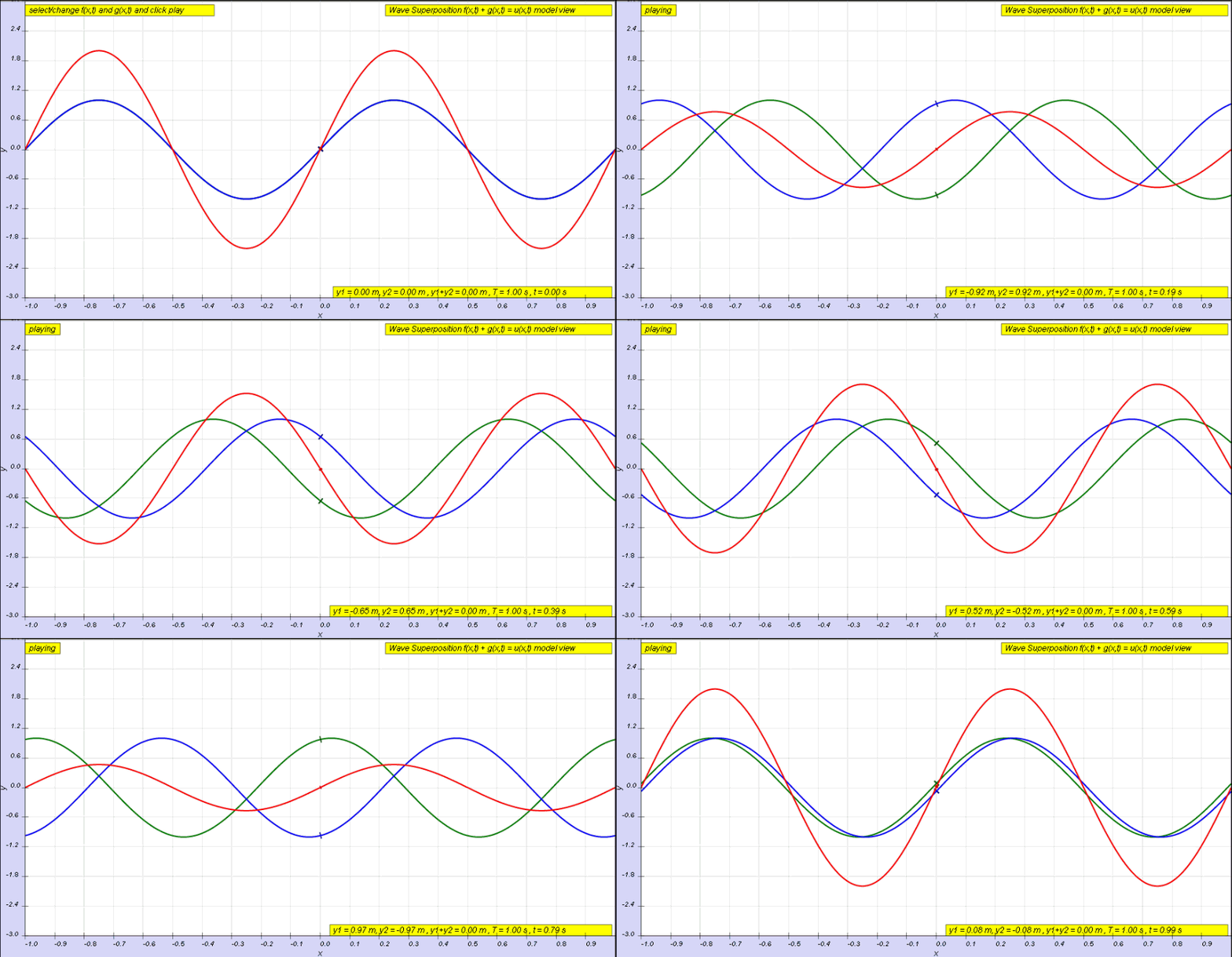
The principle of superposition states that when two or more waves overlap in the same region, the resulting displacement at any point is the algebraic sum of the individual wave displacements at that point. This principle applies to all types of waves: mechanical waves like sound and water waves, and electromagnetic waves like light.
What makes this powerful is the word algebraic. Positive displacements (crests) and negative displacements (troughs) add together, so waves can reinforce each other or cancel each other out depending on how they line up.
- The resultant wave is found by adding the displacement of each individual wave at every point in space and time
- After the waves pass through each other, they continue on unchanged. Superposition doesn't permanently alter the individual waves.
- Superposition produces phenomena like constructive interference, destructive interference, standing waves, and beat frequencies
Mathematically, if wave 1 produces displacement and wave 2 produces displacement at the same point, the resultant displacement is simply .
Constructive vs. Destructive Interference
Constructive interference occurs when waves combine so that their displacements add together, producing a larger resultant amplitude. Destructive interference occurs when waves combine so that their displacements partially or fully cancel, producing a smaller resultant amplitude.
The key factor is phase relationship: how the crests and troughs of the waves line up relative to each other.
- Constructive interference
- Waves are in phase: crests align with crests, troughs align with troughs (phase difference of , , , etc.)
- Resultant amplitude equals the sum of individual amplitudes
- Example: In a double-slit experiment, bright fringes appear where light waves arrive in phase. Two speakers playing the same tone in phase produce a louder sound at points equidistant from both.
- Destructive interference
- Waves are out of phase: crests align with troughs (phase difference of , , etc.)
- Resultant amplitude equals the difference of individual amplitudes
- If two waves have equal amplitude and are perfectly out of phase, they cancel completely: the resultant amplitude is zero
- Example: Dark fringes in a double-slit experiment occur where light waves arrive out of phase. Noise-canceling headphones work by generating a sound wave that is out of phase with incoming noise, producing destructive interference.
For any phase difference between these extremes, you get partial interference, where the resultant amplitude is somewhere between the sum and the difference of the individual amplitudes.
Formation of Standing Waves
Standing waves form when two waves with the same frequency and amplitude travel in opposite directions through the same medium. This commonly happens when a wave reflects off a boundary and interferes with the incoming wave.
Instead of a wave that appears to travel, you get a stationary pattern of vibration with fixed points that never move and other points that oscillate with maximum amplitude.
- Nodes are points of zero displacement (complete destructive interference). They stay perfectly still.
- Antinodes are points of maximum displacement (complete constructive interference). They oscillate with the greatest amplitude.
- The distance between two adjacent nodes (or two adjacent antinodes) is , where is the wavelength.
Standing waves can only form at specific frequencies called harmonics (or resonant frequencies). The lowest frequency that produces a standing wave is the fundamental frequency (first harmonic), and higher harmonics are integer multiples of it: , where
Standing waves in different systems:
- Strings fixed at both ends (guitar, violin): Both ends are nodes. The fundamental has one antinode in the center. The wavelength of the th harmonic is , where is the string length.
- Open air columns (flute): Both ends are antinodes. All integer harmonics are present.
- Closed air columns (clarinet, closed pipe): One end is a node, the other is an antinode. Only odd harmonics are present (), which gives these instruments a distinctly different tone.
Wave Characteristics and Behavior
- A wave function describes the displacement of a wave at any point in space and time. For a sinusoidal wave traveling in the direction, this takes the form , where is amplitude, is the wave number, and is angular frequency.
- Wave velocity is the speed at which a wave propagates through a medium. It's determined by the medium's properties, not by the wave's amplitude or frequency. For waves on a string, , where is tension and is linear mass density.
- Coherence refers to how consistently two waves maintain a fixed phase relationship over time and space. Two waves must be coherent to produce a stable, observable interference pattern. Lasers produce highly coherent light, which is why they're used in interference experiments. Incoherent sources (like two separate light bulbs) produce rapidly shifting phase differences, so their interference patterns blur out and aren't visible.
Wave Reflection and Refraction
Wave Reflection vs. Refraction
Reflection and refraction both occur when a wave encounters a boundary between two different media. The difference is whether the wave bounces back or passes through.
Wave Reflection
Reflection is the change in direction of a wave at an interface, causing it to return into the original medium. This happens because of a mismatch in the properties of the two media (such as density or stiffness).
- The law of reflection states that the angle of incidence equals the angle of reflection, measured from the normal (perpendicular) to the surface:
- A wave reflecting off a fixed boundary (like a string tied to a wall) inverts: a crest reflects as a trough. A wave reflecting off a free boundary reflects without inverting.
- Applications: echoes (sound reflecting off walls), mirrors (light reflection), sonar and seismic exploration
Wave Refraction
Refraction is the change in direction of a wave as it passes from one medium into another where its speed is different. The wave bends because one side of the wavefront enters the new medium and changes speed before the other side does.
- Snell's law relates the angles and speeds in the two media:
where and are the angles of incidence and refraction (measured from the normal), and and are the wave speeds in each medium.
- When a wave enters a medium where it travels slower, it bends toward the normal. When it enters a medium where it travels faster, it bends away from the normal.
- The wave's frequency stays the same during refraction; only its speed and wavelength change.
- Applications: lenses and prisms (light refraction), the apparent bending of a straw in water, atmospheric refraction of sound (why you can sometimes hear distant sounds more clearly at night)
See Fiveable more often in Google
Mark Fiveable as a preferred source and Google is more likely to show you our guides in Top Stories, with a "preferred" badge in AI Mode and AI Overviews.