11.3 RL circuits and transient behavior
Updated March 2026Fiveable Content Team

🧲Electromagnetism I Unit 11 Review
11.3 RL circuits and transient behavior
🧲 Electromagnetism I
Unit 11 – Inductance and Magnetic Energy
RL circuits are like the slow-pokes of the electrical world. They take their sweet time reaching steady-state, thanks to inductors resisting current changes. This sluggish behavior is called transient response, and it's all about the current's gradual rise or fall.
The time constant, τ = L/R, is the key player here. It tells us how long it takes for the current to hit 63.2% of its final value. Understanding this helps us predict how RL circuits will behave when we flip the switch or change the voltage.
RL Circuit Basics
Components and Characteristics
- RL circuit consists of a resistor and an inductor connected in series
- Time constant represents the time required for the current to reach 63.2% of its final value
- Depends on the inductance and resistance in the circuit
- Measured in seconds
- Transient response refers to the circuit's behavior during the time when the current is changing
- Occurs when the circuit is switched on or off, or when there is a change in the applied voltage
- Characterized by the exponential growth or decay of current
- Steady-state is the condition reached after the transient response has ended
- Current and voltage remain constant
- Inductor acts as a short circuit in DC steady-state

Analysis Techniques
- Kirchhoff's Voltage Law (KVL) is used to analyze RL circuits
- Sum of voltages around a closed loop is equal to zero
- , where is the voltage across the resistor, is the voltage across the inductor, and is the source voltage
- Current in an RL circuit can be calculated using the equation
- is the current as a function of time
- is the source voltage
- is the resistance
- is the time constant
- is the time elapsed since the circuit was switched on
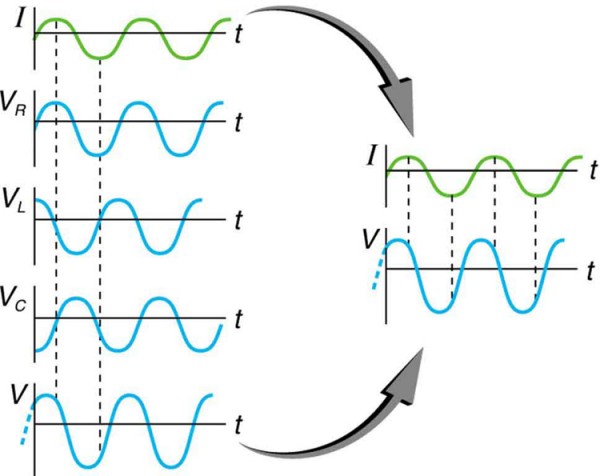
Inductive Transient Behavior
Exponential Growth and Decay
- When a voltage is applied to an RL circuit, the current grows exponentially from zero to its final value
- Growth is governed by the equation
- The current reaches 63.2% of its final value after one time constant
- It takes approximately five time constants for the current to reach 99.3% of its final value
- When the voltage is removed, the current decays exponentially from its initial value to zero
- Decay is governed by the equation , where is the initial current
- The current decreases to 36.8% of its initial value after one time constant
Rise Time and Back EMF
- Rise time is the time required for the current to rise from 10% to 90% of its final value
- Approximately equal to 2.2 time constants ()
- Shorter rise times indicate faster response of the circuit to changes in the applied voltage
- Back EMF (electromotive force) is the voltage induced across the inductor that opposes changes in current
- Governed by Faraday's law,
- The negative sign indicates that the induced voltage opposes the change in current
- Back EMF is responsible for the exponential growth and decay of current in RL circuits
- Acts to limit the rate of change of current, causing the transient behavior
See Fiveable more often in Google
Mark Fiveable as a preferred source and Google is more likely to show you our guides in Top Stories, with a "preferred" badge in AI Mode and AI Overviews.