14.2 Justinian's reign and legal reforms

🏺Early World Civilizations Unit 14 Review
14.2 Justinian's reign and legal reforms
🏺 Early World Civilizations
Justinian's Reign in the Byzantine Empire

Top images from around the web for The "Golden Age" of the Byzantine Empire
Justinien Ier — Wikipédia View original
Is this image relevant?
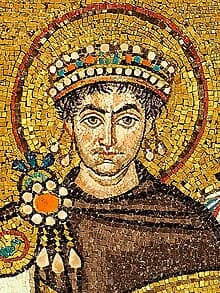
Justinian I - Wikipedia View original
Is this image relevant?
Hagia Sophia - wonder of Byzantine architecture | Wondermondo View original
Is this image relevant?
Justinien Ier — Wikipédia View original
Is this image relevant?
Justinian I - Wikipedia View original
Is this image relevant?
The "Golden Age" of the Byzantine Empire
Justinian I (ruled 527–565 CE) presided over what's often called the "Golden Age" of the Byzantine Empire. His reign combined aggressive military expansion, sweeping legal reform, massive building projects, and active religious policy into a period that dramatically expanded Byzantine power across the Mediterranean.
The label "Golden Age" fits in many ways, but it comes with serious caveats. The same ambition that drove Justinian's achievements also pushed the empire to its limits.
Consequences and Challenges of Justinian's Policies
Justinian's accomplishments came at a steep price. His military campaigns drained the treasury, and heavy taxation fueled resentment across the empire.
The Plague of Justinian (beginning in 541 CE) made everything worse. This was one of the deadliest pandemics in recorded history, killing an estimated 25–50 million people across the Mediterranean world. The plague gutted the empire's tax base, shrank its labor force, and undermined the military's ability to hold newly conquered territory. The combination of overextension and plague left the empire economically and socially weakened for generations after Justinian's death in 565 CE.
Justinian's Legal Reforms
The Corpus Juris Civilis
Justinian's most lasting achievement was the Corpus Juris Civilis ("Body of Civil Law"), a massive project to organize, update, and preserve centuries of Roman legal tradition. By the 500s, Roman law had become a tangled mess of overlapping statutes, outdated rulings, and contradictory legal opinions. Justinian tasked a commission led by the jurist Tribonian with sorting it all out.
The Corpus Juris Civilis consisted of four parts:
- The Code (Codex Justinianus): A collection of imperial constitutions and decrees, streamlined to remove contradictions and outdated provisions.
- The Digest (Digesta or Pandectae): A compilation of legal opinions and interpretations from centuries of Roman jurists, organized by subject. This was the most ambitious part of the project, condensing roughly 1,500 books of legal commentary into 50 volumes.
- The Institutes (Institutiones): A textbook designed for law students, covering the fundamental principles of Roman law in a structured, teachable format.
- The Novellae (Novellae Constitutiones): New laws issued by Justinian after the original compilation was finished, addressing issues that arose during his ongoing reign.
The Corpus Juris Civilis became the backbone of the Byzantine legal system for the rest of the empire's history. Later emperors continued adding their own novellae to the collection.

Influence on Western Legal Traditions
For centuries after the fall of Rome in the west, Justinian's legal compilation was largely forgotten in Western Europe. Then, during the Middle Ages (particularly from the 11th century onward), European scholars rediscovered the Corpus Juris Civilis and began studying it at universities like Bologna.
This rediscovery had enormous consequences. The Corpus Juris Civilis served as the foundation for major European legal codes, including the French Napoleonic Code (1804) and the German Civil Code (Bürgerliches Gesetzbuch, 1900). The principles embedded in Justinian's compilation continue to shape civil law systems (as opposed to common law systems like those in England and the U.S.) in much of continental Europe, Latin America, and parts of Asia and Africa.
Justinian's Military Campaigns
The Justinianic Reconquest
Justinian aimed to restore the old Roman Empire's territorial reach through a series of wars known as the Justinianic Reconquest. His most talented general, Belisarius, led the key campaigns.
- The Vandalic War (533–534 CE): Belisarius defeated the Vandal Kingdom in North Africa with surprising speed, bringing the region back under Byzantine control. This early success encouraged Justinian to push further.
- The Gothic War (535–554 CE): This was a far more grueling conflict against the Ostrogothic Kingdom in Italy. What Justinian expected to be a quick campaign dragged on for nearly 20 years. The Byzantines eventually reconquered the Italian peninsula, but the prolonged fighting devastated Italy's cities, population, and economy.
At its greatest extent under Justinian, the Byzantine Empire controlled North Africa, Italy, southern Spain, and the eastern Mediterranean.
Challenges in Maintaining the Reconquered Territories
Holding these reconquered lands proved even harder than taking them:
- The Plague of Justinian weakened the empire's ability to garrison and govern distant provinces.
- Ongoing wars with the Sassanid Persian Empire on the eastern frontier forced Justinian to split his military resources between east and west.
- Conflict with the Visigoths in the Iberian Peninsula further stretched the army thin.
The cost of maintaining such a large military contributed to economic strain and social unrest. While Justinian temporarily reassembled much of the old Roman Empire's territory, many of these gains were short-lived. Within a few generations, the Byzantines lost most of Italy to the Lombards and much of North Africa to Arab conquests.

Theodora's Influence on Byzantine Governance
Theodora's Background and Personality
Theodora was Justinian's wife, co-ruler, and most trusted advisor. Her background was unusual for an empress: she came from the lower classes of Constantinople and had worked as an actress, a profession associated with low social status in Byzantine society. Justinian actually had to change the law to marry her, since existing legislation prohibited senators from marrying actresses.
Theodora's unconventional origins and forceful personality made her a controversial figure at court, but they also gave her a perspective on power and social justice that shaped many of Justinian's policies.
Theodora's Role in the Nika Revolt
Theodora's most famous moment came during the Nika Revolt of 532 CE, a massive uprising in Constantinople that nearly toppled Justinian's government. Rioters set fire to large parts of the city and declared a new emperor. Justinian and his advisors were preparing to flee the capital.
Theodora refused to run. According to the historian Procopius, she told the imperial council that she would rather die an empress than live as a fugitive. Her resolve stiffened Justinian's spine. He stayed, ordered Belisarius to suppress the revolt, and the rebellion was crushed. Without Theodora's intervention, Justinian's reign might have ended right there.
Theodora's Influence on Justinian's Policies
Theodora served as a key advisor on political, military, and religious matters throughout their joint reign. Her influence was especially visible in policies affecting women's rights:
- She sponsored legislation prohibiting forced prostitution and established shelters for former prostitutes.
- She expanded women's property rights, giving wives greater control over their own assets.
- She supported laws allowing women to initiate divorce proceedings under certain circumstances.
On religious matters, Theodora was a supporter of Monophysitism, a Christian doctrine that held that Christ had only one nature (divine), in contrast to the Chalcedonian position (accepted by the mainstream Church) that Christ had two natures (divine and human). Her sympathies created ongoing tension with the Chalcedonian Church establishment, and Justinian sometimes had to balance his wife's religious preferences against the need to maintain Church unity.
Theodora's Cultural Legacy
Theodora was also a patron of the arts and architecture. The famous mosaics in the Basilica of San Vitale in Ravenna, which depict both Justinian and Theodora in full imperial regalia, remain some of the most iconic images of Byzantine art.
After her death in 548 CE, Theodora's direct influence on imperial policy faded. But her impact on Byzantine law, religious politics, and the status of women left a mark that outlasted her lifetime. She remains one of the most powerful and historically significant women of the ancient and medieval world.
See Fiveable more often in Google
Mark Fiveable as a preferred source and Google is more likely to show you our guides in Top Stories, with a "preferred" badge in AI Mode and AI Overviews.