
Exergy and Energy Quality
Definition and Significance of Exergy
Exergy is the maximum useful work you can extract from a system as it reversibly reaches equilibrium with its surroundings. Unlike energy, which is always conserved (First Law), exergy can be destroyed. That destruction is what makes real processes less efficient than ideal ones.
A few core ideas to lock in:
- Exergy measures energy quality, not just quantity. It tells you how much of a given energy source can actually be converted into useful work.
- Exergy depends on two things: the state of the system and the state of the environment. Work potential comes from the difference between them. A hot gas at 500 K has exergy only because the surroundings are cooler (say, 300 K). If the environment were also at 500 K, that gas would have zero exergy.
- Exergy is always destroyed in real processes due to irreversibilities like friction, unrestrained expansion, heat transfer across a finite temperature difference, and mixing. Every irreversibility chips away at the energy's ability to do useful work.
A system at the dead state (thermal, mechanical, and chemical equilibrium with the environment) has zero exergy. It can't do any work because there's no driving force left.
Relationship between Exergy and Energy Quality
Energy quality refers to how readily an energy form can be converted into work. Not all joules are created equal:
- High-quality energy (electricity, shaft work) can be converted almost entirely into useful work. Electricity has an exergy content essentially equal to its energy content.
- Low-quality energy (low-temperature waste heat just slightly above ambient) has very little capacity to produce work, even though it still contains energy.
Exergy puts a number on this distinction. A kilojoule of electricity is worth far more than a kilojoule of heat at 350 K when the environment is at 300 K, because the electricity can do more useful work. Every time energy is converted from one form to another in a real process, some exergy is destroyed, and the overall quality of the energy decreases.
Work Potential in Thermodynamics
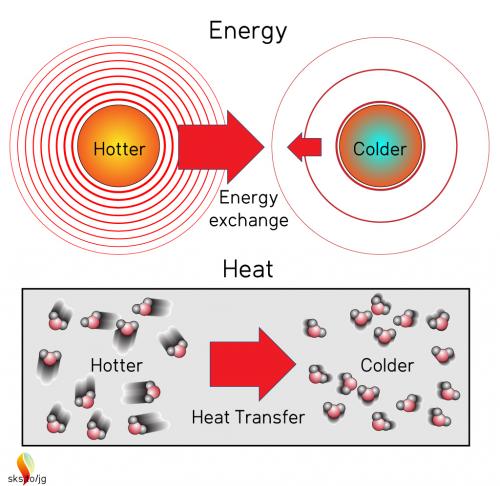
Concept and Determination of Work Potential
Work potential is the maximum useful work obtainable from a system as it undergoes a reversible process to reach equilibrium with its surroundings. It's determined by the system's state variables (temperature, pressure, composition) relative to a reference environment at , , and a specified composition.
The bigger the gap between the system state and the dead state, the greater the work potential. A steam line at 10 MPa and 800 K has far more work potential than one at 200 kPa and 400 K, because it's further from equilibrium with typical ambient conditions.
The difference in work potential between the initial and final states of a process sets an upper bound: it's the maximum work output (or, for the reverse direction, the minimum work input required).
Significance of Work Potential in Thermodynamic Systems
- Process design: Knowing the work potential at each state in a cycle helps you pinpoint where useful work can be extracted and where losses occur.
- Efficiency improvement: Maximizing utilization of work potential leads to better performance in power plants, refrigeration cycles, and chemical processes.
- Waste heat recovery: Analyzing the work potential of exhaust or cooling streams reveals whether recovering that energy is thermodynamically worthwhile. A waste stream at 600 K has significant work potential; one at 310 K (with K) has almost none.
Calculating Exergy Values

Exergy of Different Energy Forms
Exergy calculations differ depending on the form of energy involved.
Thermal exergy is the work potential associated with heat transfer. For a heat transfer at a constant temperature , with the environment at :
This is just the Carnot efficiency applied to the heat source. Notice that as approaches , the thermal exergy approaches zero, confirming that low-grade heat near ambient temperature has almost no work potential.
Mechanical exergy arises from pressure differences. For an ideal gas at pressure in an environment at :
where is the specific gas constant. Compressed air at 800 kPa in a 100 kPa environment, for example, stores usable work because it can expand against the surroundings.
Electrical exergy equals the electrical energy itself:
Electricity is pure work, so none of its energy content is "unavailable." This is why electricity is considered the highest-quality energy form.
Chemical exergy is the maximum work obtainable when a substance reacts reversibly to reach chemical equilibrium with the reference environment. It's calculated using standard chemical exergy tables and the composition of the substance. For fuels, chemical exergy is closely related to (but not identical to) the heating value.
Examples and Applications
- Hot gas stream: A flue gas at 800 K exhausting to a 300 K environment carries thermal exergy that could drive a bottoming power cycle. You'd use the thermal exergy formula to quantify how much power generation is theoretically possible.
- Compressed air storage: The mechanical exergy of air stored at high pressure tells you the upper limit of energy you can recover during expansion.
- Fuel comparison: Calculating the chemical exergy of natural gas versus biogas lets you compare their true work-producing potential, which is more informative than comparing heating values alone.
- Renewable sources: Solar radiation carries high exergy (the effective source temperature is roughly 5800 K), while low-temperature geothermal heat carries much less, even if the total energy flow is large.
Exergy Content of Thermodynamic States
Factors Influencing Exergy Content
The exergy of any thermodynamic state depends on how far that state is from the dead state. Three types of deviation matter:
- Temperature: States hotter (or colder) than have thermal exergy. The further from , the greater the exergy. A stream at 1000 K has much more thermal exergy than one at 400 K, assuming K.
- Pressure: Pressures above (or below) create mechanical exergy. High-pressure steam or compressed gases can produce work by expanding toward atmospheric pressure.
- Composition: Mixtures with high concentrations of reactive or valuable species (fuels, pure oxygen, etc.) carry chemical exergy. This represents the work obtainable through chemical reactions or mixing processes that bring the composition to environmental equilibrium.
For a general flow stream, the specific flow exergy combines all three contributions:
where and are the enthalpy and entropy at the dead state, and the last two terms account for kinetic and potential energy (which are fully convertible to work).
Analyzing and Optimizing Exergy Content
Exergy analysis goes beyond First Law efficiency by revealing where and how much work potential is wasted:
- Map the exergy at each state point in your system. Calculate at every inlet, outlet, and intermediate state.
- Identify the largest exergy destructions. Components with the biggest gap between exergy in and exergy out (plus any work or heat interactions) are your worst offenders. In a typical power plant, the combustion chamber destroys the most exergy due to the large temperature difference during heat release.
- Target those components for improvement. Reducing irreversibilities in the highest-destruction components gives you the biggest efficiency gains.
- Minimize exergy in waste streams. Flue gases, cooling water, and exhaust flows that leave the system boundary still carry exergy. Lowering their exergy content (through heat recovery, for instance) reduces overall system losses.
The difference in exergy between two states represents the maximum work obtainable from any process connecting them. Real processes always produce less work (or require more work input) because of irreversibilities. That gap between the ideal and the actual is exactly the exergy destroyed.