8.4 Diffusion

🎲Statistical Mechanics Unit 8 Review
8.4 Diffusion
🎲 Statistical Mechanics
Fundamentals of diffusion
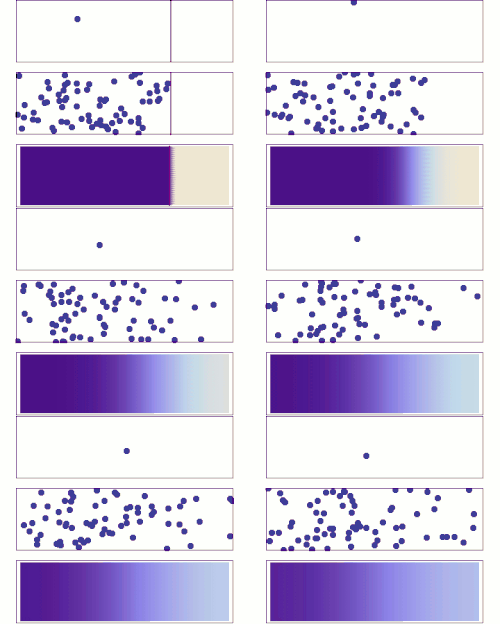
Diffusion describes the net movement of particles from regions of high concentration to regions of low concentration, driven by random thermal motion. It governs transport phenomena in gases, liquids, and solids at the molecular level, and it connects directly to the statistical foundations of kinetic theory.
Fick's laws
Fick's first law relates the diffusive flux to the concentration gradient. In steady state, the flux of particles is proportional to how steeply concentration changes in space:
Here is the diffusion coefficient (with units ), is the particle flux, and is the concentration gradient. The negative sign captures the physical fact that particles flow down the gradient, from high to low concentration.
Fick's second law (the diffusion equation) describes how concentration evolves in time and is covered in the next section.
Brownian motion
Brownian motion is the erratic, random motion of particles suspended in a fluid, caused by incessant collisions with the surrounding molecules. Robert Brown first observed it in 1827 watching pollen grains in water, but it was Einstein's 1905 theory that provided the quantitative framework.
The key result: the mean square displacement of a Brownian particle grows linearly with time, connecting the microscopic randomness of molecular collisions to the macroscopic diffusion coefficient. This linear growth is the hallmark of normal (Fickian) diffusion.
Random walk model
The random walk is the simplest microscopic model of diffusion. A particle takes a series of steps in random directions, with each step independent of the previous ones (a Markovian process).
- The walk can be 1D, 2D, or 3D
- After many steps, the probability distribution of the particle's position converges to a Gaussian (by the central limit theorem)
- The mean displacement is zero (no net drift), but the mean square displacement grows linearly with the number of steps
This model provides the microscopic justification for Fick's laws and the diffusion equation.
Diffusion equation
The diffusion equation describes how a concentration profile spreads out over space and time. It's the same mathematical form as the heat equation, so techniques you learn here apply directly to heat conduction problems as well.
Derivation from Fick's laws
The derivation combines two ingredients:
- Fick's first law: (flux is proportional to concentration gradient)
- The continuity equation: (particles are conserved locally)
Substituting the first into the second gives the diffusion equation:
This assumes is constant. If varies in space or time, you'd need to keep it inside the divergence operator: .
Solutions for various geometries
Analytical solutions exist for simple geometries:
- Infinite domain: The fundamental solution (Green's function) is a spreading Gaussian: in 1D
- Finite domains (slab, sphere, cylinder): Separation of variables yields solutions as series of eigenfunctions (sines, Bessel functions, etc.)
- Periodic boundary conditions: Fourier series solutions are natural
For complex or irregular geometries, numerical methods (finite difference, finite element) are typically required.
Boundary conditions
To solve the diffusion equation, you need both boundary conditions and an initial condition:
- Dirichlet: concentration specified at the boundary (e.g., surface held at fixed concentration)
- Neumann: flux specified at the boundary (e.g., impermeable wall means zero flux)
- Robin (mixed): a linear combination of concentration and flux at the boundary (models surface reactions or partial permeability)
- Periodic: used for systems with repeating structure
The choice of boundary conditions reflects the physical setup and strongly affects the solution.
Microscopic theory of diffusion
This is where kinetic theory meets diffusion. The goal is to derive macroscopic quantities like from microscopic particle properties.
Einstein-Smoluchowski relation
This relation connects the diffusion coefficient to the mobility of a particle and the thermal energy:
Here is the particle mobility (drift velocity per unit force), is Boltzmann's constant, and is temperature. The physical content is profound: diffusion and drift are two manifestations of the same underlying random thermal motion. This is an example of a fluctuation-dissipation relation, and it holds for systems in thermal equilibrium.
For a spherical particle of radius in a fluid of viscosity , the Stokes drag gives , yielding the Stokes-Einstein relation: .
Diffusion coefficient
The diffusion coefficient quantifies how fast particles spread through a medium. Several factors control its value:
- Temperature: higher means faster diffusion. In many solids, the temperature dependence follows an Arrhenius form: , where is the activation energy
- Particle size: larger particles diffuse more slowly (see Stokes-Einstein above)
- Medium properties: viscosity, density, and intermolecular interactions all matter
Typical orders of magnitude: in gases, in liquids, and to in solids.
Mean square displacement
The mean square displacement (MSD) is the central observable connecting microscopic motion to the diffusion coefficient:
where is the spatial dimensionality (1, 2, or 3). For a 3D system, .
- Linear growth of MSD with time signals normal diffusion
- Any deviation from linearity indicates anomalous diffusion (see below)
- Experimentally, you can extract by plotting MSD vs. time and measuring the slope
Diffusion in different media
Diffusion rates and mechanisms vary enormously depending on the state of matter. The differences trace back to how tightly packed the molecules are and how strongly they interact.
Gases vs liquids
In gases, molecules travel relatively long distances between collisions (large mean free path), so diffusion is fast. Typical gas-phase diffusion coefficients are on the order of at standard conditions.
In liquids, molecules are much closer together and interact more strongly. Diffusion coefficients drop to roughly . Temperature and pressure effects are more dramatic in gases because the mean free path is sensitive to both.
Solids and crystal lattices
Diffusion in solids is much slower still and proceeds through specific mechanisms:
- Vacancy diffusion: an atom jumps into a neighboring empty lattice site
- Interstitial diffusion: small atoms (like carbon in iron) hop between interstitial sites
- Grain boundary diffusion: faster transport along defects and interfaces
Because each jump requires overcoming an energy barrier, solid-state diffusion is strongly temperature-dependent and well-described by the Arrhenius equation.
Porous materials
In porous media, the geometry of the pore network modifies diffusion:
- When pore diameters are much larger than the mean free path, ordinary (Fickian) diffusion dominates
- When pore diameters are comparable to the mean free path, Knudsen diffusion takes over: molecules collide with pore walls more often than with each other
- The effective diffusion coefficient accounts for the porosity (void fraction) and tortuosity (how winding the paths are)
Models like the dusty gas model and Maxwell-Stefan equations handle multicomponent diffusion in porous media. Applications include catalysis, gas separation membranes, and contaminant transport in soils.
Anomalous diffusion
Normal diffusion predicts . In many real systems, this breaks down. Anomalous diffusion is characterized by:
where .
Subdiffusion vs superdiffusion
- Subdiffusion (): particles spread more slowly than expected. This happens in crowded or disordered environments where particles get temporarily trapped. A classic example is protein diffusion in the crowded cytoplasm of a cell.
- Superdiffusion (): particles spread faster than expected. This occurs in systems with long-range correlations, active transport, or Lévy flight-like dynamics. Turbulent transport is a common physical example.
Fractional diffusion equation
To model anomalous diffusion mathematically, the standard diffusion equation is generalized using fractional calculus:
Here and are fractional orders of the time and space derivatives, respectively. When and , you recover the standard diffusion equation. Fractional time derivatives introduce memory effects (the system's future depends on its entire history), while fractional space derivatives capture long-range spatial correlations.
Examples in complex systems
- Protein diffusion in cell membranes often shows subdiffusion due to membrane heterogeneity and crowding
- Transport in fractal structures (percolation clusters, porous rocks) displays anomalous scaling
- Contaminant spreading in heterogeneous aquifers can deviate from Fickian predictions
- Turbulent flows produce superdiffusive particle transport
- Financial market price fluctuations have been modeled with superdiffusive frameworks
Collective diffusion
So far, most of the discussion has focused on single-particle (tracer) diffusion. In real many-body systems, particle-particle interactions change the picture.
Self-diffusion vs collective diffusion
These are two distinct quantities:
- Self-diffusion tracks the motion of a single tagged particle in a sea of identical particles. It's measured by following individual trajectories (e.g., with fluorescent labels).
- Collective diffusion describes how density fluctuations relax. It's what Fick's law describes macroscopically, and it governs how concentration gradients decay.
In an ideal (non-interacting) system, the two are identical. In interacting systems, they can differ substantially. For example, in a concentrated colloidal suspension, repulsive interactions can make collective diffusion faster than self-diffusion.
Onsager reciprocal relations
In systems with multiple coupled transport processes (e.g., simultaneous diffusion of heat and mass), the Onsager relations constrain the transport coefficients:
These symmetry relations hold near equilibrium and follow from microscopic reversibility (detailed balance). They're essential for multicomponent diffusion and thermodiffusion (the Soret effect), where a temperature gradient drives mass transport.
Kubo formula
The Kubo formula connects transport coefficients to equilibrium fluctuations via time correlation functions:
This is a Green-Kubo relation: the diffusion coefficient equals the time integral of the velocity autocorrelation function, divided by the dimensionality . It's derived from linear response theory and is the standard way to compute from molecular dynamics simulations. Analogous formulas exist for viscosity (stress autocorrelation) and thermal conductivity (heat flux autocorrelation).
Applications of diffusion
Materials science
- Semiconductor doping: controlled diffusion of dopant atoms (e.g., phosphorus into silicon) creates the p-n junctions that make transistors work
- Surface hardening: carburization and nitriding rely on diffusing carbon or nitrogen into metal surfaces
- Diffusion bonding: joining materials at high temperature by allowing atoms to interdiffuse across an interface
- Diffusion barriers: thin layers in microelectronics that prevent unwanted atomic migration between device layers
- Solid-state batteries: ion diffusion through solid electrolytes determines charge/discharge rates
Biological systems
- Gas exchange: oxygen diffuses from alveoli into blood in the lungs; diffuses the other way
- Synaptic transmission: neurotransmitters released into the synaptic cleft diffuse to receptors on the postsynaptic cell
- Morphogen gradients: during embryonic development, signaling molecules spread by diffusion to create concentration patterns that guide cell differentiation
- Passive membrane transport: small nonpolar molecules cross cell membranes by simple diffusion down their concentration gradient

Chemical engineering
- Catalysis: in heterogeneous catalysis, reactants must diffuse to the catalyst surface and products must diffuse away; pore diffusion can be rate-limiting
- Separation processes: dialysis, osmosis, and membrane separations exploit differences in diffusion rates
- Controlled drug release: polymer matrices release drugs at rates governed by diffusion
- Reactor design: mass transfer (diffusion) limitations often determine reactor performance and scaling
Experimental techniques
Neutron scattering
Neutron scattering probes atomic and molecular motions on length scales of angstroms and time scales of picoseconds to nanoseconds. Quasielastic neutron scattering (QENS) measures the broadening of the elastic peak, which is directly related to the self-diffusion coefficient. It's particularly powerful for studying hydrogen diffusion in metals and other materials, since hydrogen has a large neutron scattering cross-section.
Fluorescence correlation spectroscopy
FCS measures diffusion by monitoring fluorescence intensity fluctuations in a tiny observation volume (typically a femtoliter). As fluorescently labeled molecules diffuse in and out of this volume, the intensity fluctuates. The autocorrelation function of these fluctuations yields the diffusion coefficient and concentration. FCS is widely used in biophysics to study molecular diffusion in solutions and cell membranes, and it can detect anomalous diffusion when the autocorrelation deviates from the standard model.
Pulsed field gradient NMR
PFG-NMR is a non-invasive technique that measures self-diffusion coefficients by applying magnetic field gradient pulses. The basic idea:
- A gradient pulse labels the spatial position of nuclear spins
- Spins diffuse during a waiting period
- A second gradient pulse detects how far the spins have moved
- The signal attenuation depends on the diffusion coefficient
This technique works well for liquids, polymers, and molecules confined in porous materials. It can also measure anisotropic diffusion (different rates in different directions) in oriented systems like liquid crystals.
Computational methods
Molecular dynamics simulations
MD simulations integrate Newton's equations of motion for a system of interacting particles. To extract diffusion coefficients, you can either:
- Compute the MSD over time and use
- Compute the velocity autocorrelation function and integrate it (Kubo formula)
Modern MD can handle millions of atoms, but the results are only as good as the interatomic potentials used. These simulations reveal diffusion mechanisms at atomic resolution that experiments alone cannot access.
Monte Carlo methods
Monte Carlo approaches use random sampling to simulate diffusion:
- Kinetic Monte Carlo (KMC): particularly efficient for rare-event dynamics like vacancy diffusion in solids, where the time between jumps is long compared to vibrational periods
- Metropolis algorithm: samples equilibrium configurations and can be used to study thermodynamic properties of diffusing systems
- Lattice gas models: simulate particles hopping on discrete lattice sites, useful for studying diffusion in porous media and on surfaces
Lattice Boltzmann models
The lattice Boltzmann method discretizes the Boltzmann transport equation onto a lattice. Rather than tracking individual particles, it evolves distribution functions at each lattice node through streaming and collision steps. It handles complex boundary conditions naturally and is well-suited for modeling diffusion coupled with fluid flow, multiphase systems, and multicomponent transport.
Advanced topics
Diffusion-limited reactions
When reactants diffuse slowly compared to the intrinsic reaction rate, the overall kinetics become diffusion-limited. Smoluchowski theory predicts the rate constant for such reactions by solving the diffusion equation with an absorbing boundary at the reaction radius.
Reaction-diffusion equations couple local reaction kinetics with spatial diffusion:
where describes the reaction terms. These equations can produce spontaneous pattern formation (Turing patterns), relevant to morphogenesis, chemical oscillations, and ecological spatial dynamics.
Diffusion in non-equilibrium systems
Far from equilibrium, diffusion can behave in counterintuitive ways. External driving forces, chemical potential gradients, or energy input can produce phenomena like:
- Uphill diffusion: particles moving against their concentration gradient (driven by coupling to other gradients)
- Pattern formation: sustained non-equilibrium conditions can stabilize spatial structures
- Active matter: self-propelled particles (bacteria, molecular motors) exhibit enhanced or anomalous diffusion
Non-equilibrium statistical mechanics provides the theoretical framework, but many problems remain open.
Stochastic differential equations
At the microscopic level, diffusion is inherently stochastic. Two key equations capture this:
- Langevin equation: , where is the friction coefficient and is a random force (white noise). This describes the trajectory of a single Brownian particle.
- Fokker-Planck equation: describes the time evolution of the probability density for the particle's position. It's the deterministic counterpart to the stochastic Langevin equation.
The Itô and Stratonovich interpretations of stochastic calculus give different prescriptions for handling the noise term, which matters when the noise amplitude depends on position (multiplicative noise). Applications extend beyond physics to financial modeling, population dynamics, and chemical kinetics.
See Fiveable more often in Google
Mark Fiveable as a preferred source and Google is more likely to show you our guides in Top Stories, with a "preferred" badge in AI Mode and AI Overviews.