8.1 Occupational segregation and gendered division of labor

🚻Intro to Gender Studies Unit 8 Review
8.1 Occupational segregation and gendered division of labor
🚻 Intro to Gender Studies
The workforce remains divided along gender lines, with women and men concentrated in different occupations at rates that go well beyond individual preference. This pattern, called occupational segregation, stems from historical norms, socialization, discrimination, and structural barriers. Understanding it is central to explaining the gender pay gap, unequal career advancement, and the persistence of stereotypes about who belongs in which jobs.
Occupational Segregation and Gendered Division of Labor

Top images from around the web for Patterns of occupational gender segregation
Frontiers | Traditional Gender Role Beliefs and Career Attainment in STEM: A Gendered Story? View original
Is this image relevant?
Introduction to Diversity – Professional Communications View original
Is this image relevant?
Frontiers | The Multiple Dimensions of Gender Stereotypes: A Current Look at Men’s and Women’s ... View original
Is this image relevant?
Frontiers | Traditional Gender Role Beliefs and Career Attainment in STEM: A Gendered Story? View original
Is this image relevant?
Introduction to Diversity – Professional Communications View original
Is this image relevant?
Patterns of occupational gender segregation
Gender-based occupational segregation has deep historical roots. For most of modern history, women were confined to domestic roles or a narrow set of "feminine" occupations like teaching, nursing, and secretarial work. Men dominated manufacturing, construction, and management. These weren't just cultural habits; they were often reinforced by law and institutional policy.
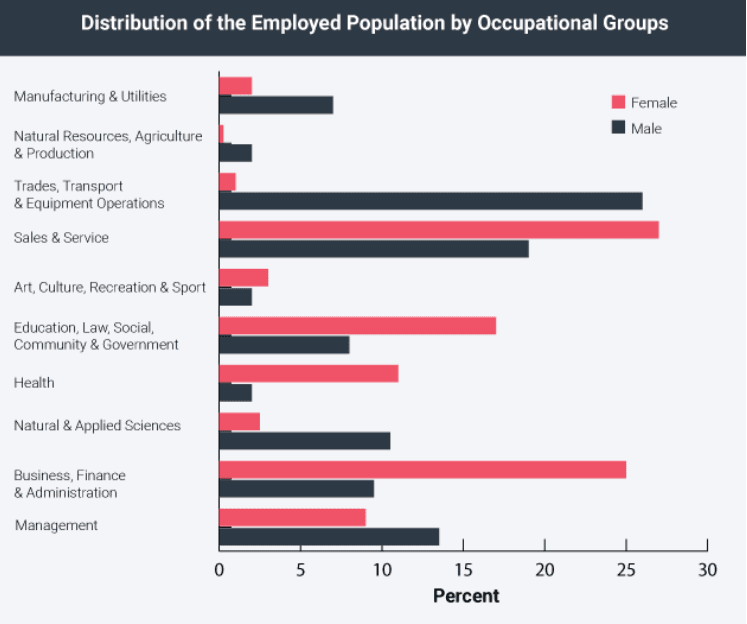
Contemporary data shows this segregation persists, even as it has shifted in form:
- Women remain overrepresented in service, education, and healthcare sectors (retail, K-12 teaching, nursing). In the U.S., about 76% of K-12 teachers and nearly 85% of registered nurses are women.
- Men remain overrepresented in STEM fields, skilled trades, and senior leadership (engineering, plumbing, executive roles). Women hold only about 28% of STEM jobs nationally.
- Gradual shifts are happening in some fields. Women's representation in medicine, law, and business has grown significantly over the past few decades. Men are also slowly entering female-dominated occupations like nursing and early childhood education, though at much lower rates.
The key takeaway: segregation has loosened in certain professions but remains remarkably durable overall.

Factors in gendered labor division
Three broad categories of factors sustain the gendered division of labor.
Socialization and gender norms shape career expectations long before anyone enters the workforce. Traditional gender roles cast women as nurturers and caregivers and men as breadwinners and decision-makers. This plays out concretely: girls are more often encouraged toward arts and humanities, boys toward math and science. By the time students choose college majors, gendered patterns are already well established.
Discrimination and bias operate at every stage of a career:
- Overt discrimination in hiring and promotion still occurs, though it's less socially acceptable than it once was.
- Unconscious biases shape perceptions of competence and "fit." For example, studies show that identical resumes receive different ratings depending on whether a male or female name is attached, particularly in STEM fields.
Structural and institutional barriers make segregation self-reinforcing:
- Limited access to affordable childcare and inadequate parental leave policies disproportionately push women out of demanding career tracks or into part-time work.
- Male-dominated professional networks and mentorship pipelines exclude women from the informal relationships that drive advancement.
- Gendered workplace cultures discourage diversity. A finance firm with an aggressively masculine culture, for instance, can make women feel unwelcome regardless of formal policy.

Impact of segregation on careers
Occupational segregation has concrete, measurable consequences.
Wage disparities are one of the most direct outcomes. Female-dominated occupations tend to pay less than male-dominated ones, even when they require comparable levels of education and skill. Nursing and teaching, for example, are both demanding professions requiring advanced training, yet they pay significantly less than many male-dominated fields with similar credential requirements. This pattern is a major driver of the overall gender pay gap.
Limited career advancement compounds the wage problem. The "glass ceiling" describes the invisible barriers that prevent women from reaching senior leadership, even in organizations where they make up most of the workforce. In male-dominated fields like tech, the scarcity of female role models and mentors makes it harder for women to advance or even stay in the field.
Reinforcement of stereotypes creates a feedback loop. When people rarely see women in engineering or men in early childhood education, it reinforces assumptions that those jobs are naturally suited to one gender. This reduces exposure to diverse perspectives and makes it harder for the next generation to break the pattern.
Strategies for workforce gender diversity
Addressing occupational segregation requires action at multiple levels.
Education and awareness-raising target the root of the problem:
- Challenging gender stereotypes early, through media literacy programs and inclusive curricula, can broaden what children see as possible career paths.
- Actively encouraging diverse career aspirations for all genders helps counteract socialization pressures.
Workplace policies and practices address bias within organizations:
- Implementing fair hiring and promotion processes. Blind resume screening (removing names and gender indicators) and structured interviews with standardized questions reduce the influence of unconscious bias.
- Establishing mentorship and sponsorship programs that connect underrepresented genders with senior leaders who can advocate for their advancement.
- Promoting work-life balance through flexible schedules, robust parental leave, and onsite or subsidized childcare.
Legal and policy interventions set enforceable standards:
- Anti-discrimination laws like Title VII of the Civil Rights Act prohibit employment discrimination based on sex.
- Affirmative action and diversity initiatives push organizations to actively recruit underrepresented groups.
- Pay transparency measures, such as salary history bans, help close gaps by preventing past pay discrimination from following workers to new jobs.
Collective action and empowerment build momentum from within:
- Professional networks and organizations (like Women in Tech groups) provide community, resources, and visibility.
- Allyship from men in leadership positions amplifies efforts for change.
- Building workplace cultures grounded in inclusion and respect makes diversity sustainable rather than performative.
See Fiveable more often in Google
Mark Fiveable as a preferred source and Google is more likely to show you our guides in Top Stories, with a "preferred" badge in AI Mode and AI Overviews.