2.4 Challenging the gender binary

🚻Intro to Gender Studies Unit 2 Review
2.4 Challenging the gender binary
🚻 Intro to Gender Studies
Understanding the Gender Binary

Top images from around the web for Concept of gender binary
Conceptualizing Structures of Power | Introduction to Women Gender Sexuality Studies View original
Is this image relevant?
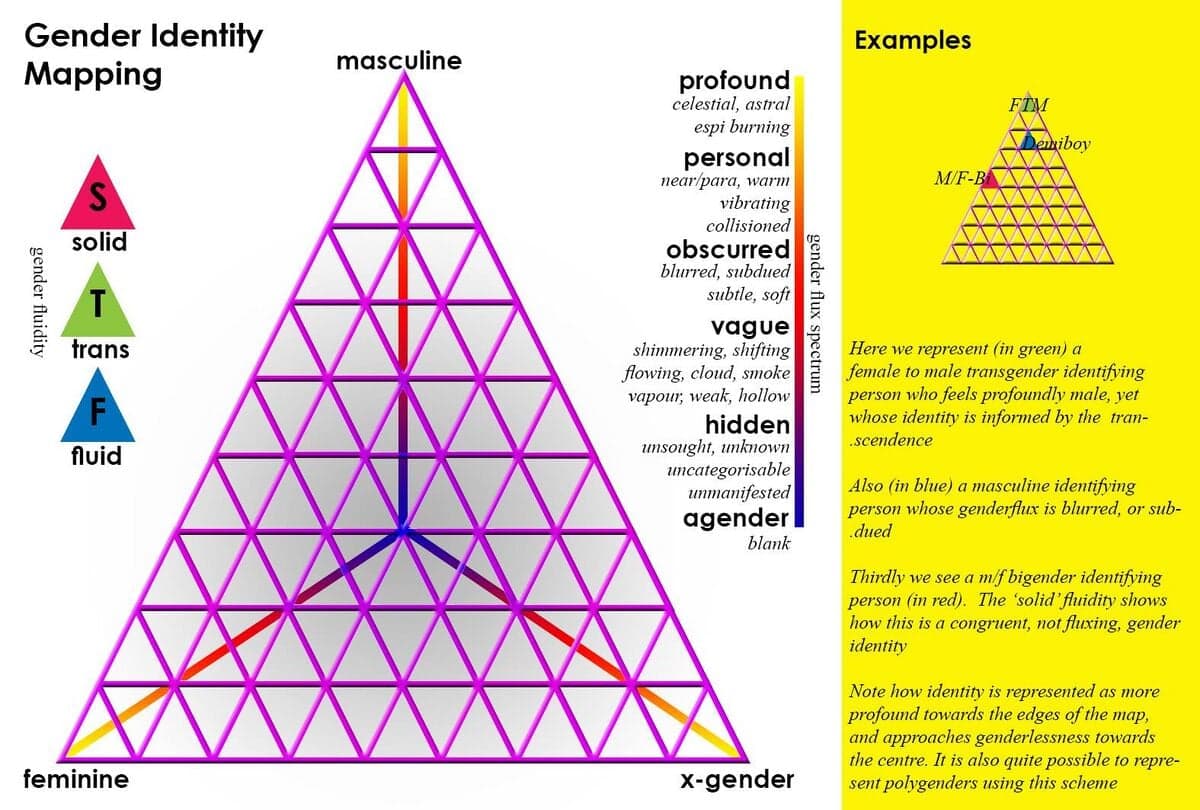
Gender spectrum - Nonbinary Wiki View original
Is this image relevant?
Conceptualizing Structures of Power | Introduction to Women Gender Sexuality Studies View original
Is this image relevant?
Gender spectrum - Nonbinary Wiki View original
Is this image relevant?
Concept of the Gender Binary
The gender binary is a social construct that sorts all of gender into exactly two categories: male and female. It treats these categories as opposite, fixed, and disconnected from each other. Under this framework, your gender is assumed to follow directly from your biological sex characteristics, and your roles, behaviors, and expressions are expected to match accordingly.
This model creates real problems. It reinforces rigid stereotypes that limit how anyone can express themselves, regardless of identity. And it actively marginalizes people whose identities or expressions don't fit neatly into one of two boxes, contributing to discrimination and social inequality. The core issue is that the binary presents itself as natural and inevitable, when in reality it's a culturally constructed system that many societies have organized differently throughout history.
Non-Binary Gender Identities
A range of gender identities exist beyond the male/female binary. Here are some of the most commonly discussed:
- Genderqueer: A broad umbrella term for anyone whose gender identity falls outside the binary. It can encompass many different identities and expressions.
- Agender: A person who does not identify with any gender, or who experiences gender as neutral or absent.
- Bigender: A person who identifies with two gender identities, either experiencing them at the same time or moving between them.
- Gender fluid: A person whose gender identity shifts over time, moving between different identities or expressions rather than staying fixed.
- Pangender: A person who identifies with many or all genders, often experiencing a wide range of gender expressions.
- Two-Spirit: A term used by some Indigenous North American communities to describe people who embody both masculine and feminine qualities or who fulfill distinct gender roles recognized within their specific cultures. This is a culturally specific term with deep roots in Indigenous traditions, not a generic synonym for non-binary.

Challenging the Gender Binary
Factors That Maintain the Binary
Several overlapping systems keep the gender binary in place:
- Socialization starts reinforcing gender norms early in life. Think gendered toys, color-coded clothing, and different behavioral expectations for boys versus girls. By the time children reach school age, many of these norms already feel "natural."
- Cultural and religious beliefs in many contexts promote traditional gender roles and treat deviation from the binary as wrong or unnatural.
- Media representation tends to rely on gender stereotypes and rarely portrays non-binary identities. When the vast majority of characters on screen are clearly coded as male or female, the binary gets reinforced as the default.
- Legal and institutional structures often enforce binary classification directly. Identity documents typically offer only "M" or "F," facilities like restrooms are segregated by binary gender, and dress codes frequently specify different rules for men and women.
- Medical and scientific frameworks have historically relied on binary understandings of sex and gender. Non-binary identities have often been pathologized (treated as disorders) or simply erased from clinical and research contexts.
These factors don't operate in isolation. They reinforce each other, making the binary feel like an unchangeable fact rather than a system that can be questioned.
Strategies for Deconstructing the Binary
Language
- Using gender-neutral pronouns (such as they/them) and inclusive phrasing that doesn't default to binary assumptions
- Rethinking common expressions that reinforce the binary, like "opposite sex" (which implies there are only two, and that they're opposites) or "both genders"
Media
- Increasing the visibility of non-binary and gender-diverse people in film, television, advertising, and journalism
- Critiquing and pushing back against media narratives that rely on binary stereotypes, such as the assumption that every character's story must revolve around traditionally masculine or feminine roles
Institutions
- Advocating for practical accommodations like gender-neutral restrooms and inclusive dress codes
- Pushing for legal and administrative changes, such as adding non-binary or third-gender options on identity documents (several countries and U.S. states have already begun doing this)
- Promoting education about gender diversity in schools, workplaces, and other settings so that people understand the limitations of the binary framework rather than simply accepting it as given
See Fiveable more often in Google
Mark Fiveable as a preferred source and Google is more likely to show you our guides in Top Stories, with a "preferred" badge in AI Mode and AI Overviews.