6.1 B cell development in bone marrow

🛡️Immunobiology Unit 6 Review
6.1 B cell development in bone marrow
🛡️ Immunobiology
B cell development in the bone marrow is a complex process that shapes our immune system. It starts with stem cells and ends with mature B cells ready to fight infections. Along the way, these cells undergo genetic changes and face several checkpoints to ensure they're functional and not harmful.
The bone marrow provides a nurturing environment for B cells to grow. Stromal cells and various proteins guide the developing B cells through each stage. The process involves rearranging genes to create unique antibodies, while also making sure these antibodies won't attack our own body.
B Cell Development in Bone Marrow

Top images from around the web for Stages of B cell development
19.4 B Lymphocytes and Humoral Immunity – Microbiology: Canadian Edition View original
Is this image relevant?
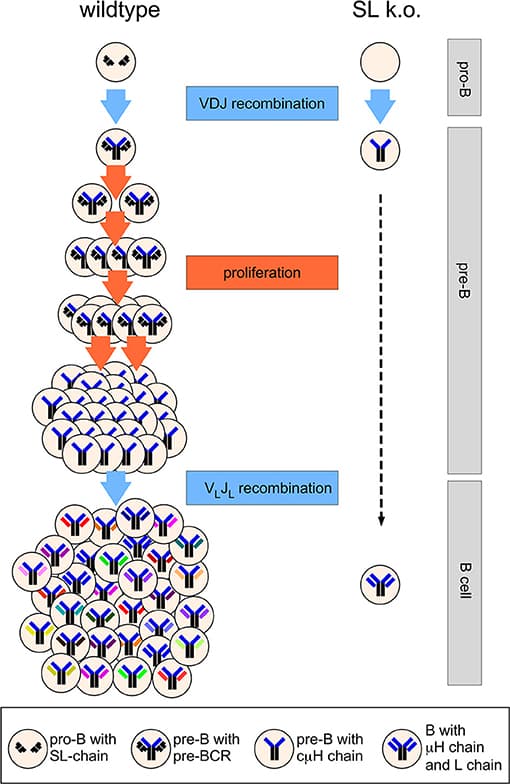
Frontiers | The Role of the Pre-B Cell Receptor in B Cell Development, Repertoire Selection, and ... View original
Is this image relevant?
Frontiers | Communications Between Bone Marrow Macrophages and Bone Cells in Bone Remodeling View original
Is this image relevant?
19.4 B Lymphocytes and Humoral Immunity – Microbiology: Canadian Edition View original
Is this image relevant?
Frontiers | The Role of the Pre-B Cell Receptor in B Cell Development, Repertoire Selection, and ... View original
Is this image relevant?
Stages of B cell development
- Hematopoietic stem cells (HSCs) self-renew and differentiate into all blood cell types including lymphocytes
- Common lymphoid progenitor (CLP) commits to lymphoid lineage producing B and T cells
- Pro-B cell initiates immunoglobulin gene rearrangement starting with heavy chain D-J joining
- Pre-B cell expresses pre-B cell receptor triggering proliferation and light chain rearrangement
- Immature B cell displays complete IgM on surface undergoes negative selection for self-reactivity
- Mature B cell co-expresses IgM and IgD ready to exit bone marrow and enter circulation

Role of stromal cells and cytokines
- Stromal cells create supportive microenvironment secreting growth factors and cytokines
- CXCL12 (SDF-1) guides B cell precursors to bone marrow niches
- Stem cell factor (SCF) promotes early progenitor survival and division
- Interleukin-7 (IL-7) crucial for pro-B and pre-B cell survival and proliferation
- Flt3 ligand supports early B cell development by activating Flt3 receptor
- BAFF and APRIL promote survival of immature and transitional B cells in bone marrow and periphery

V(D)J recombination process
- D-J joining occurs in heavy chain locus during pro-B cell stage
- V-DJ joining follows in heavy chain during pre-B cell stage
- V-J joining happens in light chain locus at immature B cell stage
- RAG1 and RAG2 enzymes create double-strand breaks at specific recombination signal sequences (RSS)
- Non-homologous end joining (NHEJ) repairs breaks adding nucleotides for junctional diversity
- Process generates vast array of unique B cell receptors (BCRs)
Checkpoints for functional B cells
- Pre-BCR checkpoint tests successful heavy chain rearrangement triggers light chain rearrangement
- Central tolerance checkpoint eliminates or edits self-reactive immature B cells (clonal deletion, receptor editing, anergy)
- Positive selection ensures BCR can recognize self-MHC molecules for antigen presentation
- Transitional B cell checkpoint further screens against autoreactivity in periphery
- Receptor editing allows rearrangement of alternative light chains to rescue potentially autoreactive B cells
- Allelic exclusion ensures expression of single BCR specificity per cell maintaining clonal selection principle
See Fiveable more often in Google
Mark Fiveable as a preferred source and Google is more likely to show you our guides in Top Stories, with a "preferred" badge in AI Mode and AI Overviews.