2.2 Primary and secondary lymphoid organs

🛡️Immunobiology Unit 2 Review
2.2 Primary and secondary lymphoid organs
🛡️ Immunobiology
Primary Lymphoid Organs
Your immune system depends on two categories of specialized organs. Primary lymphoid organs are where immune cells are born and educated. Secondary lymphoid organs are where those cells encounter antigens and mount responses. Understanding how these organs are structured and what they do is central to understanding how adaptive immunity works.

Top images from around the web for Structure of primary lymphoid organs
Frontiers | Regulatory T-Cell Development in the Human Thymus | Immunology View original
Is this image relevant?
The Adaptive Immune Response: T lymphocytes and Their Functional Types | Anatomy and Physiology II View original
Is this image relevant?
Anatomy of the Lymphatic and Immune Systems | Anatomy and Physiology II View original
Is this image relevant?
Frontiers | Regulatory T-Cell Development in the Human Thymus | Immunology View original
Is this image relevant?
The Adaptive Immune Response: T lymphocytes and Their Functional Types | Anatomy and Physiology II View original
Is this image relevant?
Bone Marrow
Bone marrow is the soft, spongy tissue found inside bones. It houses hematopoietic stem cells (HSCs) and serves as the production site for virtually all blood cells.
- Red marrow actively produces blood cells, while yellow marrow stores fat. In adults, red marrow is concentrated in flat bones (sternum, pelvis, vertebrae), while long bones like the femur and tibia contain mostly yellow marrow.
- A network of vascular sinusoids runs through the marrow, allowing newly formed cells to migrate into the bloodstream and enabling nutrient exchange.
Bone marrow has two major immune functions:
- Hematopoiesis: All blood cell lineages originate here, including erythrocytes, leukocytes (both innate and adaptive), and platelets.
- B cell development: B cells mature through defined stages (pro-B → pre-B → immature B cell) within the marrow. Cells that react too strongly to self-antigens are eliminated or edited before they leave.
- The marrow also maintains a stem cell niche that supports HSC self-renewal, ensuring a lifelong supply of progenitor cells.
Thymus
The thymus is a bilobed organ located in the upper chest (anterior mediastinum). It's the site where T cell precursors from the bone marrow mature into functional T cells.
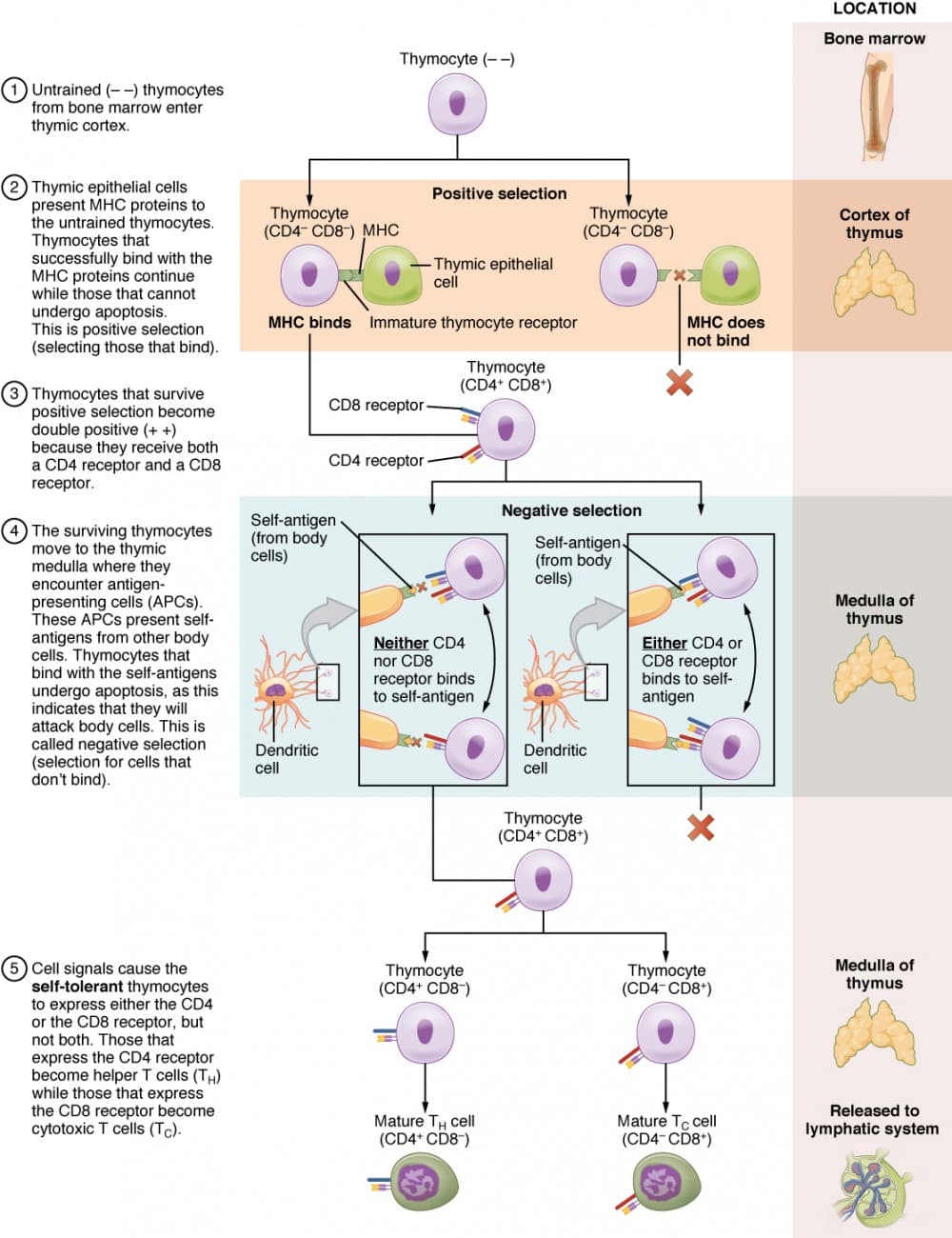
- The cortex is packed with immature thymocytes (developing T cells), while the medulla contains more mature T cells nearing the end of their selection process.
- Thymic epithelial cells (TECs) and dendritic cells form the stromal network that drives T cell education.
- The thymus undergoes thymic involution with age: it gradually shrinks and is replaced by fatty tissue, which is one reason immune function declines in older adults.
The thymus performs three critical functions:
- T cell receptor (TCR) generation: Thymocytes undergo V(D)J recombination to produce a hugely diverse repertoire of TCRs, each recognizing a different antigen.
- Positive selection (in the cortex): Thymocytes are tested for their ability to recognize self-MHC molecules. Those that can't bind MHC at all die by neglect. This ensures MHC restriction, meaning T cells will only respond to antigens presented on the body's own MHC.
- Negative selection (primarily in the medulla): Thymocytes that bind self-antigens too strongly are eliminated, establishing central tolerance and preventing autoimmunity.
The thymus also produces hormones like thymosin and thymulin that promote T cell maturation.

Secondary Lymphoid Organs
Secondary lymphoid organs are strategically positioned throughout the body to intercept antigens from different sources: lymph nodes filter lymph, the spleen filters blood, and MALT protects mucosal surfaces. All of them serve as meeting points where antigen-presenting cells activate naive lymphocytes.
Lymph Nodes
Lymph nodes are small, bean-shaped organs distributed along lymphatic vessels. They filter lymph fluid, trapping antigens and cellular debris before the fluid returns to the bloodstream.
Their internal architecture is highly organized:
- Cortex: Contains B cell follicles, which can develop germinal centers during an active response.
- Paracortex: The T cell zone, where dendritic cells present antigen to naive T cells.
- Medulla: Contains medullary cords rich in plasma cells that secrete antibodies into the efferent lymph.
This organization ensures that dendritic cells arriving with antigen are positioned right next to the T cells they need to activate, and that B and T cells can interact efficiently to launch antibody responses.

Spleen
The spleen is the largest secondary lymphoid organ and the primary site for filtering blood-borne antigens (as opposed to lymph nodes, which filter lymph).
- Red pulp: Responsible for filtering blood and removing old or damaged erythrocytes. It also stores platelets and monocytes that can be rapidly deployed during infection or injury.
- White pulp: The lymphoid compartment, organized similarly to a lymph node with T cell zones (the periarteriolar lymphoid sheath, or PALS) and B cell follicles.
The spleen is especially important for mounting responses against encapsulated bacteria like Streptococcus pneumoniae, Haemophilus influenzae, and Neisseria meningitidis. This is why asplenic patients (people without a functioning spleen) are at high risk for sepsis from these organisms and require vaccination against them.
Mucosa-Associated Lymphoid Tissue (MALT)
MALT protects the vast mucosal surfaces of the body, including the respiratory tract, gastrointestinal tract, and urogenital tract. These surfaces are the most common entry points for pathogens.
- Peyer's patches in the small intestine and tonsils in the oropharynx are well-known examples of organized MALT.
- M cells are specialized epithelial cells that sample antigens directly from the intestinal lumen and deliver them to underlying immune cells.
- MALT is the primary source of secretory IgA, the dominant antibody at mucosal surfaces. Secretory IgA neutralizes pathogens and toxins without triggering inflammation, which is important for protecting delicate mucosal tissue.
Organization of Lymphoid Tissues
Secondary lymphoid organs share common organizational principles that maximize the efficiency of immune responses.
Compartmentalization separates B and T cell functions:
- T cell zones (paracortex in lymph nodes, PALS in spleen) are where T cells interact with antigen-presenting cells.
- B cell follicles house resting B cells and, during active responses, germinal centers.
- Marginal zones in the spleen sit at the border of white pulp and are specialized for capturing blood-borne antigens.
Specialized stromal cells create the structural and chemical framework:
- Fibroblastic reticular cells (FRCs) build the scaffolding of T cell zones and secrete the chemokines CCL19 and CCL21, which attract T cells and dendritic cells.
- Follicular dendritic cells (FDCs) reside in B cell follicles, display antigen on their surface for B cells to sample, and produce CXCL13 to recruit B cells.
Lymphocyte trafficking depends on specialized structures:
- High endothelial venules (HEVs) are specialized blood vessels that allow naive lymphocytes to cross from the bloodstream into lymphoid tissue. They express adhesion molecules like PNAd (in lymph nodes) and MAdCAM-1 (in gut-associated tissues) that lymphocytes recognize.
- Afferent lymphatics carry antigens and antigen-presenting cells into lymph nodes, while efferent lymphatics allow activated cells to exit and return to the circulation.
Chemokine gradients direct cells to the right compartment once they enter:
- CCL19/CCL21 → guide T cells and dendritic cells to T cell zones
- CXCL13 → directs B cells to follicles
This chemokine-driven compartmentalization is what keeps the organ organized and ensures the right cells find each other.
Germinal Centers
Germinal centers (GCs) are transient structures that form within B cell follicles during a T-dependent immune response. They're where B cells undergo the processes that produce high-affinity antibodies and long-term memory.
Formation requires two signals: antigen stimulation and help from follicular helper T cells (Tfh), which provide CD40L co-stimulation and cytokines (like IL-21) to activated B cells.
Structure is divided into two functional zones:
- Dark zone: A CXCL12-rich region where B cells (called centroblasts) proliferate rapidly and undergo somatic hypermutation, which introduces point mutations into immunoglobulin variable region genes.
- Light zone: An FDC-rich region where mutated B cells (called centrocytes) are tested. They compete for antigen displayed on FDCs, and only those with improved antigen binding receive survival signals. This is also where class switch recombination occurs.
Key processes and outputs of the germinal center:
- Clonal expansion: Antigen-specific B cells divide rapidly, amplifying the response.
- Somatic hypermutation: Random point mutations in immunoglobulin genes create variants with different binding affinities.
- Affinity selection: B cells compete for limited antigen on FDCs. High-affinity clones survive; low-affinity clones undergo apoptosis. This process, called affinity maturation, progressively improves antibody quality over the course of a response.
- Class switch recombination (CSR): The antibody heavy chain constant region is swapped (e.g., from IgM to IgG, IgA, or IgE), changing the antibody's effector function without altering its antigen specificity.
The two major outputs of germinal centers are memory B cells, which enable faster and stronger secondary responses upon re-exposure, and long-lived plasma cells, which migrate to the bone marrow and maintain baseline serum antibody levels for years.
See Fiveable more often in Google
Mark Fiveable as a preferred source and Google is more likely to show you our guides in Top Stories, with a "preferred" badge in AI Mode and AI Overviews.