11.1 Central and peripheral tolerance mechanisms

🛡️Immunobiology Unit 11 Review
11.1 Central and peripheral tolerance mechanisms
🛡️ Immunobiology
Central and Peripheral Tolerance
Central and peripheral tolerance are the immune system's safeguards against autoimmunity. They work by eliminating or suppressing T cells that react against the body's own tissues. Central tolerance operates in the thymus during T cell development, while peripheral tolerance handles any self-reactive T cells that slip through into the circulation.
Together with immune checkpoints and immunological ignorance, these mechanisms maintain a balanced immune response: effective against pathogens, but restrained from attacking self.

Top images from around the web for Central tolerance in thymus
Frontiers | Regulatory T-Cell Development in the Human Thymus | Immunology View original
Is this image relevant?
Frontiers | Thymic Crosstalk Coordinates Medulla Organization and T-Cell Tolerance Induction View original
Is this image relevant?
Frontiers | Thymic B Cells and Central T Cell Tolerance View original
Is this image relevant?
Frontiers | Regulatory T-Cell Development in the Human Thymus | Immunology View original
Is this image relevant?
Frontiers | Thymic Crosstalk Coordinates Medulla Organization and T-Cell Tolerance Induction View original
Is this image relevant?
Central Tolerance
Central tolerance in the thymus
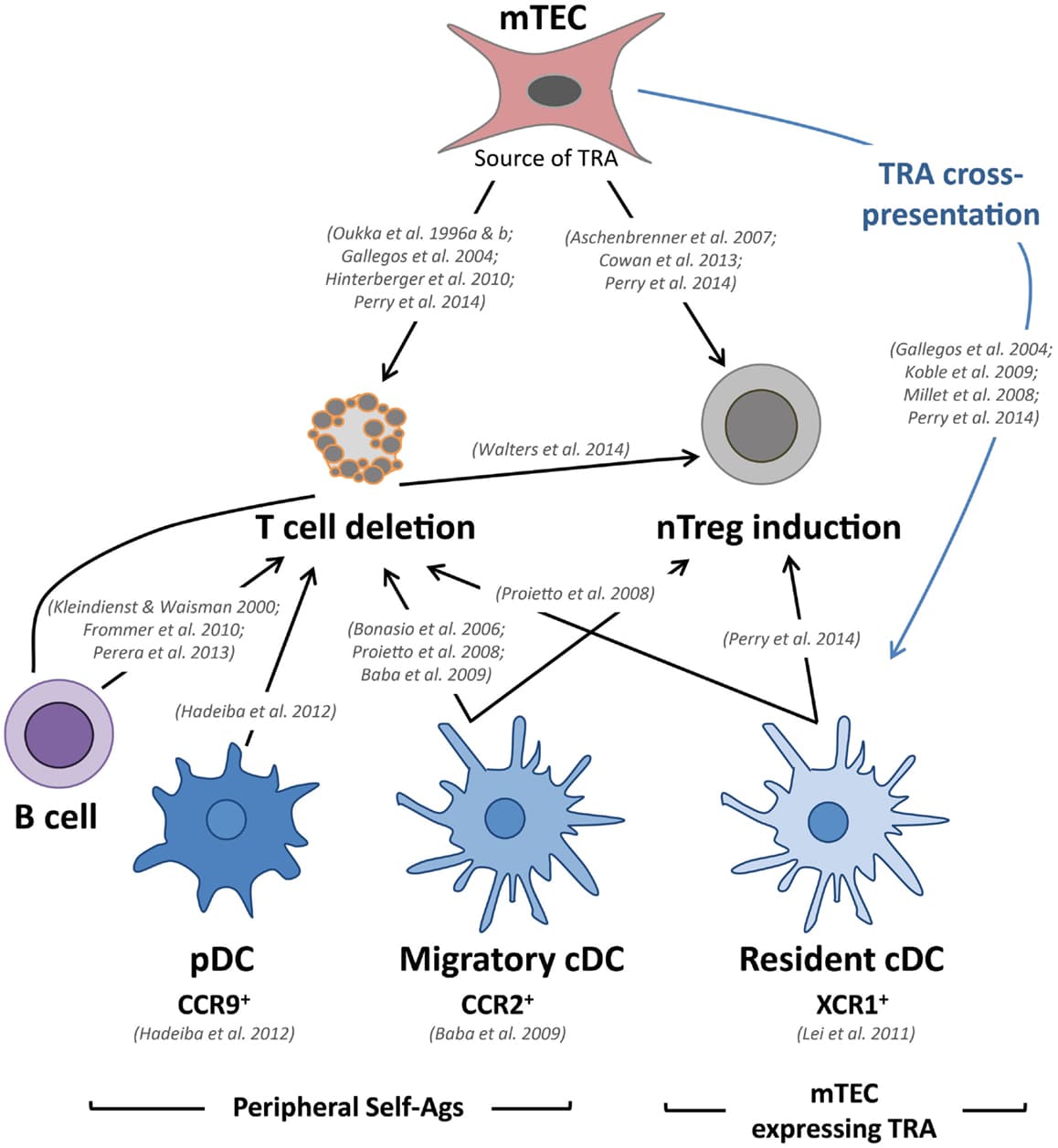
The thymus is where the T cell repertoire gets shaped through a two-step selection process. Each step tests developing thymocytes (immature T cells) against self-antigens presented on MHC molecules.
- Positive selection occurs in the thymic cortex. Thymocytes that can recognize self-MHC molecules (called HLA in humans) with at least moderate affinity survive. Those that fail to bind MHC at all die by neglect. This step ensures every mature T cell can interact with the body's own antigen-presenting machinery.
- Negative selection occurs in the thymic medulla. Thymocytes that bind self-antigen/MHC complexes too strongly are eliminated through apoptosis, a process called clonal deletion. This removes the most dangerous autoreactive cells before they ever reach the periphery.
A critical player in negative selection is the AIRE gene (Autoimmune Regulator), expressed by medullary thymic epithelial cells (mTECs). AIRE drives expression of tissue-specific antigens (like insulin and thyroglobulin) within the thymus, even though those proteins are normally found only in the pancreas or thyroid. This lets the thymus "preview" peripheral self-antigens so it can delete T cells that react to them.
The result: the vast majority of strongly autoreactive T cells are purged before entering circulation, greatly reducing the risk of T cell-mediated autoimmune diseases such as type 1 diabetes and multiple sclerosis. Still, this process isn't perfect, which is why peripheral tolerance exists.

Peripheral Tolerance
Mechanisms of peripheral tolerance
Some self-reactive T cells escape thymic selection. Peripheral tolerance provides backup mechanisms to keep them in check once they're in the body.
- Anergy is functional inactivation. A T cell that encounters its cognate antigen without the required co-stimulatory signal (specifically the CD28-B7 interaction) becomes anergic. It's alive but unresponsive, unable to mount an immune attack.
- Deletion via AICD (activation-induced cell death) eliminates T cells that have been repeatedly stimulated. This works through the Fas-FasL pathway: Fas ligand on one cell binds Fas on the activated T cell, triggering apoptosis. This is especially important for shutting down prolonged immune responses.
- Regulatory T cells (Tregs) actively suppress the activation and proliferation of other T cells. Tregs are identified by high expression of CD25 and the transcription factor Foxp3, which is essential for their development and function. They suppress through immunosuppressive cytokines like IL-10 and TGF-β, as well as through direct cell-cell contact mechanisms.

Immune checkpoint molecules
Checkpoint molecules are inhibitory receptors on T cells that dial down activation, particularly in peripheral tissues like the skin and joints where self-antigen exposure is common.
- CTLA-4 competes with CD28 for binding to CD80/CD86 on antigen-presenting cells. Because CTLA-4 has higher affinity than CD28, it outcompetes the co-stimulatory signal and inhibits T cell activation. It acts primarily during the early priming phase.
- PD-1 binds its ligands PD-L1 and PD-L2, which are expressed on many peripheral tissues. PD-1 signaling induces T cell exhaustion or apoptosis, limiting damage in tissues that express these ligands. It acts mainly during the effector phase.
- LAG-3 binds MHC class II molecules and negatively regulates T cell expansion, adding another layer of control.
These checkpoints maintain the balance between immune activation and tolerance. (This is also why checkpoint inhibitor drugs used in cancer immunotherapy can trigger autoimmune side effects: they release these brakes on T cell activity.)
Concept of immunological ignorance
Not all self-reactive T cells are deleted or suppressed. Some simply never encounter their target antigen, a state called immunological ignorance. The T cells are functional but remain inactive because they're physically separated from their cognate self-antigens.
Several factors contribute to this:
- Anatomical barriers like the blood-brain barrier prevent immune cells from accessing certain tissues
- Immune-privileged sites such as the eyes, testes, and CNS actively sequester antigens away from immune surveillance
- Low antigen presentation under steady-state conditions, due to minimal self-antigen expression and the absence of danger signals (like DAMPs or PAMPs) that would activate antigen-presenting cells
Immunological ignorance complements the other tolerance mechanisms. However, it's fragile: tissue damage or infection that breaks down barriers (for example, traumatic injury exposing sequestered antigens) can activate previously ignorant self-reactive T cells and potentially trigger autoimmunity.
See Fiveable more often in Google
Mark Fiveable as a preferred source and Google is more likely to show you our guides in Top Stories, with a "preferred" badge in AI Mode and AI Overviews.