2.3 Leukocyte trafficking and lymphatic system

🛡️Immunobiology Unit 2 Review
2.3 Leukocyte trafficking and lymphatic system
🛡️ Immunobiology
Leukocyte Trafficking and the Lymphatic System
Leukocyte trafficking is the process by which immune cells move from the bloodstream into tissues where they're needed. Without it, your immune cells would just circulate in the blood and never reach sites of infection or injury. The lymphatic system complements this by providing a network that returns fluid, antigens, and immune cells from tissues back to the blood, while routing them through lymph nodes where adaptive immune responses get started.
Together, these two systems ensure that the right immune cells reach the right place at the right time.

Top images from around the web for Mechanisms of leukocyte trafficking
Frontiers | Vascular Endothelial Galectins in Leukocyte Trafficking View original
Is this image relevant?
Frontiers | Leucocyte Trafficking via the Lymphatic Vasculature— Mechanisms and Consequences View original
Is this image relevant?
Frontiers | Platelets in Inflammation: Regulation of Leukocyte Activities and Vascular Repair ... View original
Is this image relevant?
Frontiers | Vascular Endothelial Galectins in Leukocyte Trafficking View original
Is this image relevant?
Frontiers | Leucocyte Trafficking via the Lymphatic Vasculature— Mechanisms and Consequences View original
Is this image relevant?
Leukocyte Trafficking
Mechanisms of leukocyte trafficking
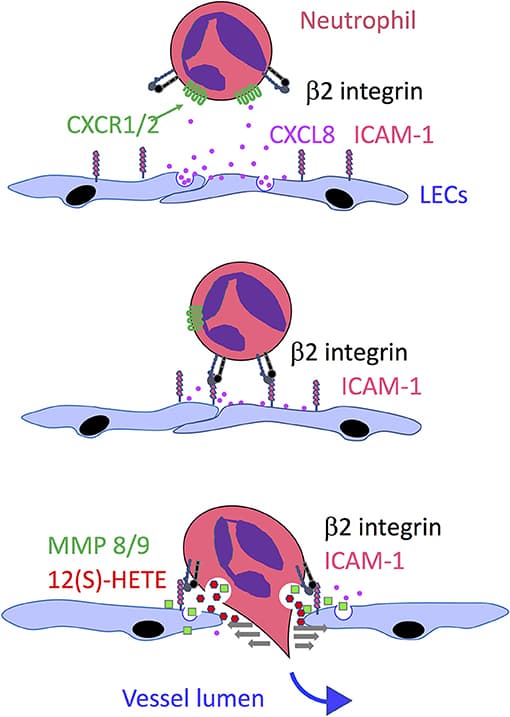
Getting a leukocyte out of the bloodstream and into tissue isn't random. It follows a tightly regulated sequence called the leukocyte adhesion cascade. Each step depends on specific molecular interactions between the leukocyte and the vascular endothelium.
The adhesion cascade, step by step:
- Tethering and rolling — Selectins on the endothelium (E-selectin, P-selectin) and on leukocytes (L-selectin) bind carbohydrate ligands with low affinity. This slows the leukocyte down so it "rolls" along the vessel wall instead of flying past.
- Activation — Chemokines displayed on the endothelial surface bind receptors on the rolling leukocyte. This triggers a conformational change in integrins on the leukocyte surface, switching them from low-affinity to high-affinity states.
- Firm adhesion — Activated integrins (LFA-1, VLA-4) bind tightly to immunoglobulin superfamily ligands on the endothelium (ICAM-1, VCAM-1). The leukocyte stops moving.
- Transmigration (diapedesis) — The leukocyte squeezes between (or sometimes through) endothelial cells to enter the tissue, guided by chemokine gradients and additional adhesion molecule interactions.
Key molecular players:
- Selectins mediate the initial rolling phase. E-selectin and P-selectin are expressed on activated endothelium; L-selectin is constitutively expressed on most leukocytes.
- Integrins mediate firm adhesion. LFA-1 () binds ICAM-1; VLA-4 () binds VCAM-1.
- Chemokines are small signaling proteins classified by cysteine motifs (CC, CXC, CX3C, XC). They signal through G protein-coupled receptors and form concentration gradients that direct leukocyte movement toward the source.
What triggers this whole process? Endothelial cells at sites of infection or inflammation become activated by cytokines like TNF and IL-1. This upregulates expression of E-selectin, ICAM-1, and VCAM-1 on their surface, essentially putting up "exit here" signs for passing leukocytes. Local blood flow dynamics also matter: shear stress affects how efficiently leukocytes can tether and roll along the vessel wall.

Lymphatic System
Structure and function of the lymphatic system
The lymphatic system is a one-way drainage network that collects interstitial fluid (the fluid that bathes your tissues) and returns it to the bloodstream. But it's far more than plumbing. It's the main route by which antigens and antigen-presenting cells reach lymph nodes, making it essential for initiating adaptive immune responses.
How lymph flows:
- Initial lymphatics (lymphatic capillaries) are blind-ended vessels in tissues that absorb interstitial fluid. Their specialized structure (discussed below) makes them highly permeable.
- Collecting lymphatics receive fluid from initial lymphatics and propel it toward lymph nodes through valves and muscular contractions.
- Lymph nodes filter the lymph, trapping antigens and providing a site where T cells and B cells encounter antigen and become activated.
Lymph composition is similar to interstitial fluid: it contains proteins, soluble antigens, and immune cells. Antigens reach lymph nodes in two main ways. Soluble antigens are carried passively by lymph flow. Cell-associated antigens are actively transported by dendritic cells, which pick up antigen in peripheral tissues and migrate to draining lymph nodes.
Secondary lymphoid organs are where adaptive immune responses are organized:
- Lymph nodes are distributed throughout the body and filter lymph from specific tissue regions
- Spleen filters blood-borne antigens (it has no afferent lymphatics)
- Mucosal-associated lymphoid tissues (MALT), including tonsils and Peyer's patches, protect mucosal surfaces

High endothelial venules in lymphocyte homing
Naive lymphocytes need to enter lymph nodes from the blood to scan for their cognate antigen. They do this through high endothelial venules (HEVs), specialized postcapillary venules found in the paracortex of lymph nodes.
HEV endothelial cells have a distinctive cuboidal morphology (unlike the flat endothelium elsewhere) and express a unique set of adhesion molecules that capture circulating lymphocytes. Their phenotype is maintained by signals from the local microenvironment, particularly lymphotoxin signaling from surrounding lymphoid cells.
Lymphocyte entry through HEVs follows the same multistep adhesion cascade as general leukocyte trafficking, but with tissue-specific molecules:
- Rolling — L-selectin (CD62L) on naive lymphocytes binds PNAd (peripheral node addressin) on HEVs. For gut-associated lymphoid tissue, the integrin binds MAdCAM-1 instead.
- Activation — Chemokines on the HEV surface activate integrins. CCL21 is a key chemokine that attracts naive T cells and dendritic cells; CXCL12 promotes B cell migration.
- Firm adhesion and transmigration — Activated integrins bind their ligands, and the lymphocyte crosses the HEV into the lymph node parenchyma.
This system of tissue-specific homing receptors is how the immune system directs different lymphocyte populations to different tissues. For example, lymphocytes expressing high levels of preferentially home to gut-associated lymphoid tissue, while those expressing L-selectin home to peripheral lymph nodes.
Lymphatic vessels and fluid drainage
Beyond immune function, the lymphatic system maintains fluid homeostasis. About 3 liters of fluid per day leaks from blood capillaries into tissues (driven by Starling forces, the balance between hydrostatic and oncotic pressures). Lymphatic vessels recover this fluid and return it to the venous circulation.
Structural features that enable fluid uptake:
- Initial lymphatic endothelial cells are connected by button-like junctions (not the continuous tight junctions found in blood vessels), creating flap-like openings that allow fluid and cells to enter
- A discontinuous basement membrane further reduces barriers to entry
- Anchoring filaments tether the vessel to surrounding extracellular matrix, preventing collapse when tissue pressure rises
How lymph moves (there's no central pump):
- Primary valves in initial lymphatics prevent backflow of absorbed fluid
- Secondary valves in collecting lymphatics ensure unidirectional flow toward lymph nodes
- Intrinsic pumping from smooth muscle in collecting lymphatic walls provides propulsion
- Extrinsic pumping from skeletal muscle contraction and respiratory movements also drives flow
Immune cell migration through lymphatics is critical for surveillance. Dendritic cells enter initial lymphatics using CCR7-dependent chemotaxis (responding to CCL21 produced by lymphatic endothelium). T cells and B cells also recirculate through afferent lymphatics as part of their ongoing patrol of tissues.
Lymphangiogenesis, the growth of new lymphatic vessels, is driven by VEGF-C and VEGF-D signaling through VEGFR-3 on lymphatic endothelial cells. This can expand the lymphatic network during inflammation or development.
When lymphatic drainage fails, as in lymphedema, the consequences go beyond tissue swelling. Impaired fluid drainage also compromises immune cell trafficking and antigen transport, weakening local immune surveillance.
See Fiveable more often in Google
Mark Fiveable as a preferred source and Google is more likely to show you our guides in Top Stories, with a "preferred" badge in AI Mode and AI Overviews.